

Did You Blow Up The Internet?
The content you were looking for couldn't be found. Try something else below!

What Does It Mean to Run a Business on Systems Instead of Yourself?
Table of Contents:
What does it mean when your business runs on you?
Why do most small businesses unintentionally end up running on the owner?
What is the difference between a process and a system?
What does a business operating system actually include?
How do you know if your business is running on you?
Why does running on you create invisible growth ceilings?
What changes when a business runs on systems instead of you?
Does running on systems mean removing the human element?
How do you begin shifting from running on you to running on systems?
Why does system architecture matter more than adding more tools?
What does stable growth look like when systems are in place?
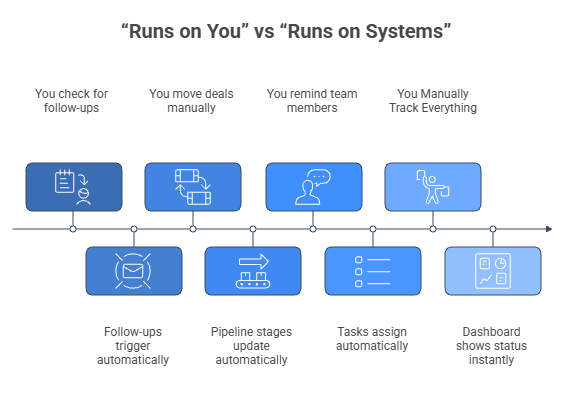
What does it mean when your business runs on you?
When your business runs on you, progress depends on your attention instead of structured systems. That dependency limits growth, creates bottlenecks, and increases stress over time.
You know the pattern.
A lead comes in and you think, “I’ll follow up in an hour.”
A team member asks, “Did we send that proposal?”
You open three tabs to check.
Nothing is technically broken. But nothing moves unless you move it.
Follow-ups happen because you remember.
Deals move because you check the pipeline.
Tasks get done because you ask about them.
Customers get updates because you notice they have not heard from you.
It works…until your attention shifts.
From the outside, things look fine. Revenue comes in. Clients are served. The team stays busy.
Inside, the system is you.
You are the reminder.
You are the quality control.
You are the handoff between sales and delivery.
You are the one who says, “Just making sure…”
Take a day off and momentum slows. Stop checking for a week and something slips. Get overloaded and response time stretches longer than it should.
This is not a discipline issue. It is not a motivation issue.
It is a structure issue.
A business that runs on you is dependent. It depends on vigilance instead of visibility.
At first, that feels responsible. Hands-on. Committed.
Over time, it feels heavy.
You’re not leading a system. You’re carrying one.
Why do most small businesses unintentionally end up running on the owner?
Most businesses don’t plan to depend on the owner. It happens slowly. Growth comes first. Structure comes later. And by the time you realize everything runs through you, the habits are already baked in.
In the early days, running on yourself makes sense.
You’re small.
You’re scrappy.
You know every customer.
You can keep it all in your head.
When a lead comes in, you respond. When a client needs something, you handle it. When a task pops up, you take care of it.
It feels efficient because there’s no coordination required.
Then you grow:
You add tools.
You add team members.
You add more customers.
But you don’t redesign how work flows. So instead of building systems, you build workarounds.
A new CRM gets added, but follow-ups still depend on you checking it.
A team member gets hired, but they still ask, “What should I do next?”
A pipeline exists, but you’re the one moving deals forward.
Nothing is technically wrong. It just isn’t structured.
Most small businesses evolve this way because survival mode rewards speed, not architecture.
When you’re trying to close deals and deliver work, you don’t stop to design triggers, handoffs, and accountability loops. You just keep moving.
Over time, those short-term decisions become long-term dependencies.
You become:
The bridge between sales and fulfillment
The context keeper across tools
The escalation point for stalled work
The person who sees what others don’t
That dependency feels normal because you built the business.
But growth adds complexity faster than most owners add structure. And complexity without structure always lands on someone.
Usually, that someone is you.
What is the difference between a process and a system?
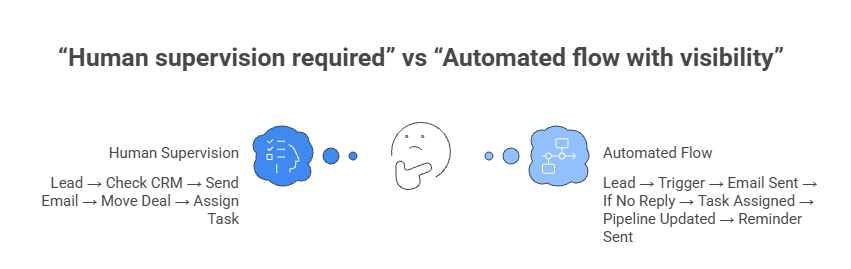
A process is a set of steps. A system is what makes those steps happen without constant supervision. If your process only works when someone remembers to follow it, you don’t have a system. You have instructions.
Many small businesses say, “We have processes.”
What they often mean is:
There’s a checklist.
There’s a document in Google Drive.
There’s an SOP someone wrote last year.
There’s a Loom video explaining what to do.
That’s helpful. But it’s not a system.
A process tells someone what should happen. A system ensures it does happen.
Here’s the real difference:
Process: “When a lead comes in, send a follow-up email within 10 minutes.”
System: When a lead comes in, the follow-up email is automatically triggered. A task is assigned if there’s no reply. The pipeline updates. The activity is logged. The next step is scheduled.
No one has to remember.
A process depends on discipline.
A system reduces dependence on discipline.
This is where many owners get stuck. They invest time documenting steps, but the execution still relies on:
Someone checking the inbox
Someone moving the deal
Someone assigning the task
Someone asking, “Did this get done?”
Documentation organizes knowledge. Systems organize execution.
You can have excellent processes and still feel overwhelmed if those processes don’t connect to triggers, ownership, and visibility.
That’s why businesses with binders full of SOPs still feel reactive.
The work is defined. It just isn’t automated, connected, or tracked in a way that removes pressure from you.
If your processes require supervision to function, they are not yet systems.
And supervision doesn’t scale.
What does a business operating system actually include?
A business operating system connects your tools, people, and workflows so work moves forward automatically. It creates shared visibility, clear ownership, and built-in follow-through. Instead of relying on you to connect the dots, the system connects them for you.
When most owners hear “operating system,” they think software.
That’s not the point.
An operating system is about how work flows. In a structured business, several components work together:
1. A Central Source of Truth
You need one place where customer information lives.
Not scattered across:
Email
Text messages
Notes
Spreadsheets
DMs
Someone’s memory
A real system means when someone calls, replies, or books a meeting, that activity updates the same record.
Everyone sees the same context.
No guessing. No asking, “What happened here?”
2. Connected Communication
Messages should not live in isolation. If a prospect replies to an email, that reply should:
Attach to their record
Notify the right person
Trigger the next step if needed
If communication and records are separate, someone becomes the bridge.
Usually, that’s you.
3. Trigger-Based Workflows
In a structured system, actions create reactions.
When:
A lead submits a form
A deal moves stages
A task is completed
A payment is received
Something happens next automatically.
A task is created.
A reminder is sent.
A pipeline advances.
A follow-up sequence begins.
Without triggers, you’re the trigger.
4. Clear Ownership
Every step should have an owner.
If a deal stalls, the system shows who’s responsible.
If a task is overdue, it’s visible.
If a follow-up hasn’t happened, it’s flagged.
Ambiguity is what creates internal friction.
A system removes ambiguity.
5. Real-Time Visibility
You should be able to answer, quickly:
How many leads came in this week?
How many were contacted?
How many moved forward?
Where are deals getting stuck?
What tasks are overdue?
If answering those questions requires investigation, you don’t have visibility.
You have activity.
6. Built-In Accountability
This is where most small businesses struggle.
They have tools.
They have processes.
They even have dashboards.
But they don’t have enforcement.
A real operating system doesn’t rely on someone remembering to check reports. It surfaces what matters automatically. That’s what reduces mental load.
This is why adding more apps rarely fixes the problem.
If your CRM, inbox, calendar, task manager, and pipeline don’t share context, you’re still stitching the business together manually.
An operating system is not about having everything under one login. It’s about everything working together.
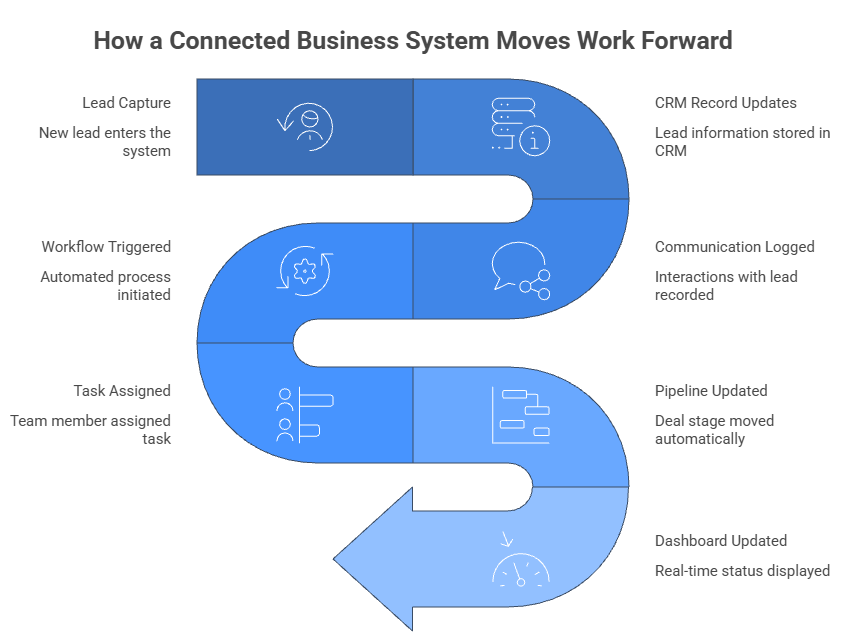
When communication updates records, records trigger workflows, workflows assign tasks, and tasks create visibility, the business starts moving without constant supervision.
That’s the shift.
From: You keeping everything connected.
To: The system keeping everything connected.
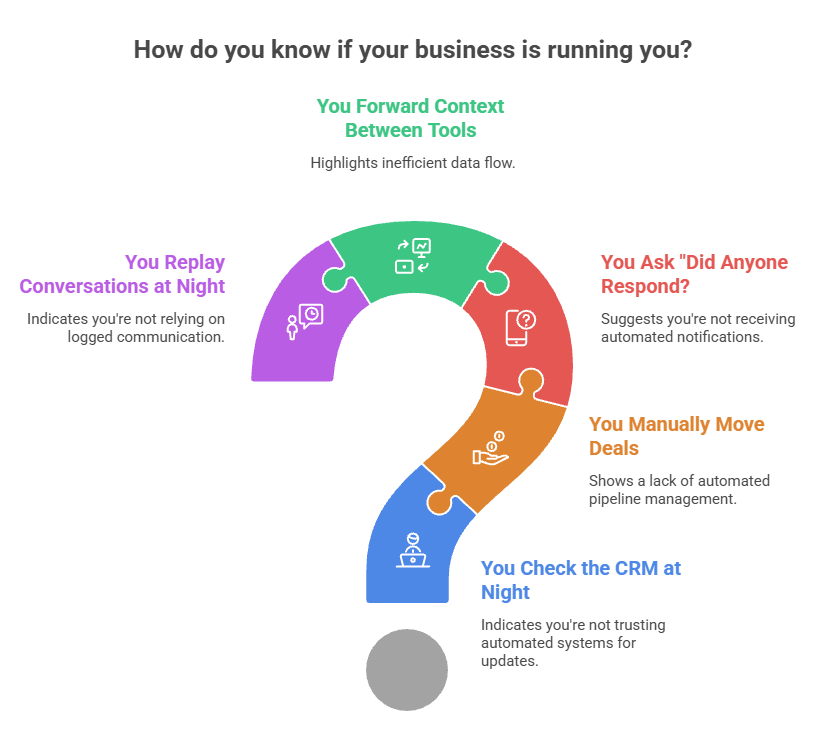
How do you know if your business is running on you?
You don’t notice it in a single moment. You notice it in patterns.
If your business runs on you, you probably recognize at least a few of these:
You check the CRM at night to make sure no lead slipped through.
You ask, “Did anyone respond to that?” more than once a week.
You move deals manually from one stage to another.
You forward messages to team members with extra context because the system doesn’t show the full picture.
You remind someone to send an invoice.
You double-check that a proposal went out.
You scan your inbox looking for things that feel unfinished.
None of those things are time killers by themselves. But they add up.
Here’s a simple test.
If you step away for five business days, what happens?
Do leads still get contacted quickly?
Do tasks continue moving forward?
Do customers receive updates without you prompting it?
Do deals advance without you checking them?
Or does momentum slow down?
Another signal is decision fatigue.
If you end most days mentally replaying conversations, worrying about whether something got handled, that’s not just stress.
That’s structural dependency. You are carrying open loops in your head.
High-performing owners often normalize this. You might even tell yourself, “This is just leadership.”
It’s not.
Leadership is direction.
Supervision of every moving part is compensation for missing structure.
If you feel like:
You are the follow-up safety net
You are the escalation path for everything
You are the only one who sees the whole picture
Then the business is still centered around you. That works at one level of growth.
It becomes a ceiling at the next.
These are early warning signs of operational blind spots. They rarely show up on a dashboard, but they show up in your stress level.
Why does running on you create invisible growth ceilings?
When your business runs on you, growth eventually slows. Not because demand disappears. Not because your team lacks talent. It slows because you become the bottleneck.
At first, being involved in everything feels like control.
You see every deal.
You approve every decision.
You review every message.
That works when volume is low.
But growth adds variables.
More leads.
More customers.
More conversations.
More handoffs.
More tasks.
If every one of those still requires your attention, capacity becomes fixed.
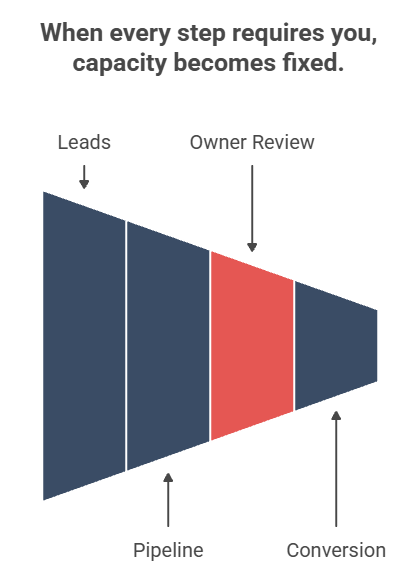
There are only so many:
Messages you can personally review
Deals you can manually move
Follow-ups you can remember
Problems you can catch
When volume increases but structure does not, response time stretches.
A lead sits for two hours instead of ten minutes.
A proposal waits an extra day.
A stalled deal goes unnoticed.
No single delay looks catastrophic. But compound delay kills momentum.
Research consistently shows that faster response times increase conversion rates. The first serious response often shapes the buyer’s direction. If your system depends on you noticing and reacting, speed fluctuates with your availability.
This is one of the three structural blind spots that quietly slow growth. If response time depends on your availability, you are operating in the responsiveness gap most businesses never measure.
That creates inconsistency.
Inconsistent follow-up leads to inconsistent conversion. Inconsistent conversion leads to unpredictable revenue.
There’s another ceiling...
Decision fatigue.
When you carry open loops all day, your cognitive bandwidth shrinks. Strategic thinking gets replaced by operational monitoring.
You spend more time checking than leading.
Over time, that shifts your identity.
You stop acting like a CEO. You start acting like the operations coordinator.
That’s not because you lack vision. It’s because the structure underneath the business requires constant supervision.
And supervision does not scale.
Growth without systems does not feel exciting. It feels heavier.
You hire, but still have to check their work.
You add tools, but still connect the dots.
You close more deals, but feel more tension.
That’s the ceiling.
Not a marketing problem. Not a motivation problem.
A structural one.
What changes when a business runs on systems instead of you?
When your business runs on systems, work moves forward without you chasing it. Follow-ups happen on time. Tasks advance automatically. Visibility replaces guesswork. You stop asking, “Did that get done?” because the answer is already clear.
The difference shows up in small, practical ways first.
A new lead comes in… Instead of you checking the inbox, a follow-up sends automatically. If there’s no reply, a task is assigned. If the lead books a call, the pipeline updates and the next step is scheduled.
No manual movement.
No extra reminder.
No mental note.
Now multiply that across the business.
When a deal closes:
An onboarding workflow starts.
Tasks are assigned to the right team members.
Deadlines are created.
Internal notifications are sent.
No one waits for you to say, “Okay, here’s what happens next.”
When a payment is received:
The record updates.
The project stage changes.
The next milestone activates.
Instead of asking your team for status updates, you can see:
What’s in progress
What’s stalled
What needs attention
What’s completed
That visibility changes your role.
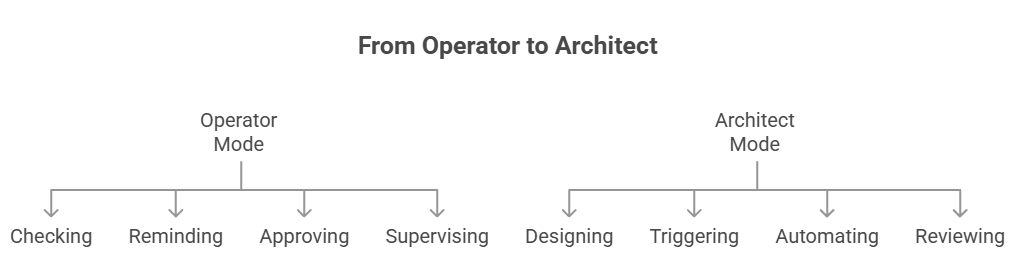
You shift from:
Catching problems → to → Designing improvements
From:
Remembering everything → to → Reviewing dashboards
From:
Answering “What’s next?” → to → Asking “How do we optimize this?”
That shift reduces friction inside the team.
When systems are clear:
Fewer Slack messages start with “Quick question…”
Fewer deals stall silently.
Fewer customers wait longer than they should.
Fewer tasks fall through gaps.
Most importantly, your mental load changes.
You stop replaying conversations at night.
You stop scanning your inbox for unfinished threads.
You stop being the bridge between disconnected tools.
You become the leader of a system instead of the glue holding it together.
And that changes how growth feels.
Not chaotic. Not fragile. Not dependent on your constant attention.
Structured. Visible. Steady.
Does running on systems mean removing the human element?
No. Systems do not remove the human element. They remove the pressure of remembering. A well-designed system protects relationships by ensuring consistency, speed, and follow-through. It supports your team. It does not replace them.
Some owners hesitate here. They think, “If we automate too much, it’ll feel robotic.”
That concern makes sense. No one wants customers to feel like a ticket number.
But here’s what actually creates a cold experience:
Late responses.
Missed follow-ups.
Inconsistent communication.
Dropped handoffs.
That’s not humanity. That’s friction.
A system does not eliminate personalization. It creates the structure that allows personalization to happen consistently.
For example: A follow-up email can be triggered automatically. But it can still use the customer’s name. It can still reference their service. It can still come from a real person.
The difference is that it happens on time.
When your business runs on you, personalization depends on your capacity.
When your business runs on systems, personalization is supported by structure.
Your team still builds relationships.
Your team still solves problems.
Your team still makes judgment calls.
The system simply ensures that:
No lead waits too long.
No customer is forgotten.
No task disappears.
No one has to guess what happens next.
Think of it this way.
Systems handle repetition. Humans handle nuance.
Without systems, humans waste energy on repetition. With systems, humans can focus on judgment, empathy, and improvement.
That is not less human. It is more intentional.
And when customers experience consistent communication, clear next steps, and reliable follow-through, trust increases.
Not because you automated. Because you became dependable.
How do you begin shifting from running on you to running on systems?
You don’t fix this by buying more tools. You fix it by redesigning how work moves. The shift starts with clarity, not software. Before you automate anything, you need to see where dependency lives.
Here’s where to begin.
1. Map the moments where you are the trigger
Look at your last five deals or client projects.
Ask yourself:
What only moved forward because I stepped in?
What required me to remind someone?
What did I manually check?
Where did I have to say, “Hey, don’t forget…”?
Those are structural gaps.
If progress depends on you initiating the next step, that step needs a trigger.
2. Identify recurring handoffs
Growth breaks down at transitions.
Sales to fulfillment. Fulfillment to billing. Billing to follow-up.
Write down what should happen at each handoff.
Then ask:
Is this triggered automatically?
Is ownership clear?
Is visibility built in?
If the answer is no, you’ve found a leverage point.
3. Connect communication to context
If emails, texts, and DMs live outside your customer record, someone is constantly bridging information.
That someone is usually you.
When communication updates the record automatically and triggers the next action, you eliminate invisible glue work.
That single shift reduces more mental load than most owners expect.
4. Replace reminders with automation
If you rely on calendar reminders to follow up, that’s still personal supervision.
Instead, build logic such as:
If no reply in 24 hours, send follow-up.
If deal sits in stage for 3 days, notify owner.
If invoice is unpaid, send reminder sequence.
You are not removing responsibility. You are removing dependence on memory.
5. Review architecture before adding complexity
This is where many businesses go wrong.
They add:
A new CRM
A new email tool
A new project manager
A new automation app
But they never redesign flow.
Before scaling, ask:
Do our tools talk to each other?
Are triggers clear?
Is ownership defined?
Can we see bottlenecks instantly?
If not, adding volume will amplify chaos.
Structure first. Scale second.
6. Shift your role from executor to architect
This is the identity shift.
Instead of asking, “Did this get done?”
Start asking, “What system ensures this gets done every time?”
Instead of solving today’s delay manually, design a rule that prevents it next time.
That mindset compounds:
Each system you build reduces supervision.
Each automation reduces friction.
Each connected workflow reduces decision fatigue.
You don’t need to overhaul everything at once.
Start with one recurring flow.
Lead intake. Proposal follow-up. Onboarding.
Design it so it moves without you.
Then build the next one.
Over time, the weight shifts.
Not because you’re working harder. Because the structure is.
Why does system architecture matter more than adding more tools?
Adding more tools feels productive. Redesigning architecture feels slower. But tools without structure increase complexity. Architecture reduces it.
Most growing businesses follow a predictable pattern.
Something breaks. So you add a tool.
Leads slipping? Add a CRM.
Follow-ups inconsistent? Add email automation.
Tasks unclear? Add a project manager.
Messages scattered? Add a shared inbox.
Individually, each tool makes sense.
Collectively, they create fragmentation.
Now you have:
Customer data in one place
Conversations in another
Tasks somewhere else
Reports in a separate dashboard
And you become the integration layer.
You copy information from one system to another. You manually update stages. You forward messages for context. You double-check reports because nothing fully connects.
The problem is not the tools.
It is the lack of architecture.
Architecture answers questions tools cannot:
What triggers what?
Who owns each stage?
What happens if someone does nothing?
Where is visibility created?
How does information move across the lifecycle?
Without architecture, automation becomes isolated.
You might automate email campaigns. But if pipeline movement is manual, deals still stall.
You might automate invoices. But if onboarding is not triggered automatically, clients still wait.
You might track tasks. But if task creation depends on someone remembering to create them, nothing changes.
Architecture ensures that:
Communication updates records.
Records trigger workflows.
Workflows assign tasks.
Tasks create visibility.
When those links break, growth feels unpredictable. That unpredictability is not random. It usually traces back to one of three hidden structural gaps in how the business is wired.
Everything connects. This is why some businesses feel more overwhelmed after “upgrading” their tech stack.
They increased capability without redesigning flow.
More tools amplify gaps. Better architecture closes them.
Before adding software, ask:
If this tool works perfectly, what should it trigger next?
Where does its data need to show up?
Who should be notified?
What should move automatically?
If you cannot answer those clearly, the issue is not the feature set.
It is the design. And design is what turns software into a system.
What does stable growth look like when systems are in place?
Stable growth does not feel frantic. It feels predictable. Leads move. Customers are served. Tasks advance. And you are not constantly scanning for what might be slipping.
The difference shows up in rhythm.
A lead comes in and is contacted quickly. Not because you saw it. Because the system handled it.
A deal progresses and the next stage activates automatically. No manual movement. No extra reminder.
A client pays and onboarding begins without someone asking, “What happens next?”
Momentum continues whether you are watching it or not.
That stability changes how decisions are made.
You stop making choices based on pressure. You start making choices based on data.
Instead of reacting to problems after they surface, you see patterns early:
Where deals stall
Where response time slows
Where tasks stack up
Where customers hesitate
You adjust before things break.
Your team changes too:
They stop waiting for direction.
They know what to do because the next step is visible.
Ownership becomes clear.
Handoffs become smoother.
Internal questions decrease.
Customers feel it as well:
They receive faster responses.
They experience consistent communication.
They see progress without having to ask for updates.
Trust builds because the experience feels organized.
For you, the biggest shift is mental:
You are no longer carrying dozens of open loops in your head.
You are reviewing a system.
You are refining it.
You are improving it.
That is what stable growth actually looks like.
Not explosive spikes followed by stress. Not constant firefighting. Not growth that feels heavier every quarter.
Stable growth feels structured.
It feels visible. It feels calm.
And most importantly, it does not depend on you remembering everything.
It depends on the system you built.
If growth in your business feels unstable or heavier than it should, it is worth examining where visibility, trust, or responsiveness may be leaking behind the scenes.

(205) 736-8422
1236 Blue Ridge Blvd,
Hoover, AL 35226

Resources
Company




Copyright Kyrios Systems 2026 - All Rights Reserved | Privacy Policy | Terms and Conditions
Resources
Company
1236 Blue Ridge Blvd, Hoover, AL 35226
Download Kyrios systems app now