

Small Business Growing Pains: 7 Signs Growth Is Creating Chaos
What Are Small Business Growing Pains?
Small business growing pains happen when your company grows faster than the way work gets managed.
You may have more customers, more employees, and more revenue, yet everyday operations become harder to coordinate because the processes that worked when the business was smaller can no longer keep up.
Common symptoms include:
missed follow-ups
unclear ownership
scattered customer information
repeated questions
inconsistent handoffs
decisions that keep coming back to you
Growth itself is not the problem.
The problem appears when complexity increases faster than your systems, workflows, and responsibilities evolve.
As a business grows, its operational setup may not be the only thing that needs to change. Its legal and financial structure may also need to evolve with its size, risk, and goals. If you are reviewing that side of the business too, this guide explains how to choose the right business structure for your needs.
What Changes When a Business Grows?
Growth adds more than customers and revenue.
As your business expands, several things increase at the same time:
Customer interactions
Internal communication
Task volume
Handoffs between people
Process variations
Decisions and exceptions
At a smaller scale, informal processes often work.
A quick conversation can assign a task. You may personally remember which customer needs a response. A spreadsheet may be enough to track active work.
But those same methods become less reliable as volume increases.
A follow-up that was easy to manage with 15 leads becomes harder with 150. A verbal instruction that worked with two people can disappear when eight people are involved. Information that once lived in one place starts spreading across inboxes, spreadsheets, CRMs, messaging apps, calendars, and project tools.
Nothing has necessarily gone wrong.
The business has simply become more complex than the way the work is being managed.
That gap creates many of the growing pains small businesses experience.
Why Small Business Growth Exposes Weak Processes
Growth exposes processes that only worked because the business was small.
At low volume, people can compensate for weak processes manually. They remember details, ask each other questions, check multiple systems, and solve problems as they appear.
As volume increases, those workarounds become harder to maintain.
You start seeing:
follow-ups happening inconsistently
verbal instructions getting lost
owners answering the same questions repeatedly
customer information spread across several places
routine work waiting for approval
small mistakes becoming larger delays
The problem is usually not effort.
The way the work gets managed has simply not evolved with the size of the business. These are early signs your business is falling behind and may need automation to keep up with demand.

Then growth multiplies fragility.
And fragility feels like chaos.
Why Growth Can Feel Heavier Instead of Easier
Most owners expect growth to create more freedom.
But more customers, employees, and revenue also create more communication, coordination, and decisions.
If your systems do not absorb that additional complexity, the work lands on people instead.
That is why a growing business can become more successful financially while becoming harder to operate day to day.
Then move immediately into the signs section.
What Are the Signs of Growing Pains in a Small Business?
Your business is growing faster than its systems when more sales, customers, or employees create more coordination problems instead of making the company easier to run.
Common signs include missed follow-ups, unclear ownership, scattered customer information, inconsistent handoffs, repeated questions, and decisions that keep coming back to you.
Most owners do not say:
“Our systems haven't scaled.”
They say:
“We're scattered.”
“I feel behind every day.”
“Why does everything still depend on me?”
“We're busier than ever, but it feels chaotic.”
Those symptoms usually appear before the underlying operational problem becomes obvious.
1. Tasks and Customer Follow-Ups Start Slipping
Tasks and follow-ups start slipping when the volume of work becomes greater than what your current tracking process can reliably handle.
The information may already exist somewhere.
A lead may be sitting inside your CRM. A customer request may be buried in an inbox. A task may already be written down.
The problem is that someone still has to notice it, understand what needs to happen, and manually move the next step forward.
As volume increases, you start seeing:
leads going cold
customer messages sitting unanswered
invoices being delayed
tasks living inside personal inboxes
team members assuming someone else handled something
The problem is not simply memory. The process depends too heavily on manual checking.
2. More Decisions Keep Coming Back to the Owner
The owner becomes a bottleneck when important context, approvals, and next-step decisions still depend on one person.
As the company grows, more questions begin flowing back through the owner:
The team waits for direction.
The owner answers operational questions.
Important strategic work gets interrupted.
The next question arrives.
This creates a cycle where growth increases the owner's workload instead of distributing responsibility.
If everyday work stops whenever you are unavailable, the business is still too dependent on you.
3. The Team Keeps Asking What Happens Next
As a team grows, informal communication stops being enough.
Quick conversations may work when two people are involved. With a larger team, work needs clearer ownership, visible next steps, and more consistent handoffs.
Without that structure, you start seeing:
repeated clarification
inconsistent handoffs
role confusion
competing priorities
employees waiting for approval
the same questions being answered again and again
The problem is often less about employee performance and more about unclear processes.
4. You Keep Adding Software but Still Can't See What's Happening
Many growing businesses respond to operational problems by adding another tool.
A CRM.
A project manager.
A scheduling platform.
Another communication app.
Each one solves a specific problem, but together they can create a new one: fragmentation.
You may end up with:
duplicate customer information
conversations spread across different apps
conflicting records
more logins
more places to check
less confidence about which information is current
More software does not automatically create better operations.
The tools need to support the same workflow and make the next step clearer.
5. You Spend More Time Chasing Updates Than Leading the Business
As the business becomes harder to see at a glance, the owner starts spending more time checking what is happening.
You ask:
Did anyone follow up with that lead?
Where is this project?
Did the customer approve this?
Who owns this task?
Has the invoice been sent?
When visibility decreases, reactive work increases.
Instead of focusing on decisions that move the business forward, you spend your day finding information and resolving exceptions.
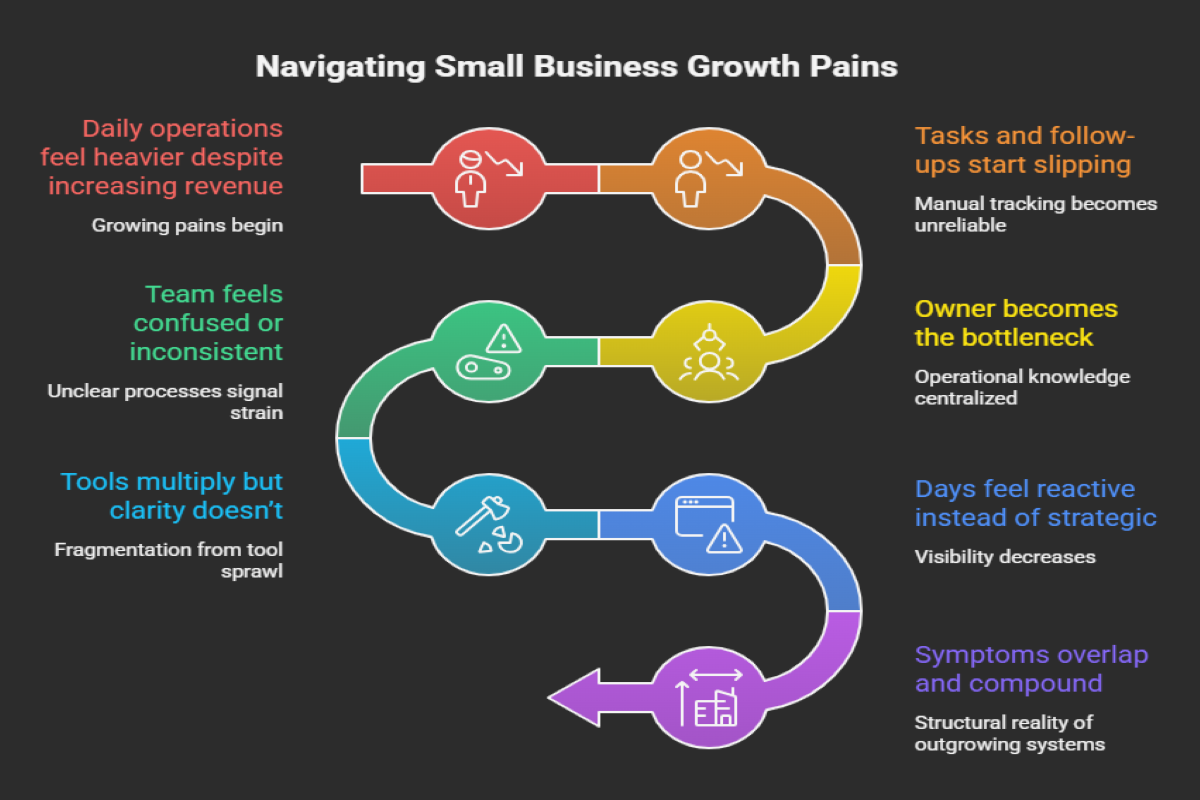
6. Customer Information Is Spread Across Too Many Places
Growing businesses often collect more information without creating a better way to access it.
Customer details may be split across:
email
spreadsheets
text messages
CRM records
project tools
calendars
individual employees
The information technically exists.
But someone still has to search for it, connect the pieces, and determine what should happen next.
That creates what many owners experience as information chaos.
It slows down decisions, creates repeated questions, and makes customer handoffs less reliable.
7. Work Slows Down When Someone Is Unavailable
A growing business becomes fragile when progress depends too heavily on specific people being available.
If the owner, manager, or key employee steps away and work stops moving, important knowledge or decision-making is still trapped with that person.
Healthy processes make it easier for someone else to understand:
what has already happened
who owns the next step
what needs to happen next
what information they need
when the process should move forward
The goal is not to make people replaceable.
The goal is to prevent everyday work from depending on one person's constant availability.
What These Growing Pains Usually Have in Common
These problems may look unrelated.
A missed follow-up feels different from a confused employee. A scattered CRM feels different from an owner who cannot take a day off.
But they often point to the same underlying problem:
The business has grown faster than the systems used to manage it.
That is why small business growing pains often appear in several areas at once.
Fixing one isolated symptom may help temporarily.
Fixing the way work moves through the business addresses the deeper problem.
Why Can a Growing Business Feel More Chaotic?
A growing business can feel more chaotic when customer volume, communication, handoffs, and decisions increase faster than the processes used to manage them.
At a smaller size, work may look relatively simple:
Lead → Close → Deliver → Invoice
As the business grows, that one sequence turns into several overlapping processes:
multiple leads coming from different channels
several team members involved in delivery
customer communication across different platforms
scheduling and billing happening at the same time
exceptions that require decisions
more people needing the same information
Revenue can grow while operations become less predictable.
That is why financial growth and operational maturity are not the same thing.
A business can sell more while still relying heavily on manual coordination.
Why Revenue Growth Does Not Equal Operational Maturity
One of the most dangerous assumptions in small business is this:
“If revenue is increasing, we must be improving.”
Revenue growth and operational maturity are not the same thing.
You can:
Increase sales faster than you build infrastructure
Hire faster than you clarify roles
Add services faster than you standardize delivery
When that gap widens, growth becomes unstable.
Externally, the business looks successful.
Internally, it runs on:
Manual coordination
Constant checking
Owner approvals
Repeated clarifications
Instead of feeling empowered by growth, the owner feels more essential to holding everything together.
That dependence is not strength.
It is centralization.
Why Freedom Requires Structure, Not Just Revenue
Freedom in business does not come from volume. It comes from predictability.
For growth to feel lighter instead of heavier, operations must:
Track work without relying on memory
Advance processes automatically
Clarify ownership of next steps
Centralize communication
Make progress visible
If these structural elements are missing, complexity lands on people instead of systems.
When systems absorb complexity:
Follow-up happens without reminders
Tasks move forward without supervision
Teams know what comes next
Owners step back without things stalling
That is when growth starts to create space instead of pressure.
Growing pains in small businesses are not a punishment for success.
They are a signal that your structure has not evolved at the same pace as your expansion.
Are Growing Pains a Leadership Problem or a Systems Problem?
Growing pains in small businesses are almost always a systems problem, not a leadership problem. They occur when operational complexity outpaces infrastructure, not when the owner lacks discipline, intelligence, or ambition.
Many business owners internalize growth stress as personal failure.
When follow-up slips, they think:
“I need to be more organized.”
When the team seems inconsistent:
“I need to manage better.”
When chaos increases:
“I should be handling this better.”
That interpretation is understandable.
It is also incomplete.
Why It Feels Like a Leadership Problem
In the early stages, the owner naturally becomes the operating system.
Decisions live in their head.
Client history lives in their head.
Process memory lives in their head.
Task tracking lives in their head.
Because the volume is low, this feels efficient.
The owner is responsive.
The team relies on them.
Nothing major breaks.
But as growth accelerates, mental bandwidth does not scale with it.
More clients create more variables.
More employees create more communication layers.
More services introduce more exceptions.
If the structure of the business still depends on one person remembering, clarifying, approving, and advancing everything, growth increases pressure directly on that person.
That pressure feels like leadership strain.
It is actually structural strain.
The Difference Between Leadership Problems and Systems Problems
Leadership problems show up as:
Lack of direction
Avoidance of responsibility
Poor communication of vision
Inconsistent standards
Systems problems show up as:
Repeated bottlenecks
Missed steps
Constant clarification
Reactive days
Work stalls when the owner steps away
In growing businesses, the second list is far more common.
When owners find themselves:
Answering the same operational questions repeatedly
Approving routine tasks
Chasing updates
Double-checking completed work
They are not failing as leaders.
They are compensating for missing infrastructure.
Why Centralization Becomes Unsustainable
When information is locked inside the owner:
The team waits.
Decisions slow down.
Progress depends on availability.

The business becomes fragile.
If the owner is unavailable for a day, things stall.
If they step away for a week, stress builds.Many growing businesses operate in this constant state of tension, always feeling one disruption away from breaking. If that sounds familiar, you may want to explore why your business feels one step away from breaking and what to do about it.
Then continue:
That fragility is not a personality flaw.
It is a design flaw.What Actually Fixes Growing Pains in a Small Business?
Growing pains in small businesses are fixed by strengthening operational systems so work no longer depends on memory, manual follow-up, or constant owner intervention. The solution is structural clarity, not more effort.
Pushing harder does not solve scaling strain.
Adding more tools without integration does not solve it either.
What resolves growing pains is building infrastructure that absorbs complexity.
1. Replace Memory With Visible Workflows
If tasks live in someone’s head, they are fragile.
Work must be:
Documented
Trackable
Assigned
Visible
A clear workflow ensures:
Every lead enters a defined process
Every project has structured stages
Every task has an owner
Every step has a trigger
When work moves forward automatically instead of through reminders, follow-up becomes consistent.
Consistency reduces stress.
2. Clarify Ownership of Next Steps
Confusion often comes from one missing element: ownership.
Every process must answer:
Who owns this step?
What happens next?
What triggers that action?
If ownership is unclear, teams default to asking the owner.
When ownership is embedded in systems instead of assumed in conversations, bottlenecks decrease.
Clarity distributes responsibility.
3. Centralize Communication
Fragmented communication increases errors and reactivity.
When messages live across:
Email
Text
Slack
Social DMs
Project tools
Information becomes siloed.
Centralized communication ensures:
Context is preserved
History is visible
Team members are aligned
Clients are not repeating themselves
Visibility replaces guessing.
4. Automate Advancement, Not Just Reminders
Automation is often misunderstood as “scheduled emails.”
Real operational automation means:
A completed task triggers the next task
A new lead triggers a follow-up automatically
A client response updates the status
A stage change notifies the right person
When processes advance, momentum increases.
The owner is no longer responsible for moving work forward manually.
5. Create Predictable Dashboards
Reactivity decreases when visibility increases.
Owners need to see:
Lead flow
Pipeline stages
Task completion
Revenue tracking
Team progress
Without dashboards, information must be chased.
With dashboards, information is available instantly.
Predictability creates calm.

What Happens When Structure Improves
When systems mature, something shifts.
Tasks stop slipping.
Teams stop waiting.
Owners stop firefighting.
Growth feels stable.
The work does not disappear.
It becomes organized.
Growing pains in small businesses resolve when structure catches up to scale.

Growth Should Feel Lighter, Not Heavier
Growing pains in small businesses happen when operational complexity increases faster than systems mature. Growth exposes structural gaps, centralization, and fragmentation that were invisible at a smaller scale.
The solution is not more effort.
It is better infrastructure.
When systems absorb complexity:
Work becomes visible
Ownership becomes clear
Follow-up becomes automatic
Teams move without constant supervision
Owners step back without fear of collapse
Growth should increase freedom.
If it feels heavier instead, it is a signal, not a failure.
Strengthen the structure beneath the expansion and the weight lifts.
When the Problem Is Bigger Than One Workflow
If several of these growing pains are happening at the same time, fixing one checklist or process may not be enough.
The deeper problem may be that customer information, workflows, communication, and follow-up are being managed separately.
Kyrios helps growing businesses connect those areas so teams can see what needs attention, move work forward more consistently, and rely less on constant owner involvement.
The goal is not to give you another tool to manage.
It is to create a clearer way for the business to operate as it grows.
👉 Explore Kyrios and start building a structure that scales
Frequently Asked Questions
What are the most common growing pains in a small business?
Common small business growing pains include missed follow-ups, unclear responsibilities, owner bottlenecks, scattered information, inconsistent handoffs, reactive workdays, and processes that become unreliable as customer or team volume increases.
How do you know if your business is growing too fast?
Your business may be growing faster than its current systems can support if more customers, employees, or sales consistently create more confusion, delays, manual checking, and owner involvement.
Are business growing pains normal?
Some growing pains are normal because processes that work at one size often need to change as the company becomes more complex. The concern is when the same operational problems repeatedly interfere with customers, employees, or the owner's ability to lead.
How do you fix growing pains in a small business?
Start by identifying where work repeatedly gets stuck. Then clarify ownership, make the next step visible, connect the information people need, and automate predictable actions where doing so reduces manual coordination.