

CRM & Contact Management
Stop Asking “Where Are We With This Client?”
Kyrios keeps every conversation, note, task, and deal history attached to one contact record so nothing falls through the cracks.
At the beginning, customer communication feels manageable.

You remember the last conversation you had with a lead.
You remember what you promised a client on a call.
You know which deals need follow-up.
As the business grows, things start to scatter:
A message comes through email.
Another comes through text.
Someone on the team writes a note after a call.
A proposal is sent.
A reminder to follow up sits in someone’s head.
A week later someone asks: “Where are we with this client?” And the answer requires digging. Searching inboxes. Scrolling through messages. Asking teammates what they remember. Nothing is technically lost, but the story of the relationship is spread across too many places. That’s where most businesses start to feel the strain.

Where This Shows Up in Your Business
You experience this problem in small moments throughout the day.
You might notice it when:
A lead replies to an email and you try to remember the last conversation
A sales rep asks what was promised during an earlier call
A client references a message you sent weeks ago
Two team members both follow up with the same prospect
A customer repeats information because no one can see the full history
Each moment seems small on its own. Over time, they create friction across sales, service, and operations.
The Real Operational Problem

Most businesses try to manage customer information in pieces. Some of it lives in email. Some in text messages. Some in spreadsheets or notes. Some in project tools. And a surprising amount lives in memory.
At a small scale, this works:
You remember conversations.
You keep mental notes about deals.
Your team asks you when they need context.
But as contact volume increases, the gaps become harder to manage. Follow-ups get delayed. Two people reach out to the same lead.
A client asks about something no one remembers discussing. The issue isn’t effort. The issue is that the relationship history has no single home.
What CRM & Contact Management Is
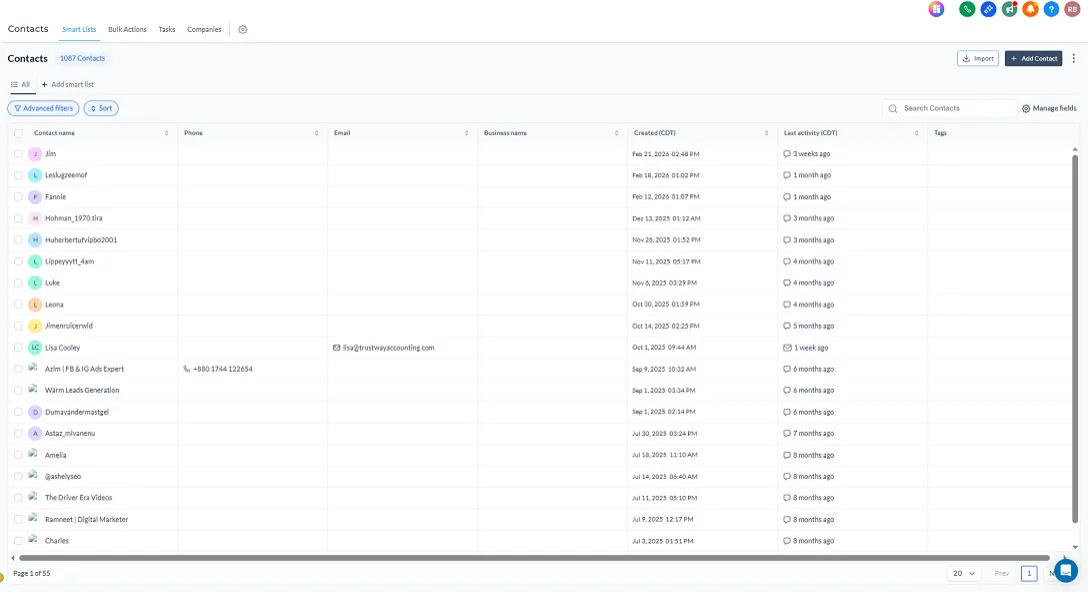
CRM & Contact Management gives every customer and lead a structured record inside Kyrios.
Instead of conversations and activity being scattered across tools, everything connects back to one contact profile. That profile becomes the shared reference point for the entire team.
It shows the full history of the relationship, including:
contact details and tags
messages and conversations
call notes and internal comments
tasks and follow-ups
pipeline stages and deal activity
automation history and system actions
Instead of searching multiple tools to understand what’s happening with a client, you open the contact record and see the full picture.

Real-World Examples
This becomes useful immediately in everyday situations:
A new lead fills out a form. Kyrios automatically creates a contact record and logs the source of the lead.
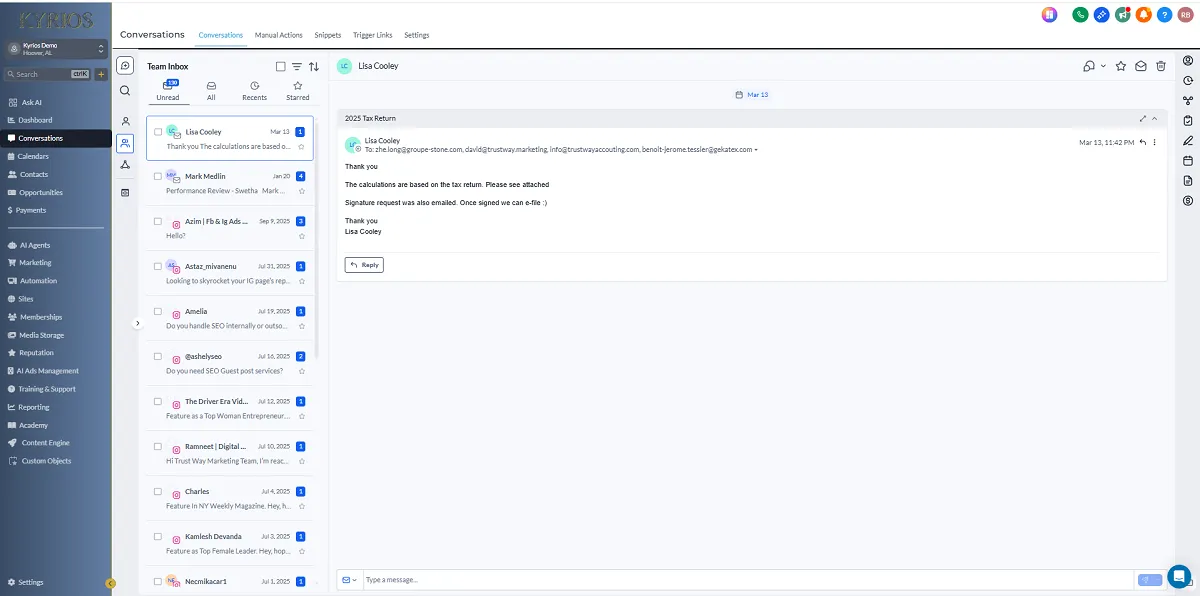
A sales rep sends an email and later receives a reply by text. Both messages appear in the same contact timeline.
A call happens and a team member leaves notes in the record. Anyone on the team can review the conversation later.
A proposal is sent and the deal moves to a new pipeline stage. The update appears directly in the contact’s history.
A client pays an invoice. The payment and revenue history become part of the relationship record.
Instead of piecing together the story, the system keeps it organized.
How It Works Inside Kyrios
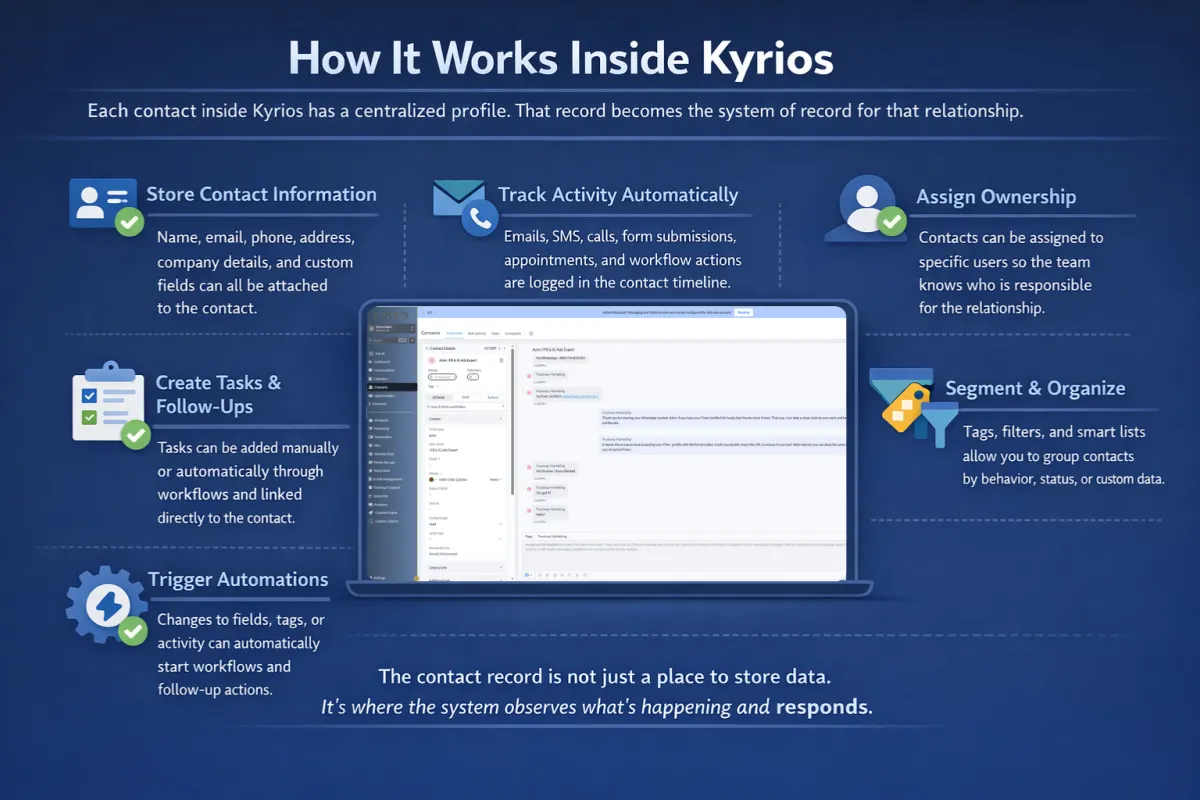
Each contact inside Kyrios has a centralized profile. That record becomes the system of record for that relationship.
Within the profile you can:
Store Contact Information
Name, email, phone, address, company details, and custom fields can all be attached to the contact.
Assign Ownership
Contacts can be assigned to specific users so the team knows who is responsible for the relationship.
Segment and Organize
Tags, filters, and smart lists allow you to group contacts by behavior, status, or custom data.
Track Activity Automatically
Emails, SMS conversations, calls, form submissions, appointments, and workflow actions are logged in the contact timeline.
Create Tasks and Follow-Ups
Tasks can be added manually or automatically through workflows and linked directly to the contact.
Trigger Automations
Changes to fields, tags, or activity can automatically start workflows and follow-up actions.
The contact record is not just a place to store data. It’s where the system observes what’s happening and responds.
How It Connects to the Rest of the Platform
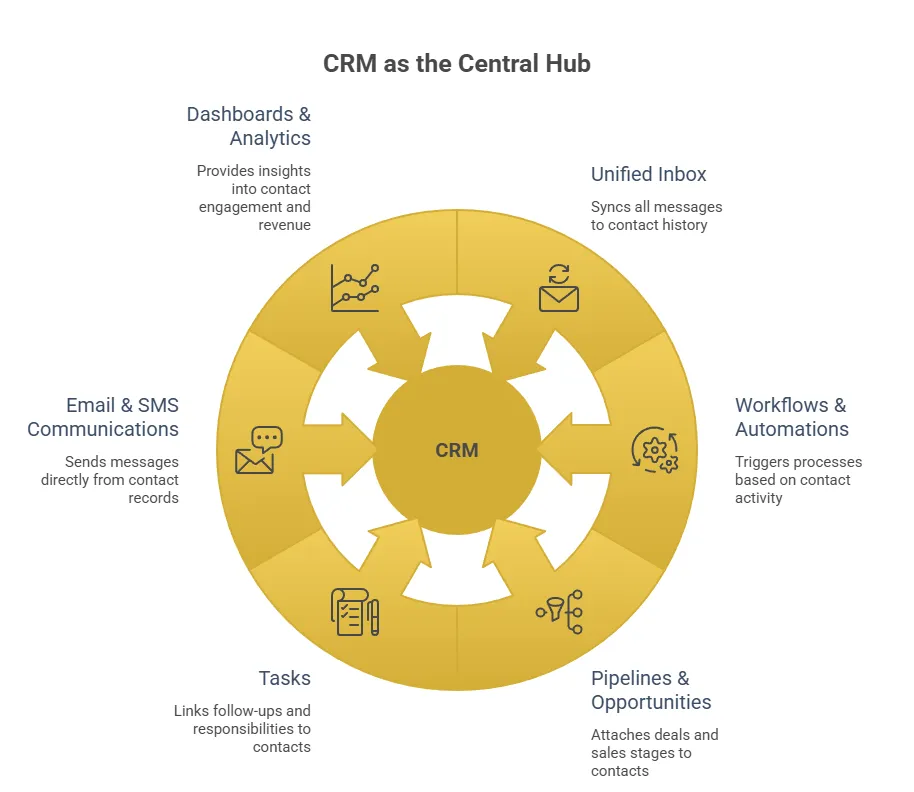
CRM & Contact Management sits at the center of Kyrios. Other parts of the platform connect back to the contact record.
For example:
Trigger Automations
Every message sent or received syncs directly to the contact’s conversation history.
Workflows & Automations
Contact activity, tags, or field updates can trigger automated processes.
Pipelines & Opportunities
Deals and sales stages attach directly to the contact so you can see progress in context.
Tasks
Follow-ups and responsibilities link to the contact so nothing is disconnected from the relationship.
Email and SMS Communications
Messages can be sent directly from the contact record or triggered automatically through campaigns.
Dashboards & Analytics
Contact activity and lifecycle data feed into reporting so you can understand engagement, conversion, and revenue patterns.
Instead of separate systems holding fragments of information, the contact record becomes the thread connecting them.
What Changes Once It's In Place
Once a structured CRM record exists for every relationship, the way work happens changes.
Fewer things live in someone’s head.
You don’t search multiple inboxes to understand what happened with a lead.
Team members don’t start conversations without context.
Follow-ups become visible instead of assumed.
When someone asks, “Where are we with this client?”
The answer is already there. The relationship history is no longer scattered. It’s all in one spot.
Why Kyrios?
Kyrios is designed to replace memory-based operations with connected systems.
In many businesses, customer relationships are tracked through a combination of messages, notes, and personal recollection. That approach works until the business grows past what one person can keep track of.
CRM & Contact Management gives the business a shared record of every relationship. From the first lead inquiry to the latest conversation or payment, the history stays visible and connected.
That structure allows the rest of the platform to operate around real information instead of assumptions.
If you want to see how contact records connect with pipelines, workflows, messaging, and reporting across Kyrios:
(205) 736-8422
1236 Blue Ridge Blvd,
Hoover, AL 35226




Copyright Kyrios Systems 2026 - All Rights Reserved | Privacy Policy | Terms and Conditions
(205) 736-8422
1236 Blue Ridge Blvd,
Hoover, AL 35226

Company


Copyright Kyrios Systems 2026 - All Rights Reserved | Privacy Policy | Terms and Conditions
1236 Blue Ridge Blvd, Hoover, AL 35226
Download the Kyrios app now