


Busy Doesn’t Mean Successful. It Means Your Business Is Running You
Busy Is Not the Problem. It’s the Symptom.
You wake up early. You work all day. You handle messages, fix issues, jump on calls, and push things forward. By the end of the day, you feel exhausted but also strangely behind, like no matter how much you do, the business still depends on you for everything.
At some point, a quiet realization starts to surface: if you stop working, everything slows down or breaks. Growth feels heavy instead of freeing. Success starts to look a lot like pressure.
This is where most business owners get trapped.
They believe the solution is simple. Work more. Stay disciplined. Push harder. But that logic creates a loop where effort increases while freedom disappears. You don’t build leverage. You build dependency.
Busy doesn’t mean successful. It means your business is running you.
The real issue is not your work ethic or your time management. It’s the way your business is structured. When there are no systems, no clear content engine, and no scalable processes, everything flows through you. You become the center of operations, decision-making, and execution.
This article breaks that pattern. You’ll see why being busy feels like progress but isn’t, why your business depends on you more than it should, and how to shift from constant effort to structured growth. The goal is not to help you work better. It’s to help you build something that works without you.
Busy Feels Like Progress. It’s Not.
Being busy gives you a sense of control. You’re doing something at all times, responding quickly, solving problems, and moving from one task to the next. It feels productive because there is constant motion.
But motion is not progress.
Progress in a business means something compound. Systems improve. Assets grow. Results continue even when you step away. Busy work, on the other hand, resets every day. You start again from zero, relying on your time and energy to push things forward.
This is where most business owners get stuck without realizing it.
A typical day looks full. You answer emails, manage operations, jump into client work, fix unexpected issues, and maybe squeeze in some planning. By the end of the day, you’ve worked nonstop, yet nothing has fundamentally changed. Tomorrow requires the same effort to produce the same results.
That’s not growth. That’s maintenance.
The core issue is simple: your output is directly tied to your input. If you work more, you produce more. If you stop, everything slows down. There is no leverage in the system, only effort.
This creates a dangerous illusion. The harder you work, the more it feels like you’re building something meaningful.
In reality, research shows that working longer hours does not improve productivity and often leads to diminishing returns over time.
Real progress looks different. It shows up in things that keep working after you’ve finished the task. A piece of content that continues to bring traffic. A process that runs without your involvement. A system that produces results consistently.
If your business only moves when you do, it’s not scaling. It’s surviving.
Why Your Business Depends on You
At this point, it’s easy to assume the problem is workload. That you simply have too much to do. But that’s not what’s actually happening.
The real issue is structural.

Your business depends on you because it was built that way. Not intentionally, but gradually, through decisions that prioritized speed over systems. You solved problems as they came up, handled tasks yourself to keep things moving, and filled every gap manually. Over time, that turned you into the central point of everything.
There are three core reasons behind this.
1. No Systems
Most of what you do exists in your head.
You know how to handle clients, how to deliver your service, how to respond to issues, and how to move things forward. But none of it is documented, repeatable, or transferable. Every task requires your input because there’s no defined process to follow.
This means nothing scales. Every new client, task, or opportunity increases your workload instead of being absorbed by a system.
2. No Structure
There’s no clear architecture behind how your business operates.
This shows up clearly in content and growth efforts. Instead of a structured system with defined categories, pillar content, and supporting assets, most businesses produce content randomly. One post here, one idea there, with no connection or long-term direction.
Without structure, nothing compounds. Each effort stands alone instead of building on the previous one.
3. No Leverage Points
Everything depends on direct effort.
No assets are working in the background. No automation handles repetitive tasks. No content consistently brings in traffic. No processes for reducing decision-making.
As a result, the business only moves when you push it.
When you combine these three gaps, the outcome is predictable.
You become the system.
If that feels familiar, it’s usually because your business is operating without real stability underneath. It’s why everything feels like it’s one step away from breaking, especially when you step back or slow down.
Every decision, every task, every piece of progress runs through you. Not because you want control, but because nothing else exists to take your place. And as the business grows, that pressure increases instead of easing.
That’s why working harder never fixes the problem. It only reinforces it.
The Cost of Being the Bottleneck
At first, being involved in everything feels necessary. You care about the details, you want things done right, and it seems faster to just handle it yourself.
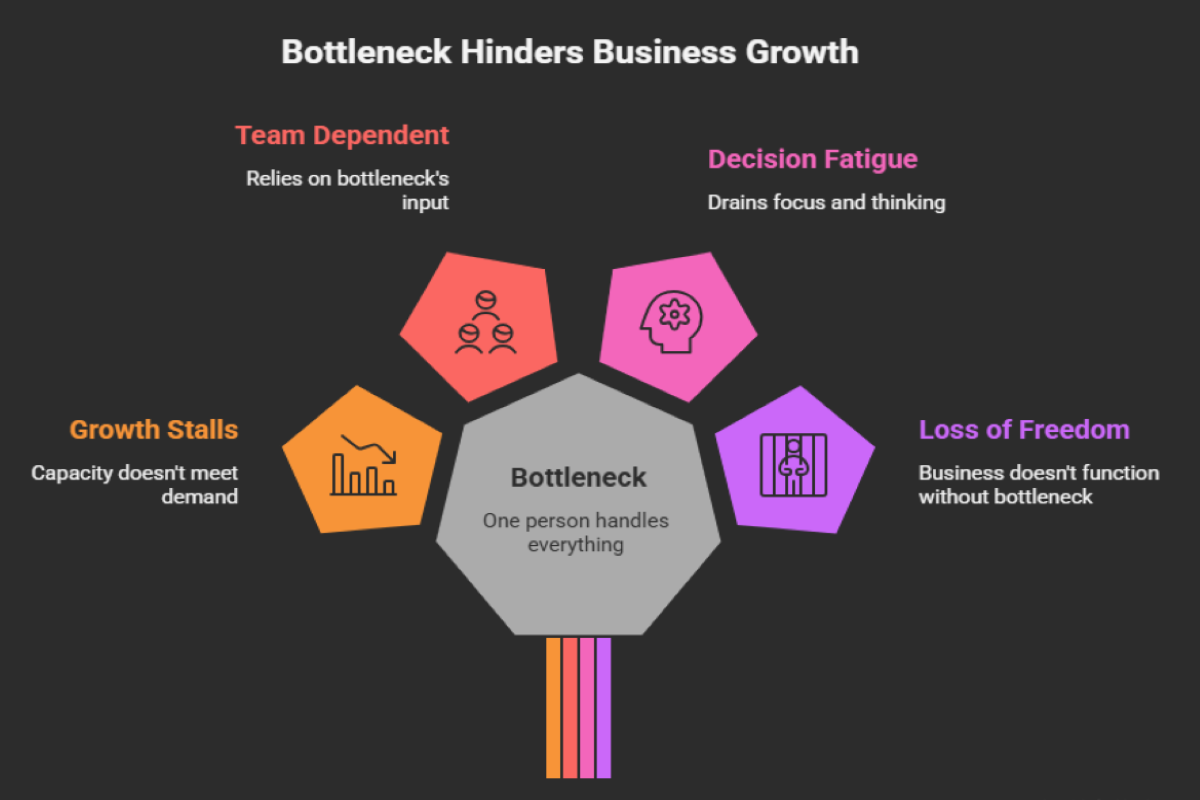
But over time, this becomes the biggest constraint in your business.
When everything depends on you, growth starts to slow down in ways that aren’t always obvious at first. You might still be generating revenue, but the effort required to sustain it keeps increasing. What once felt manageable begins to feel heavy.
Here’s what actually happens behind the scenes:
Growth stalls under pressure
As demand increases, your capacity doesn’t. More clients, more tasks, and more decisions stack on top of each other, but there’s no system to absorb the load.Your team becomes dependent instead of effective
Even if you have people around you, they still rely on your input to move forward. Decisions, approvals, and problem-solving flow back to you.Decision fatigue builds daily
You’re constantly switching contexts, making small and large decisions all day. Over time, this drains your focus and reduces the quality of your thinking.You lose the ability to step away
The business doesn’t pause when you leave, but it also doesn’t function properly. Things slow down, break, or pile up waiting for you.
A simple test makes this clear.
If you step away for a week, what happens?
In a structured business, systems continue to operate. Content keeps bringing traffic, processes keep running, and the team knows what to do. In a dependent business, everything either slows down or stops.
That difference defines whether you’re scaling or just sustaining.
Your business cannot grow faster than your capacity. And if you remain the bottleneck, growth will always come with more pressure, not more freedom.
Scaling vs Working Harder
When things start to feel heavy, the default reaction is to work harder.
You extend your hours, push through more tasks, and try to keep everything moving. It feels responsible. It feels necessary. But it creates a ceiling you can’t break through.
Because working harder and scaling are not the same thing.
Working harder increases output by increasing effort. Scaling increases output without requiring more of your time.
Here’s the difference in how each one operates:

Working Harder
You take on more tasks as the business grows
Your time becomes the main driver of results
Every increase in revenue requires more involvement
Progress stays linear and capped by your capacity
This model can grow for a while, but it eventually collapses under its own weight. There are only so many hours you can give.
Scaling
Systems handle execution instead of you
Content, processes, and automation create consistent output
Results continue even when you’re not actively working
Growth becomes compounding, not tied to effort
Scaling shifts the business from effort-driven to system-driven.
The mistake most people make is trying to scale by doing more. They add more content, more tasks, more channels, without fixing the underlying structure. That only increases complexity and pressure.
Real scaling starts when you remove yourself from execution.
That doesn’t mean stepping away completely. It means building processes that don’t require your constant involvement. It means creating assets that continue to perform after they’re created. It means designing how the business operates instead of reacting to everything inside it.
The goal is not to handle more. The goal is to build something that handles more without you.
What Scalable Businesses Actually Look Like
A scalable business feels different long before it looks different.
From the outside, it may still appear busy. Content is being published, leads are coming in, and operations are moving. But internally, the experience is not chaotic. It’s structured. There is a clear flow to how things work, and most importantly, that flow does not depend on constant input from the owner.
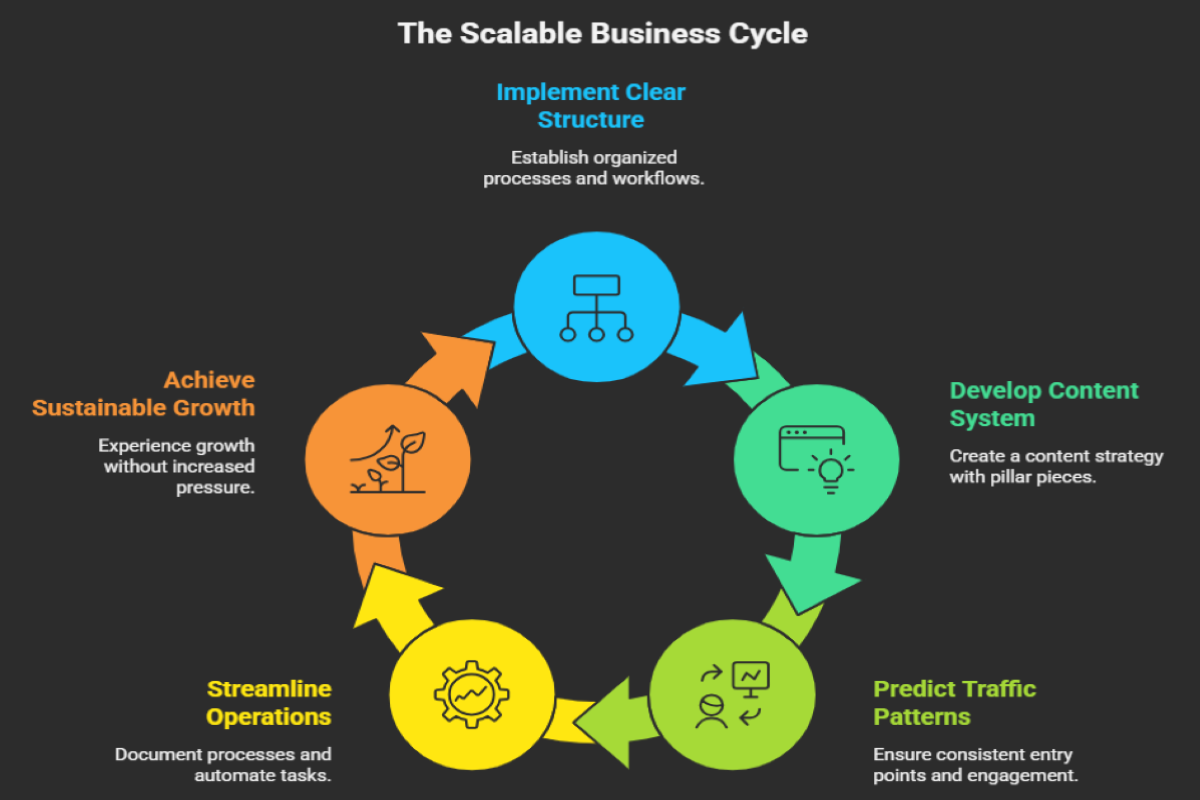
At the core of this is a system, not effort.
Content is not created randomly. It is organized into clear categories, with pillar pieces that drive traffic and support content that reinforces and expands those ideas. Instead of starting from scratch every time, each piece builds on the last, creating a body of work that compounds over time. This turns content into an asset, not a task.
Traffic and lead generation also follow a predictable pattern. Instead of relying on bursts of activity, there are consistent entry points into the business. People discover content, engage with it, and move forward through a defined path. The system guides them, not constant manual intervention.
Operations follow the same principle. Processes are documented, decisions are simplified, and repetitive tasks are either delegated or automated. The business does not pause every time something needs attention because the structure is already in place to handle it.
This is what most people miss.
A scalable business is not built on intensity. It is built on clarity. Clear structure, clear systems, and clear pathways for how work gets done and how results are produced.
The result is not just growth, but a different kind of growth. One that does not require more time, more pressure, or more constant involvement. The business continues to move, even when you are not pushing it every day.
That is the shift from effort to leverage.
The Shift From Operator to Architect
At some point, growth stops being about doing more and starts being about thinking differently. This is where most business owners get stuck, not because they lack effort, but because they stay in the wrong role for too long.
There are two ways to operate inside a business, and the difference between them defines whether you stay busy or start scaling.

1. The Operator
The operator is always in execution mode.
You handle tasks, respond to problems, manage people, and keep everything moving. Your day is filled with activity, and your value comes from how much you can get done. This works in the early stages because speed matters, and doing things yourself feels efficient.
But over time, this becomes a trap.
The more you operate, the more the business depends on you. Every task reinforces your involvement. Every decision comes back to you. Instead of building something independent, you build something that cannot function without your presence.
You stay productive, but you don’t create leverage.
2. The Architect
The architect focuses on design, not execution.
Instead of doing everything, you define how things should be done. You build systems, create structure, and establish processes that others or automation can follow. Your role shifts from solving problems daily to preventing them through better design.
This changes how the business grows.
Work becomes repeatable. Decisions become simpler. Output is no longer tied directly to your time. Instead of reacting to everything, you create an environment where things run without constant intervention.
You stop being the center of activity and start becoming the source of direction.
3. The Real Shift Most People Avoid
The transition from operator to architect is uncomfortable.
It requires stepping back from tasks you’re used to handling. It requires slowing down to build systems instead of rushing to complete work. It often feels less productive in the short term because you’re no longer measuring progress by how busy you are.
But this is where real growth begins.
If you stay in operator mode, your business will always be limited by your time and energy. If you move into the architect role, you start building something that can grow beyond you.
You don’t need to do more. You need to design better.
How to Scale a Business Without Burnout
At this point, the problem is clear. Your business depends on you because there is no structure to carry the load. The solution is not to work less randomly, but to build in a way that reduces that dependency over time.
Scaling without burnout starts with small, deliberate shifts. Not massive overhauls, but controlled changes that introduce leverage into your business.
The first step is identifying what repeats.
Look at your week closely. What do you do over and over again? Client onboarding, content creation, responding to similar questions, and managing the same types of tasks. These are not just responsibilities; they are signals. Anything that repeats should not rely on memory or manual effort. It should be turned into a process.
Once you see those patterns, you can start building simple systems around them.
This does not mean creating complex workflows or over-engineering everything. It means documenting how things are done, defining clear steps, and making the process repeatable. Even a basic structure reduces friction. It allows tasks to be handled consistently without requiring you to think through them every time.
Most businesses struggle here because they’re operating in constant workflow chaos, where nothing is clearly defined and everything depends on manual effort.
From there, you need to bring structure to how your business grows, especially through content.
Most businesses create content in isolation. One post here, one idea there, with no connection between them. This keeps you in constant production mode without building anything that compounds. Instead, you need a system where content is organized into clear categories, supported by pillar pieces that drive traffic and smaller pieces that expand and reinforce them.
This turns content into a growth engine instead of a recurring task.
As structure improves, you can start introducing leverage.
Leverage comes from anything that continues to produce results without ongoing effort. Content that ranks and brings traffic over time. Automated sequences that nurture leads. Processes that allow tasks to be completed without your direct involvement. These elements reduce the amount of energy required to keep the business moving.
At the same time, you need to redefine how you measure productivity.
If you continue to reward yourself for being busy, nothing changes. You will keep filling your time with tasks because that feels like progress. Instead, shift your focus to outcomes. What continues to work after you stop working on it? What produces results without requiring constant attention? These are the indicators of real growth.
Scaling without burnout is not about doing less. It’s about building differently.
You replace effort with structure, repetition with systems, and constant involvement with leverage. Over time, the business stops relying on you for every step, and that’s when growth starts to feel sustainable instead of exhausting.
Common Mistakes That Keep You Stuck

Most business owners don’t stay stuck because they lack effort. They stay stuck because they’re solving the wrong problem.
They try to fix burnout at the surface level while the real issue lies in how the business is built. This leads to patterns that feel productive in the moment but keep the system broken.
Here are the most common ones.
Trying to fix burnout with time management
You reorganize your schedule, block your calendar, and optimize your day. It helps temporarily, but nothing changes structurally. The workload still depends on you, so the pressure returns.Creating content without a system
You post consistently, but each piece stands alone. There’s no connection, no structure, and no long-term value being built. Instead of compounding, your efforts reset every time.Delegating chaos instead of fixing it
You hire or outsource tasks, but without clear processes, you’re just transferring confusion to someone else. You still need to step in, clarify, and fix issues, which keeps you involved.Believing growth comes from doing more
When results slow down, the instinct is to increase effort. More content, more tasks, more activity. But without systems, this only increases complexity and accelerates burnout.Avoiding system-building because it feels slower
Building a structure takes time and doesn’t give immediate visible results. So it gets postponed. Execution feels more urgent, even if it keeps you stuck in the same cycle.
Each of these mistakes reinforces the same outcome.
You stay busy. The business stays dependent. And growth continues to feel heavier instead of easier.
Fixing this is not about adding more. It’s about removing what keeps forcing you back into execution.
Stop Fixing Your Time. Fix Your Business.
Most people leave this conversation thinking they need to manage their time better.
That’s not the move.
You don’t have a time problem. You have a structure problem. And until that changes, no schedule, routine, or productivity hack will give you real freedom.
Right now, your business runs on effort. If you push, it moves. If you stop, it slows down. That’s not a growth system. That’s dependency.
The goal is to change what the business runs on.

It should run on systems. On structured content that compounds. On processes that don’t need constant decisions. On assets that continue working after you’ve built them.
That’s how you scale without burning out.
Start simple.
Look at what you’re doing repeatedly and turn it into a process.
Look at your content and give it structure instead of randomness.
Look at your workload and ask what should exist without you.
You don’t need to fix everything at once. But you do need to stop reinforcing a model that keeps you stuck.
Because the moment your business stops depending on you for every step, everything changes.
Growth becomes easier. Decisions become clearer.
And the business finally starts working for you, instead of the other way around.
If your business still depends on you to grow, it’s time to build the systems that change that.