THE BUSINESS OPERATING SYSTEM FOR GROWING COMPANIES
Stop Running Your Business Through Scattered Tools & Manual Chasing
When sales outgrow your operational foundation, your business becomes top-heavy. Kyrios is the connected business operating system that anchors your communication, tasks, and follow-up in one place—so work keeps moving without everything landing back on your plate.
Every Growing Business Reaches a Point Where Success Starts to Feel Dangerously Heavy.
You’ve built something real. You have revenue, active customers, and a capable team. But behind the scenes, your day-to-day is consumed by manual overhead.
You start answering the same customer questions over and over.
You constantly approve small decisions that you shouldn't need to.
You check whether tasks were completed.
You push deals forward because no one else does.
You jump between inboxes to see what came in.
You ask, “Did anyone follow up with them?”
Nothing is “technically” broken. But everything depends on you. The business runs. But it runs because you’re the one holding it together. This is what happens when growth outpaces structure.
It is not effort.
It is not motivation.
It is not your team.
Instead of steering the business, you are acting as the human glue, manually connecting disconnected software, spreadsheets, and inbox threads just to keep work moving along.

7 Fragmented Apps Force You to Act as the Glue...
1 Connected System Keeps Work Moving.
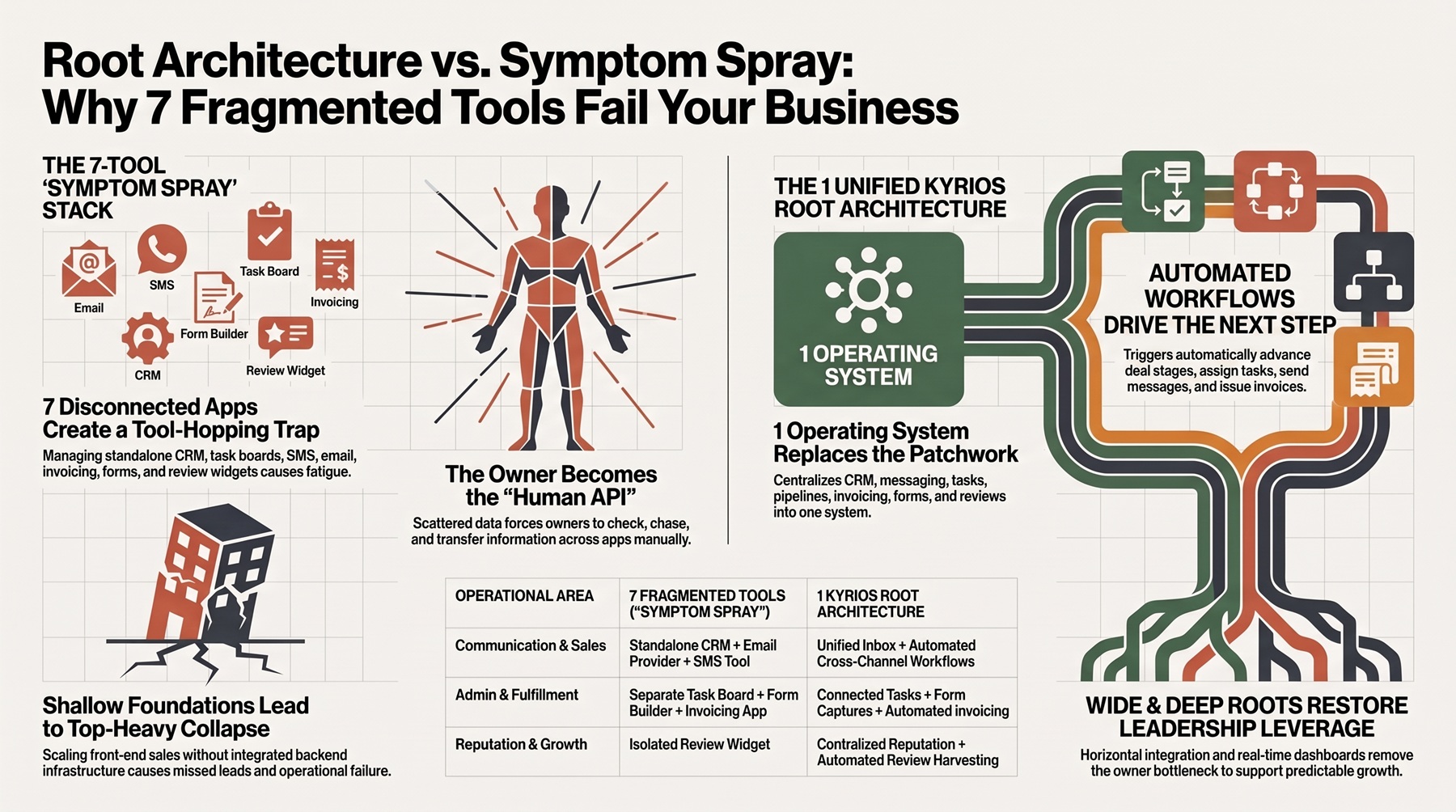
When a new lead fills out a form, gets an invoice, or sends a text message, what happens next? In a fragmented tool stack, that information lives in isolated silos. Someone has to notice it, manually re-enter it, and assign the next step.
Kyrios connects your core operations—communication, workflows, CRM, tasks, and pipelines—into one synchronized environment so the next step triggers automatically without relying on manual checking or chasing.
The Problem Isn't Effort or Discipline.
It's a Top-Heavy Structure.
Every operational fire in a growing business traces back to two fundamental structural breakdowns:
1. Systems Breakage: Your processes, communication, and software are disconnected. Next steps aren't stalling because people forget; they stall because information is trapped inside static spreadsheets, inboxes, and isolated apps that can't take action on their own.
2. Leadership Drift: Because the system breaks, you get pulled out of vision, strategy, and business development and trapped in daily execution and firefighting.
Buying another standalone app is a Symptom Spray—a quick patch on a yellow leaf while the root decay beneath the soil continues to grow. You don't need another point-solution tool; you need a complete Root Architecture.

You are still leading. You just don't have to deal with every little thing or constantly put out fires. The business feels easier because there is structure behind how the work gets handled.
Anchoring Your Business with Deep & Wide Roots
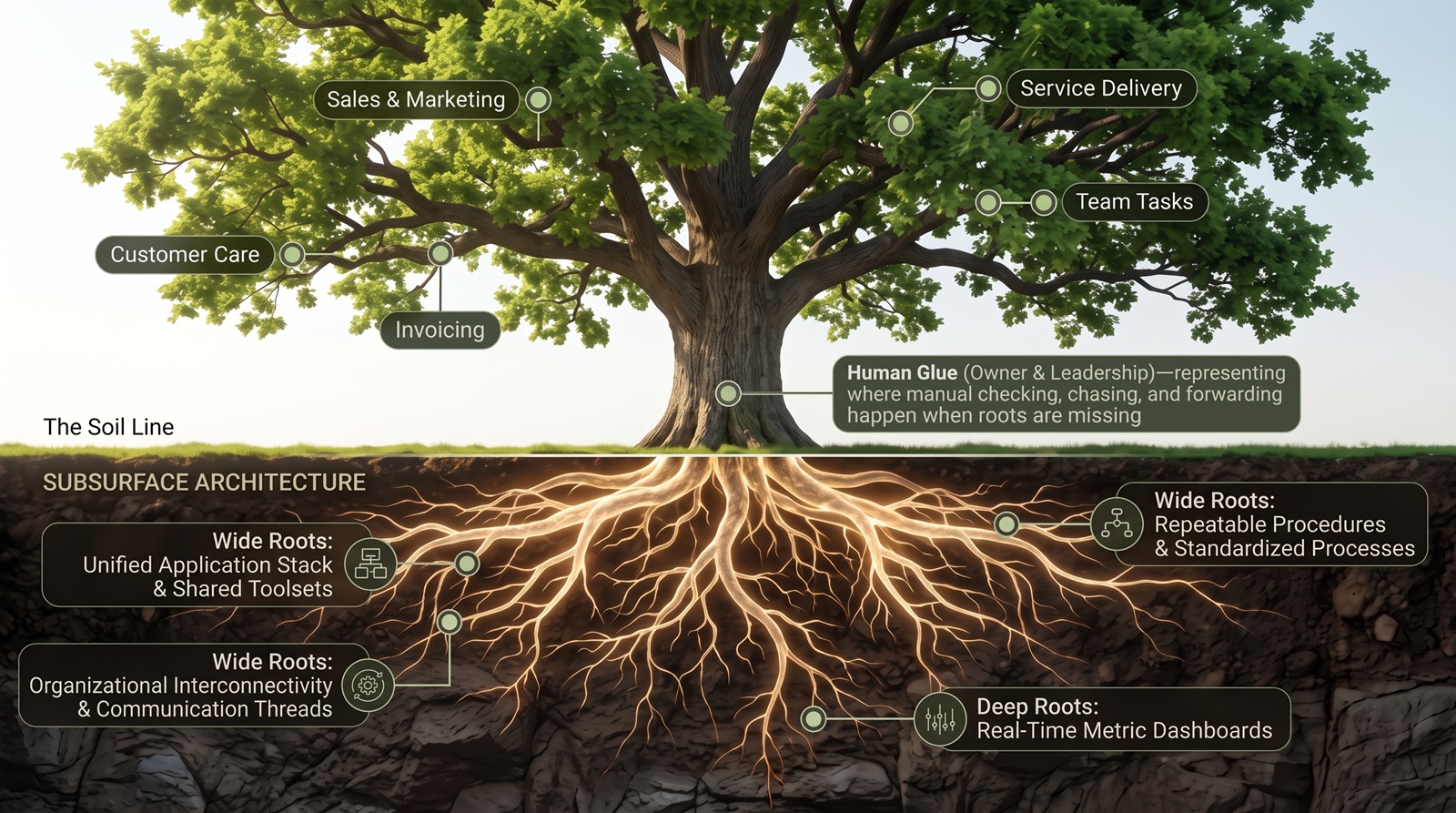
Growing businesses don’t struggle because people aren’t working hard. They struggle because how they do things still depends too much on the owner or the leadership team.
When follow-up requires someone to check, tasks stall until someone notices them, and decisions keep coming back to you, growth creates more pressure instead of more capacity.
Kyrios organizes that work into seven connected systems so follow-up, tasks, communication, handoffs, visibility, and next steps have a clearer path forward.
Lead Follow-Up
If you're still checking whether leads were called back or customers were updated.
Visibility & Control
If you don't fully trust what you are seeing in reports or dashboards.
Workflow & Automation
If tasks stall unless you personally push them forward.
Growth & Presence
If marketing, messaging, and customer experience feel disconnected.
Team & Handoff
If your team waits for direction instead of knowing the next step.
Reputation & Trust
If reviews, feedback, or communication feel inconsistent.
Sales & Revenue
If sales are unpredictable and forecasting feels like guessing.
How It All Connects
None of the areas above stand alone. When one changes, others do too.
When a deal changes stage, follow-up updates can happen automatically.
When a task is completed, you can see it instantly.
When a customer replies, the conversation is logged and routed to the right person.
When feedback comes in, reporting updates.
When a payment is made, records reflect it across the system.
You are not stitching tools together. You are not copying data from one place to another. Everything shares context and connection.
This connection is what removes the tracking, checking, and constant follow-up that slows you down. You can see what's happening across the business without asking five people or opening six apps.
Kyrios brings these parts of the business together into one connected system for running the company. That’s what we mean by a business operating system: the structure that helps your follow-up, tasks, conversations, handoffs, customer information, and everyday processes work together instead of depending on you to connect everything yourself.

When you can see clearly, you can lead confidently.
Ready to Learn More?
Choose your next step
You Don't Have to Build It Alone. We Activate Your System Step-by-Step.

Adopting a new business operating system shouldn't add another complex setup project to your plate. With our Guided Start and the Smooth Operations Starter Pack, you aren't handed a blank screen. We activate your first core workflow win within your first 30 days.
Here is what the first phase looks like:
You define key processes.
Core workflows are set in place.
Everyone starts to get on the same page.
Follow-ups start happening automatically
Conversations become easier to manage.
Tasks and projects start to move with structure.
You are not rebuilding your company overnight. You are replacing problem areas with simplified processes. Within the first 30 days, you start seeing where work used to fall through the cracks. And then you see it handled.
Consider the financial reality: operational leakage from dropped leads, delayed follow-ups, and broken team handoffs costs the average growing business $3,000+ every month. Installing a connected root architecture stops that leakage immediately, making your investment a net-negative cost.
Ready to Take the Heavy Operational Backpack Off Your Shoulders?
Stop propping up a top-heavy structure with manual chasing. Build the system that keeps your business running smoothly.
You stop being the person who has to connect every dot. You can spend more time leading, deciding, and seeing what actually needs your attention.
(205) 736-8422
1236 Blue Ridge Blvd,
Hoover, AL 35226



Copyright Kyrios Systems 2026 - All Rights Reserved | Privacy Policy | Terms and Conditions
1236 Blue Ridge Blvd, Hoover, AL 35226
Download the Kyrios app now
(205) 736-8422
1236 Blue Ridge Blvd,
Hoover, AL 35226

Company


