
The Hidden Work That No One Sees But Every Owner Feels
You wake up already feeling behind, spending your morning finding notes, verifying if tasks got done, answering quick questions, and making sure clients get a response. You are doing what needs to be done, but by mid-afternoon, you realize you haven't touched a single item on your strategic to-do list.
This friction is the hidden work of running a growing business. It isn't a failure of effort, personal discipline, or time management. It happens because your business canopy grew faster than your root system, creating an operational breakage that forces you to connect every disconnected dot personally.
When your day is consumed by checking, chasing, and fixing, you are caught in a cycle that keeps you operating the business instead of leading it. Kyrios exists to replace scattered tools and manual follow-up with a connected root architecture, keeping your daily operations moving forward without everything landing back on your plate.

What Is the Hidden Work of Business Owners?
Hidden work is the mental and manual effort spent checking, chasing, verifying, and connecting disconnected tools to ensure basic operational steps actually happen. It is the unmeasured labor that never shows up on a job description, project board, or financial statement, yet it consumes hours of an owner's daily bandwidth.
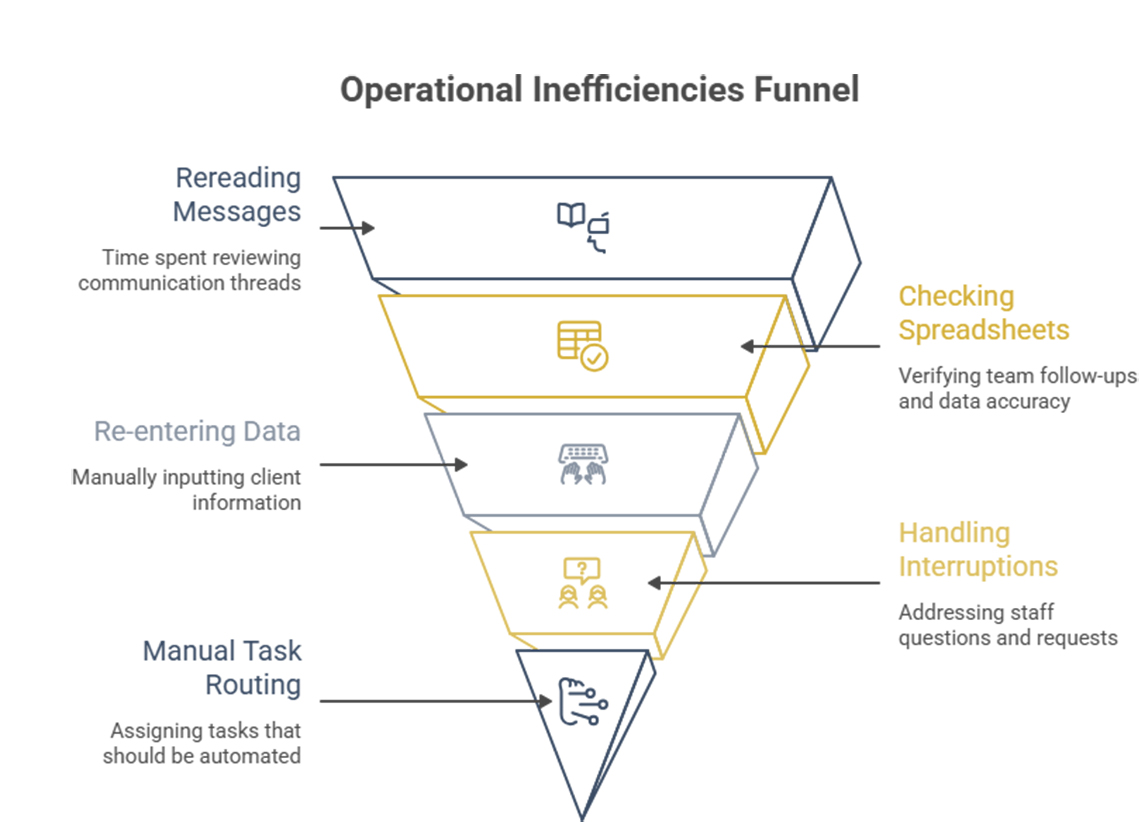
Most small business owners don't realize how much of their day is swallowed by this invisible friction until they break down where their time actually goes:
Checking and Chasing: You spend hours opening spreadsheets, searching inbox threads, and asking team members if a prospect got a call or if a client invoice was sent. The information might exist somewhere, but work stalls unless you personally verify it.
Serving as the Human API: Because your communication tools, CRM, calendars, and payment apps don't talk to each other, you have to manually copy data across systems. You become the manual bridge holding fractured software together.
Answering "Got a Minute?" Questions: When internal handoffs and next steps aren't built into a system, your team has to ask you what to do next. Every interruption breaks your deep focus and pulls you back into firefighting mode.
Fixing Preventable Ball-Drops: When a lead goes cold or a client task slips through the cracks, it lands back on your plate to fix before it damages your reputation.

Why Storing Data Is Not the Same as Moving Work Forward
A digital tool can hold information without doing anything with it. Most small business owners buy software expecting it to reduce their daily operational friction, only to realize they have built a digital filing cabinet. A spreadsheet holds a note, a CRM stores a contact, and an inbox holds a message, but none of those tools drive the next step automatically. When your software stores data without triggering action, the burden of moving work forward falls entirely back on you to check, chase, and connect the dots manually.
The information sits static inside a database until someone notices it, checks it, and decides to act on it. This disconnect is why adding more standalone software apps often creates more work rather than less. When apps act as isolated silos, you're forced to spend your day jumping between screens to make sure nothing slips through the cracks:
The CRM Lead Trap: A prospect submits a contact form on your website, and their details sit quietly inside a field in your CRM. The software saved the record successfully, but unless a team member remembers to check the database and send a text, that lead goes cold.
The Spreadsheet Checklist: A spreadsheet tracks ongoing client projects with meticulous detail across dozens of rows. However, a spreadsheet cannot send an automated update to a customer or alert a manager that a critical deliverable is past due.
The Disconnected Task Manager: A team member marks a project task complete inside a standalone task app. Because that app doesn't connect to your billing or communication systems, the next operational step stalls until you manually pass the baton.
The Siloed Communication App: A client sends an urgent text message or social DM asking for an update on their account. The message arrives, but because it lives in an isolated inbox, your fulfillment team never sees it unless you re-type the request into an internal chat thread.
When you rely on software that merely stores data, you're forced to serve as human glue holding your business together. You become the central router who reads the note in one tool, opens a second app to update a status, and sends a manual message in a third app to remind someone to do their job. This tool-hopping habit creates endless micro-interruptions that destroy your focus and consume your strategic energy.
True operational leverage happens when your software doesn't just hold information, but uses that context to trigger automated follow-up, assign tasks, and keep work moving. True digital transformation requires breaking down software silos so technology actively drives business processes forward rather than leaving data trapped in isolated apps. When a system is connected at its roots, a single action automatically drives the next step forward without requiring you to remember, check, or chase.

The Two-Problem Framework: Systems Break and Leadership Drift
When daily operational friction becomes your normal routine, it isn't because you lack discipline or personal organization. Every recurring operational breakdown in a growing company traces back to two structural failures: a Systems Break that inevitably causes Leadership Drift. These two issues feed each other in a continuous loop until your entire day is swallowed by firefighting and administrative cleanup.
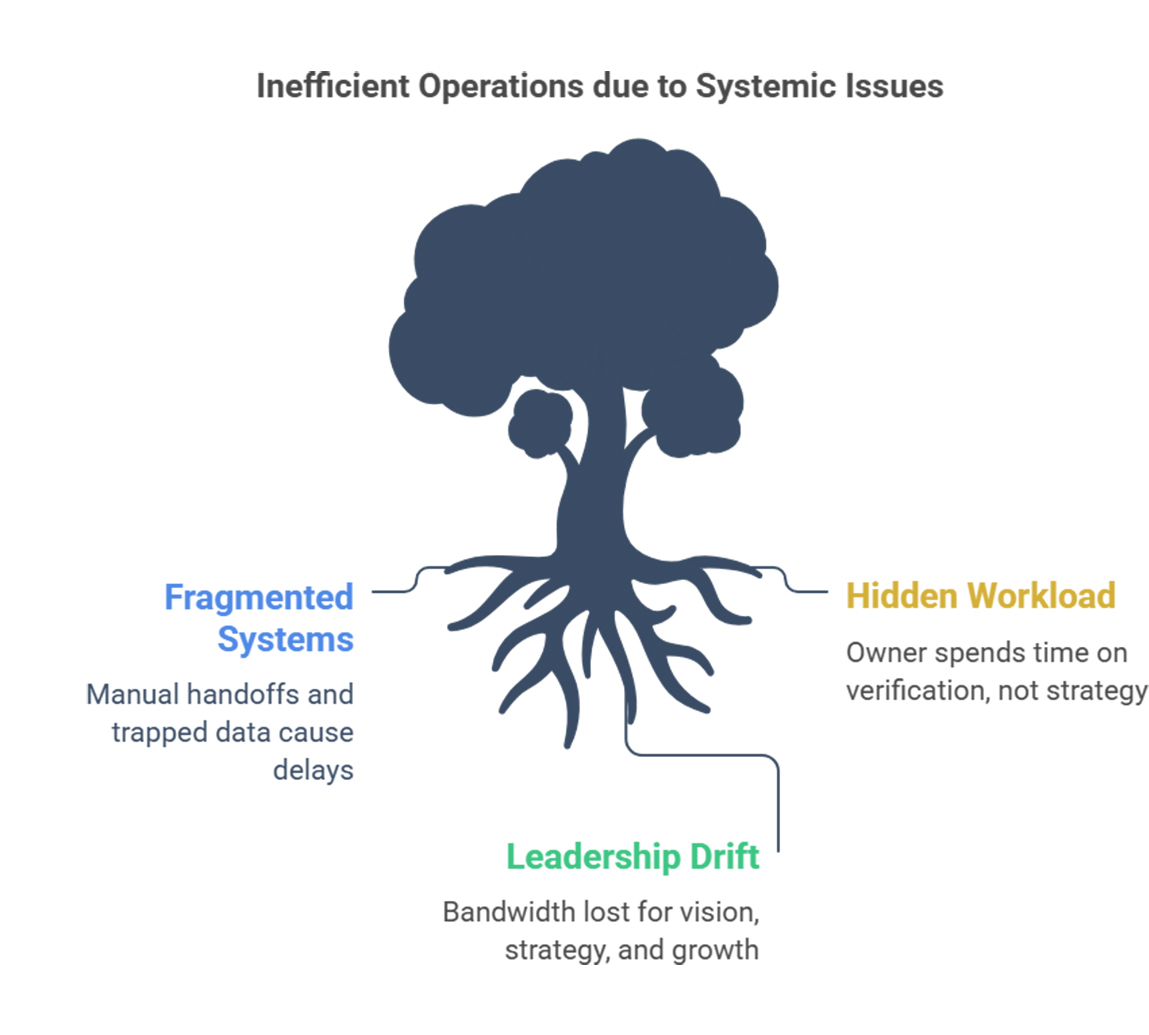
Understanding how this cycle works is the first step toward pulling yourself out of the daily operational weeds. When you identify where the system is breaking down, you can stop taking personal blame for what is actually a structural software and process failure.
How a Systems Break Traps the Owner in Daily Execution
A Systems Break occurs when your operational infrastructure can no longer support the volume of your business canopy. In the early days, you could manage work through verbal updates, sticky notes, and quick catch-ups in the hallway. As your customer list grows and your team expands, those informal handoffs turn into black holes where tasks frequently disappear.
Because your tools don't talk to each other, data gets trapped inside isolated inboxes, standalone CRMs, and personal task boards. Your team members don't have a single source of truth to check what happens next, so they naturally turn to you for answers. Without a connected root system pushing work forward automatically, every missing detail and stalled task lands back on your plate to resolve.
Why Operational Friction Directly Causes Leadership Drift
Leadership Drift is the natural consequence of falling into the leadership trap of spending your week reacting to preventable operational fires. You started your company to set the strategic direction, mentor your team, build client relationships, and drive long-term growth. Instead, you find yourself spending your highest-energy hours finding old email threads, double-checking spreadsheet entries, and reminding staff to follow up with leads.
When your mental bandwidth is continuously drained by micro-decisions and manual checking, you lose the clarity required to lead effectively. Strategic projects get pushed to next quarter, important market decisions get delayed, and you end up managing the company based on immediate feelings rather than clear metrics. You aren't drifting because you lost your vision; you're drifting because your current systems demand your constant physical presence just to stay baseline operational.
Why Pushing Harder Cannot Fix a Structural Breakage
Many owners try to solve this double-bind through sheer willpower, working longer hours or attempting to micromanage every handoff. Pushing harder against a broken process only accelerates burnout while leaving the underlying structural flaw completely untouched. Buying another point-solution app doesn't solve it either, as adding an isolated tool just creates another place you have to manually check.
The only way to eliminate Leadership Drift permanently is to fix the Systems Break at its core. When you build a unified root system that connects your communication, workflows, tasks, and pipelines, daily execution moves forward automatically. This structural stability removes you as the central bottleneck, giving you back the mental clarity and time needed to lead your business forward.

Root Architecture Over Symptom Sprays: Building Wide and Deep Roots
When you realize that scattered software and manual chasing are holding your business back, the solution isn't to buy another standalone app. Adding a new tool to a broken process just creates another place you have to check. True operational freedom requires building a connected root architecture that stabilizes your daily operations horizontally and anchors your leadership vertically.
In nature, a tree cannot sustain a tall canopy without roots that grow both wide and deep. A growing business operates under the exact same principle. When you upgrade to a fully connected business operating system, your growth becomes predictable, and daily work no longer lands back on your plate.
Wide Roots: Horizontal Integration Across Your Entire Operation
Wide roots spread horizontally across every department to stabilize your business during expansion. In your daily operations, wide roots represent complete horizontal integration across marketing, sales, fulfillment, billing, and customer support.
When your tools are disconnected, your wide roots are fractured, forcing you to act as the manual link between systems. Kyrios builds wide roots by centralizing your communication, tasks, pipelines, and workflows into one synchronized environment. When a lead arrives, follow-up starts automatically; when a project step finishes, the next task auto-assigns to the right team member without anyone asking what happens next.
Deep Roots: Objective Operational Metrics and Leadership Visibility
Deep roots anchor your business into bedrock, protecting it against unexpected market shocks and operational chaos. For a business owner, deep roots represent the objective visibility required to lead with conviction rather than managing by feelings or guesswork.
Without real-time operational visibility, you're forced to lead reactively, discovering ball-drops only after a customer complains or a deadline slips. Deep Roots surfaces live operational metrics through centralized dashboards, giving you clear insight into pipeline movement, team task completion, and active conversations. This clarity removes management anxiety, allowing you to make strategic decisions based on facts rather than stress.
Replacing Manual Chasing with Automated System Momentum
Moving from shallow, fragmented apps to a rooted operating system shifts your business from manual pushing to automated momentum. You stop spending your mornings double-checking tasks and searching through scattered inbox threads to see if work got done.
The system handles the everyday routing, reminders, handoffs, and follow-ups that used to rely on your memory or constant checking. Work moves forward predictably beneath the surface, protecting your time and freeing you to focus on the vision, culture, and growth that brought you into business in the first place.

Frequently Asked Questions About Small Business Operational Friction
To help you diagnose operational bottlenecks and understand how connected systems protect your time, we answered the most common questions business owners ask about hidden work and tool integration.
What is the hidden work of business owners?
The hidden work of business owners is the unmeasured mental and manual effort spent checking, chasing, verifying, and connecting disconnected tools to ensure basic operational steps happen. It includes searching through scattered inbox threads, double-checking spreadsheet entries, asking team members for status updates, and manually moving client details across separate software apps. This invisible labor never shows up on a financial statement, but it consumes hours of an owner's daily capacity.
Why do business owners become the main operational bottleneck?
Business owners become the central bottleneck when their business canopy grows faster than their root system. When operational processes live in people's heads or stay buried inside disconnected tools, work stalls unless a human manually checks it and prompts the next step. Because the owner takes ultimate responsibility for customer satisfaction and business outcomes, every unassigned question, dropped task, and broken handoff naturally lands back on their plate to fix.
How do disconnected tools increase an owner's mental workload?
Disconnected tools force the business owner to serve as the human API connecting separate systems. When email inboxes, CRMs, project boards, and billing software don't share context, information stays trapped in isolated silos. The owner has to constantly jump between apps to track down client details, verify if follow-ups occurred, and remind team members about upcoming deadlines, which creates constant mental fatigue and micro-interruptions.
What is the difference between storing data and moving work forward?
Storing data means saving information inside a database, such as entering a lead into a CRM or listing a project on a spreadsheet. Moving work forward means the system automatically uses that information to trigger the next operational step without relying on human memory or manual checking. A connected system immediately sends a follow-up message, assigns a team task, and updates a pipeline stage as soon as a trigger occurs.

Restoring Clarity, Control, and Unshakeable Leadership
You didn't build your business to spend your days acting as the manual glue holding disconnected tools together. The daily exhaustion you feel isn't a sign that you lack discipline, and it isn't something you can fix by pushing yourself to work longer hours. It is the natural result of running a growing business on a shallow, fragmented foundation.
When you replace scattered software apps and manual chasing with a connected root system, your daily operations keep moving forward automatically. Follow-ups happen on time, team handoffs become seamless, and you gain the objective visibility needed to lead with conviction. You stop reacting to constant operational fires and regain the mental space required to build a lasting, profitable legacy.
If you're tired of having every operational detail land back on your plate, it's time to build a foundation that supports your vision. See how Kyrios connects your communication, workflows, tasks, and metrics into one synchronized root system so your business keeps moving without depending on you for every step.