


What Happens When You Replace Memory-Based Operations With Systems
You don’t notice the problem at first. Running your business from memory feels normal. You keep track of tasks in your head, juggle conversations across platforms, and tell yourself you’ll remember what needs to happen next. It works… until it doesn’t.
Then something slips. A lead goes quiet because you forgot to follow up. A task gets pushed back because something more urgent showed up. A message sits unanswered longer than it should. None of it feels like a big failure in the moment, but it adds up fast. This is the hidden cost of not having business systems for small businesses.
It’s not just about organization. It’s about what happens when your brain becomes the system that holds everything together. And as your business grows, that system starts to break under pressure. You’re not disorganized. You’re overloaded. And the way you’re operating right now isn’t built to handle what’s coming next.

What “Memory-Based Operations” Actually Look Like in Real Life
You don’t wake up and decide to run your business from memory. It just happens. At first, it feels efficient. You answer messages as they come in. You keep mental notes of what needs to get done. You tell yourself, “I’ll handle that later,” and most of the time, you do.
But your day starts to look like this:
You check email, then jump to SMS.
You reply to a client on Facebook, then switch to your CRM.
You write something down on paper, then forget where you put it.
You open five tabs just to figure out what’s still pending.
Nothing is technically broken. But nothing is truly connected either. So your brain becomes the connector. Every task, every follow-up, every reminder runs through you. If you remember it, it gets done. If you don’t, it disappears.
This is where the pressure builds. Because now, staying “organized” doesn’t depend on a system. It depends on how much you can hold in your head at once. And that’s exactly why things start slipping as your business grows.

Why This Starts to Break as You Grow
In the early stages, running things from memory doesn’t feel like a problem. You have fewer clients. Fewer moving parts. Fewer conversations to track. You can hold everything in your head and still stay on top of things. That’s why this way of operating sticks. It works… for a while. But growth changes the rules.
Now you’re dealing with:
more leads coming in from different channels
more active clients expecting fast responses
more tasks that depend on other tasks being done first
more team members asking questions and needing direction
The volume increases. The complexity increases. But your “system” stays the same. And that’s where things start to strain. Because your brain isn’t designed to manage dozens of workflows, timelines, and follow-ups at once. It’s designed to think, decide, and create.
When it becomes your primary operating system, two things happen:
First, things get inconsistent. Some tasks get done perfectly. Others get delayed or missed entirely.
Second, everything slows down. Not because you’re lazy. Because you’re overloaded with decisions, reminders, and mental tracking.
This is the point where most business owners feel it:
“I’m working harder… but it’s getting messier.”
That’s not a motivation problem. It’s a systems problem.
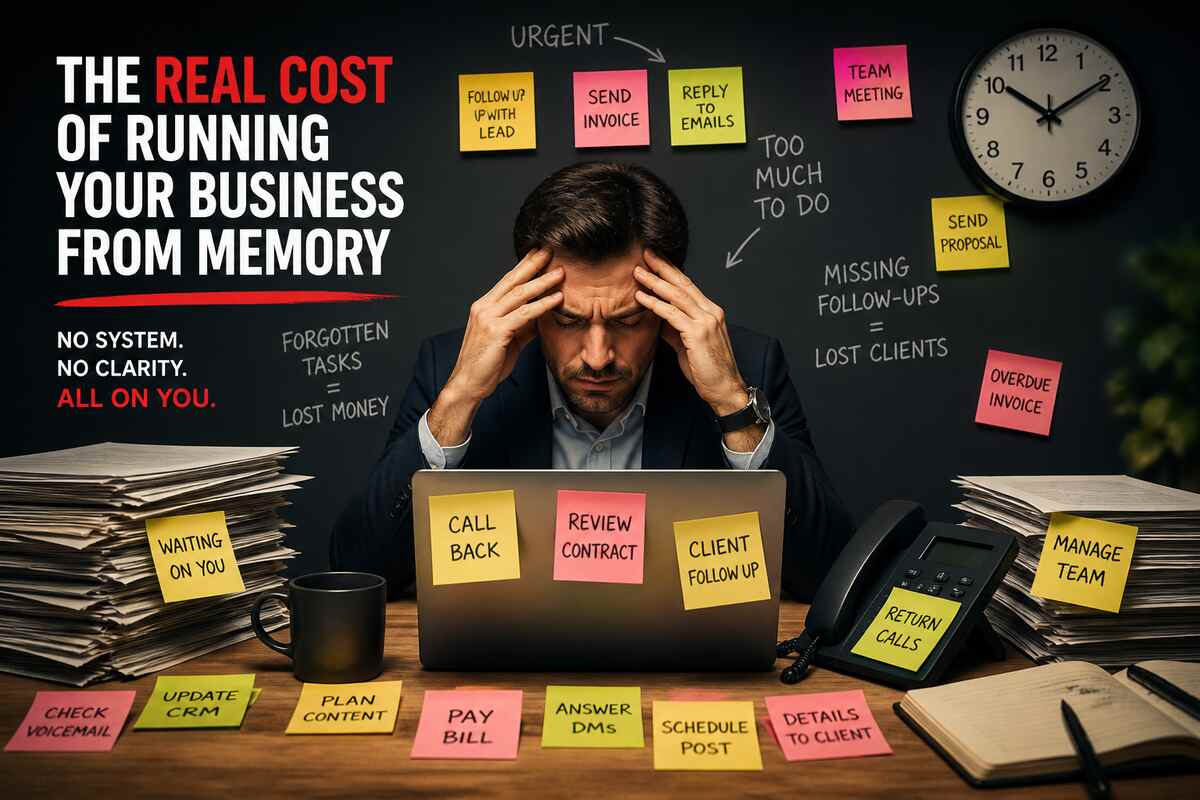
The Real Cost of Running Your Business From Memory
At first, the cracks are small. You missed one follow-up. You forgot to send one invoice. You reply a little later than you meant to. It doesn’t feel like a system failure. It feels like a busy day. But over time, these small moments stack up. And they start to cost you more than you realize.
Things Fall Through the Cracks
A lead reaches out. You mean to respond. Then something else pulls your attention. By the time you circle back, they’ve already moved on. Not because your offer wasn’t good. Because your process wasn’t reliable. This is one of the biggest hidden leaks in small businesses. And it often goes unnoticed until growth stalls.
You Stay Stuck in Reactive Mode
Your day is driven by whatever feels most urgent. A message comes in, you respond. A problem pops up, you fix it. A task gets delayed, and you rush to catch up. You’re constantly moving, but rarely moving forward, which is exactly why systemizing your business leads to clearer workflows, less stress, and more consistent results. There’s no clear flow. Just constant reaction. And that makes it almost impossible to focus on strategy, growth, or improvement.
Your Team Feels the Chaos Too
If you have a team, they rely on clarity. When everything lives in your head, they’re forced to guess. They ask more questions. They wait for direction. They redo the work because expectations weren’t clear. Not because they’re incapable. Because the system around them isn’t stable.
You Can’t Scale Cleanly
Growth should feel like progress. Instead, it feels like pressure. More clients create more work. More work creates more stress. More stress creates more mistakes. So growth starts to feel risky.
You hesitate to take on more, not because you don’t want it, but because you’re not sure your current setup can handle it. This is the real cost. Not just missed tasks or delayed responses. It’s the slow shift from control to chaos. And the longer it runs this way, the harder it becomes to fix.

The Emotional Side No One Talks About
Most people explain systems in terms of efficiency. Faster workflows. Better organization. More output. That’s not what you feel day to day. What you feel is the weight. It shows up in small, quiet moments.
You step away from your desk, but your mind doesn’t switch off. You’re halfway through dinner and suddenly think, “Did I reply to that client?” You wake up already running through a mental checklist before your day even starts.
Nothing is visibly broken. But nothing feels settled either. There’s always something you might have missed. That low-level tension becomes normal.
You start carrying your business with you everywhere. Not because you want to, but because you don’t fully trust that things are being handled without you. So you check again. You reopen tabs. You reread messages. You double-check tasks you already completed. Not because you’re inefficient. Because you’re compensating for a system that doesn’t exist.
And over time, this creates something deeper than stress. It creates fatigue. Not the kind that goes away with rest. The kind that comes from constantly holding everything together. This is the part most articles skip. But it’s the real reason the shift matters.
Because when you move away from memory-based operations, you’re not just fixing workflows. You’re removing that constant mental load. You’re giving yourself space to think clearly again.
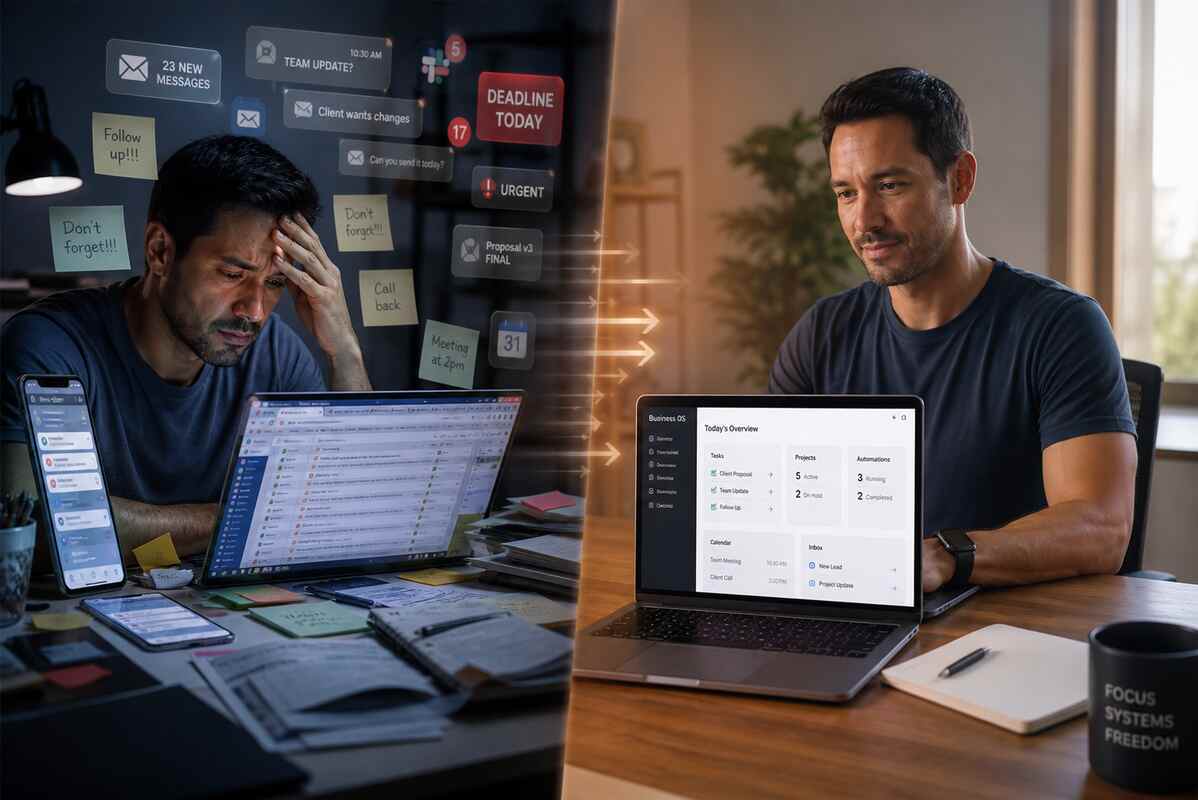
What Changes When You Move to System-Based Operations
The shift doesn’t happen all at once. It starts with one small change. Instead of telling yourself, “I need to remember this,” You start asking, “Why does this rely on me in the first place?” That question changes everything. Because now you’re not trying to keep up. You’re starting to redesign how things work.
At first, it feels simple. You set up a way to track leads so nothing gets lost. You create a repeatable process for follow-ups. You stop relying on scattered notes and bring things into one place. Then something unexpected happens. You stop thinking about those tasks entirely.
Not because they disappeared. Because they’re handled. This is the real shift from memory to systems, and it’s exactly why systems are essential for growth.
You move from “I hope I don’t forget.” to “I know this will happen.” That confidence doesn’t come from working harder. It comes from removing the need to remember in the first place. And the impact shows up quickly.
You respond faster, without chasing messages across platforms. You follow up consistently, without mental reminders. You track progress clearly, without digging through tools. Work stops feeling like a constant scramble. It starts to feel structured. More importantly, your role begins to change. You’re no longer acting as:
the reminder system
the follow-up system
the coordination system
Those responsibilities move into the system itself. Which frees you to think differently. You start focusing on:
decisions instead of tasks
strategy instead of catch-up
growth instead of maintenance
This is where relief starts to show up. Not in a dramatic moment. But in the absence of constant pressure. You don’t feel like you’re holding everything together anymore. Because you’re not. The system is.

The Transformation — From Chaos to Control
The difference isn’t subtle. It’s the kind of shift you feel in your day before you even measure it in results.
From Scattered → Centralized
Before, everything lives in different places. Messages in one app. Tasks in another. Notes somewhere else. You spend more time finding information than using it. After systems, everything has a home. You don’t wonder where to check. You don’t dig through tools.
You don’t piece things together manually. You open one place, and it’s all there. That alone removes friction you didn’t realize you were carrying.
From Reactive → Predictable
Before, your day is driven by interruptions. Something comes in, you handle it. Something breaks, you fix it. Something gets delayed, you scramble. After systems, workflows take over. Follow-ups happen when they should. Tasks move forward without constant nudging. Deadlines don’t sneak up on you. You’re no longer reacting to everything. You can actually plan.
From Overwhelmed → Clear
Before, your mental space is crowded. Too many open loops. Too many “don’t forget this” thoughts running in the background. After systems, that noise quiets down. You know what’s happening. You know what’s done. You know what’s next. Clarity replaces guesswork.
From Bottleneck → Leader
Before, everything depended on you. If you forget, it doesn’t happen. If you’re unavailable, things slow down. If you’re overwhelmed, the business feels it. After systems, the business runs beyond you.
Tasks don’t wait for your memory. Your team doesn’t rely on constant direction. Work continues even when you step away. You’re no longer the point of failure. You become the point of direction. This is the real transformation. Not just a better organization. Control. And once you experience it, going back feels impossible.

What “Systems” Actually Mean (Without the Corporate Noise)
The word “systems” throws people off. It sounds heavy. Complicated. Corporate. Like something built for large teams with operations managers and endless documentation. That’s not what this is.
At its core, a system is simple. It’s just a way to make sure something gets done the same way, every time, without relying on memory. That’s it. If you have to remember it, it’s not a system. If you have to chase it, it’s not a system. If it only works when you’re paying attention to it, it’s not a system.
A real system does three things:
It captures what needs to happen.
It organizes where it belongs.
It moves it forward without constant input from you.
In a small business, that shows up in practical ways. When a lead comes in, they don’t just sit in your inbox. They enter a pipeline that tracks where they are and what happens next. When a client reaches out, you don’t jump between platforms. The conversation is already connected and easy to continue. When a task needs to be done, it’s not floating in your head. It’s assigned, visible, and tied to a process. This is where most people get it wrong.
They think systems mean:
more tools
more complexity
more setup
In reality, good systems do the opposite.
They reduce:
decisions
confusion
manual effort
They take what’s already happening in your business and give it structure. And that’s the key shift. You’re not adding work. You’re removing the need to think about the same things over and over again. When systems are working properly, your business stops depending on how much you can remember. It starts depending on how well things are designed.
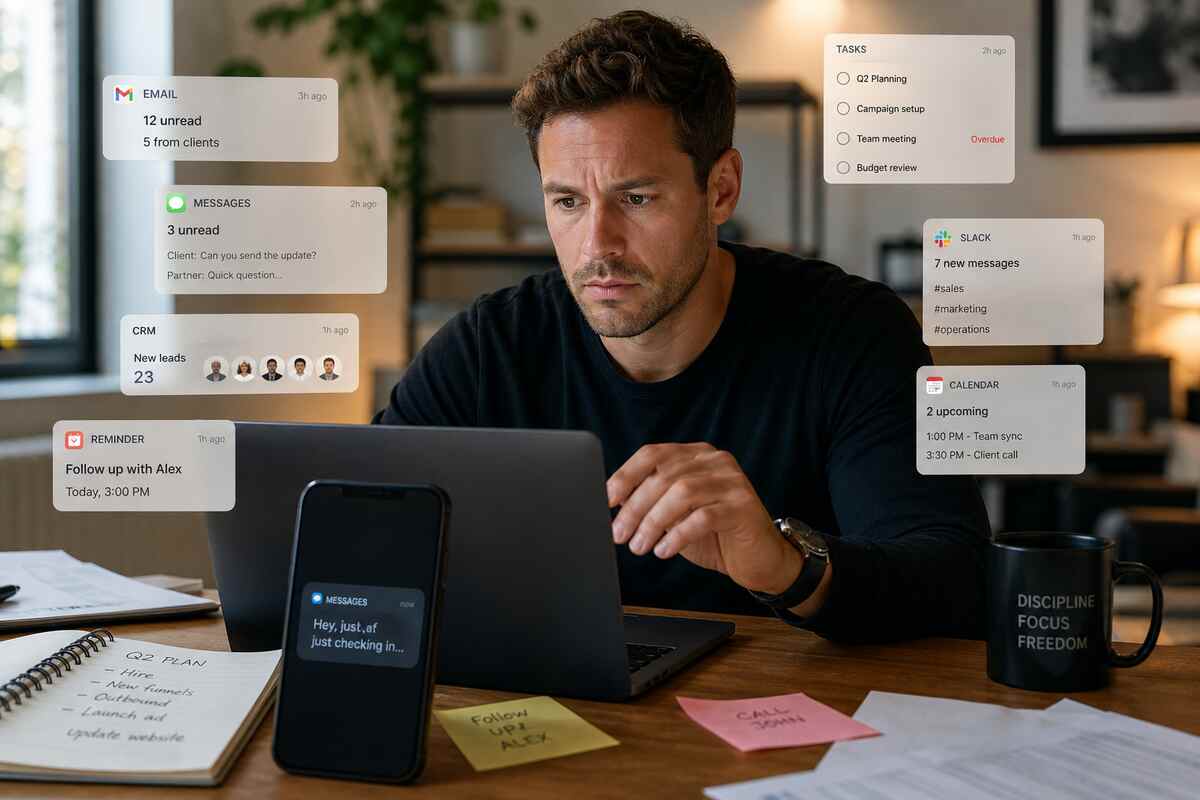
The Turning Point Most Business Owners Hit
There’s a moment most business owners don’t plan for. It doesn’t come from a strategy session or a big decision. It shows up in the middle of a normal day. You’re switching between tools. Answering messages. Trying to keep up. And then something small happens.
You miss a follow-up. A client asks, “Hey, just checking in…” A task you thought was handled… wasn’t.
You pause for a second and think:
“This shouldn’t be this hard.”
That’s the turning point. Not because everything is falling apart. But because you realize the current way of operating isn’t sustainable. Up until this point, you’ve been solving problems with effort. Work harder. Stay later. Remember more. And it works… until it doesn’t.
Because the more your business grows, the more it demands from you. More attention. More coordination. More mental tracking. And eventually, you hit a limit. Not a motivation limit. A capacity limit. This is where the shift begins.
You stop asking:
“How do I keep up with all of this?”
And start asking:
“Why does all of this depend on me?”
That question is uncomfortable. But it’s also the breakthrough. Because it forces you to see the real issue. It’s not your workload. It’s the lack of structure behind it. This is the point where systems stop feeling optional. They become necessary. Not to grow faster. But to keep growing without breaking everything in the process.
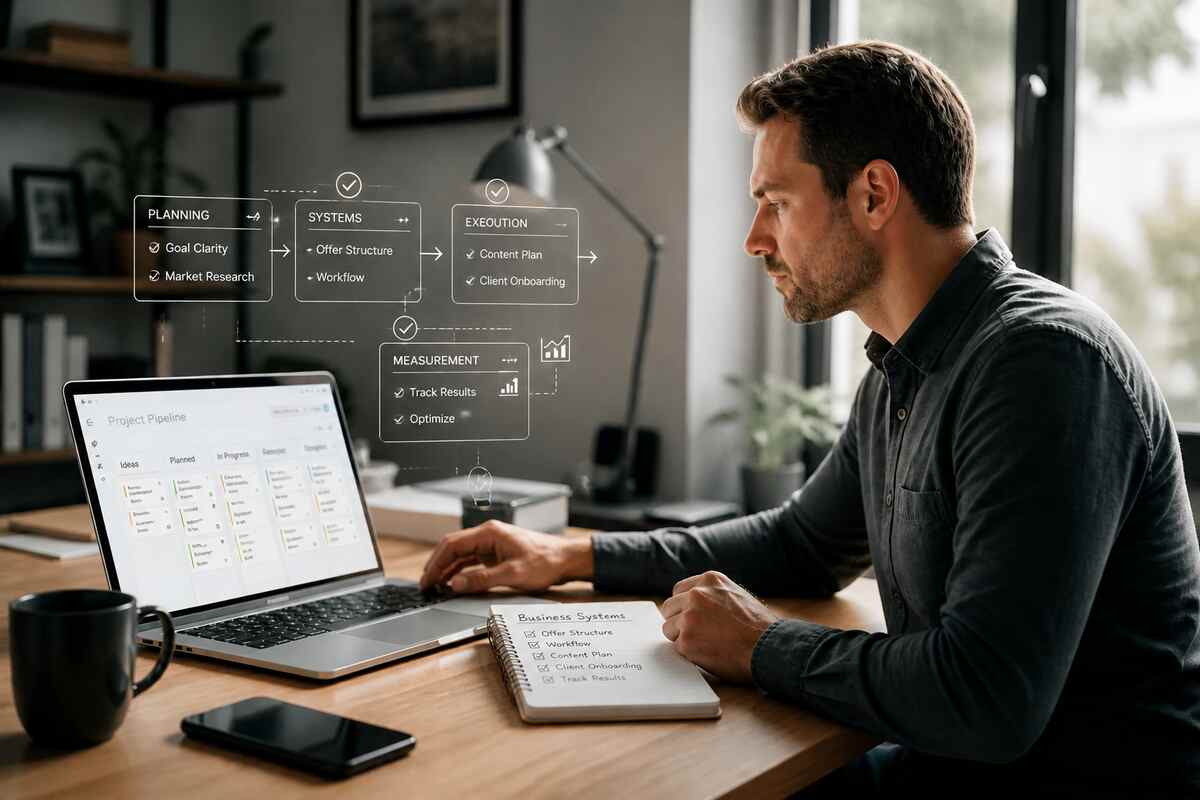
How to Start Moving From Memory to Systems
This is where most people overcomplicate things. They think they need to rebuild their entire business overnight. They don’t. The shift starts smaller than that.
Step 1: Notice What You’re Repeating
Pay attention to what shows up every day. Follow-ups. Scheduling. Answering the same questions. Tracking leads. Checking task progress.
If you’re doing it more than once, it’s not random. It’s a pattern. And patterns are where systems begin.
Step 2: Stop Storing It in Your Head
This is the simplest rule. If you have to remember it, it’s a gap.
Right now, your brain is acting as:
your task manager
your reminder system
your follow-up tracker
That’s not sustainable. Start pulling those responsibilities out of your head and into something visible. Even a basic structure is better than none.
Step 3: Centralize Before You Automate
Most people jump straight to automation. That’s a mistake. If your information is scattered, automation just makes the chaos faster. First, bring things into one place.
Your conversations
Your leads
Your tasks
When everything is visible and connected, then automation actually works.
Step 4: Automate What Slows You Down
Now look at what drains your time. Manual follow-ups. Appointment reminders. Repetitive admin work. These are not things you need to personally manage every time. This is where systems start doing the work for you. Quietly. Consistently. Without you thinking about it.
Step 5: Build for Consistency, Not Perfection
Your first system won’t be perfect. It doesn’t need to be. It just needs to be reliable. Something that works the same way every time. Because consistency creates trust. First in the system. Then in your business. This is how the shift actually happens. Not in one big overhaul. But in small decisions that remove reliance on memory and replace it with structure.

Why Most Attempts at “Getting Organized” Fail
This is where a lot of business owners get stuck. They realize things are messy. They feel the pressure. So they try to “get organized.” But nothing really changes. Because what most people do isn’t system-building. It’s surface-level fixing.
They add:
a new tool
a new to-do list
more reminders
more notes
It feels productive for a few days. Then everything slowly goes back to the way it was. Here’s why. They’re still operating from memory. A longer task list doesn’t remove the need to remember. It just gives you more to manage. More reminders don’t fix the problem either.
They create more notifications… which you still have to process, decide on, and act on. That’s not a system. That’s more noise. Another common mistake is jumping straight into tools. Buying software. Setting things up. Trying to automate everything at once.
But without a clear structure, tools don’t solve chaos. They spread it. Now, instead of juggling tasks in your head, you’re juggling:
dashboards
notifications
disconnected features
Same problem. Different format. The real issue is this: Most attempts focus on managing the workload. Very few focus on removing the dependence on memory. A real system does something different.
It reduces:
decisions
manual tracking
mental load
It creates a flow where things happen because they’re designed to happen. Not because you remembered at the right time. That’s the difference between: “I need to stay on top of this.” And: “This runs whether I think about it or not.” Until that shift happens, an organization never sticks. It just resets.
What This Looks Like When It’s Done Right
When systems are working, you notice it immediately. Not because everything is perfect. Because everything is calm. You start your day, and you’re not guessing where to begin.
You open your system, and it shows you:
what needs attention
what’s already in motion
what’s moving forward without you
There’s no mental scramble to piece things together. It’s already clear. A lead comes in. You don’t think, “I need to remember to follow up.” It’s already handled. They’re captured, placed into a pipeline, and the next step is triggered automatically. No chasing. No forgetting. No delay.
A client sends a message. You don’t switch between apps trying to find context. The conversation is there, connected to everything else:
past interactions
current status
next steps
You respond with clarity instead of scrambling for information. Tasks don’t float around in your head anymore. They exist in a system that:
assigns responsibility
tracks progress
moves things forward
You’re not checking in constantly. You already know where things stand. Your team operates differently, too. They’re not waiting on you for every decision. They can see:
what needs to be done
how it should be done
where things are in the process
Fewer questions. Fewer delays. More momentum. And the biggest shift? You’re not carrying everything anymore. You’re not the backup system. You’re not the reminder system. You’re not the safety net for missed tasks. The structure handles that. So your role changes.
You spend less time:
checking
reminding
fixing
And more time:
deciding
improving
growing
This is what “done right” actually feels like. Not complicated. Not overwhelming. Just clear, steady, and under control.
Where Kyrios Fits In
At some point, the question shifts from “Do I need systems?” to “What’s the simplest way to run them without adding more complexity?” That’s where Kyrios Systems comes in.
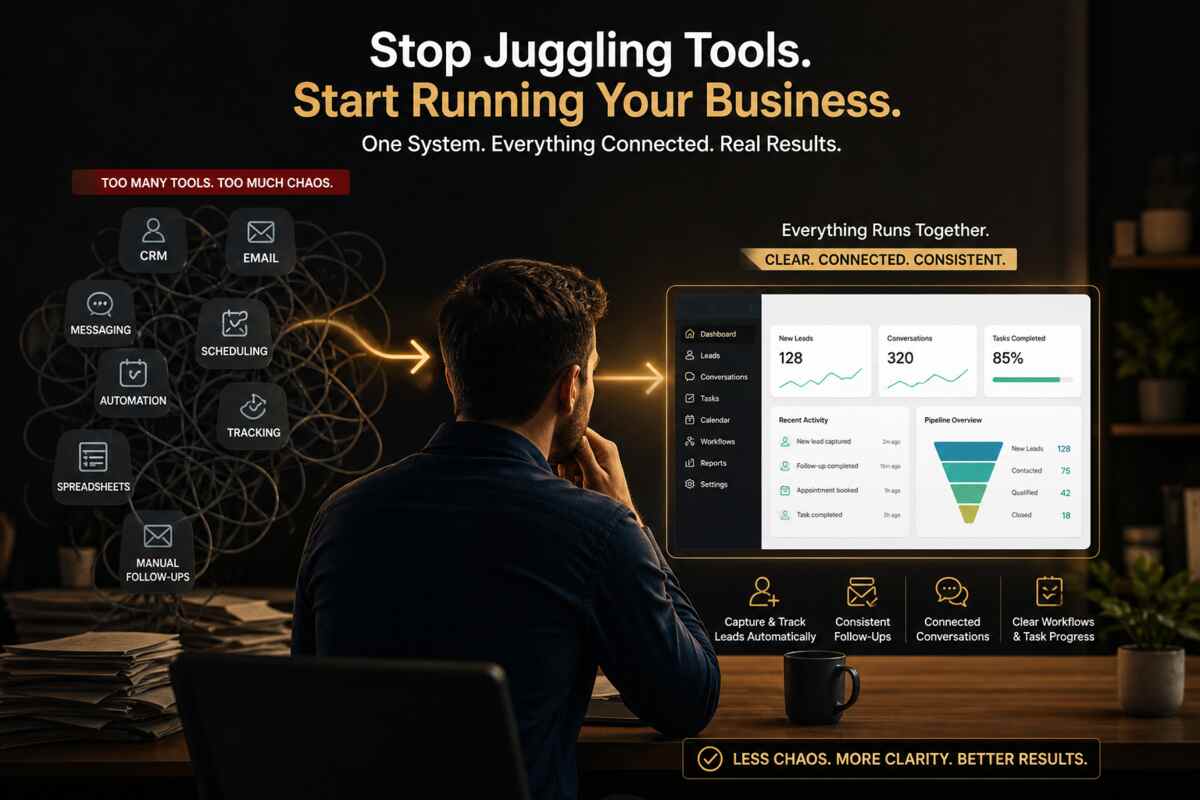
Instead of stitching together a CRM, automation tools, messaging platforms, scheduling software, and tracking systems, Kyrios brings everything into one place so your business actually runs like a system, not a collection of moving parts. Leads are captured and tracked without manual effort. Follow-ups happen consistently without you having to remember. Conversations stay connected, so you always have context. Tasks move forward based on clear workflows, not mental checklists. What used to depend on you now runs through a structure designed to support you.
This is where things start to feel different. You’re no longer chasing updates or wondering what slipped through the cracks. You can see what’s happening, trust that things are moving, and focus on decisions that actually grow the business.
If you want to see how this works in practice, take a closer look at what it looks like when your business finally runs with clarity instead of chaos.