


Why Automated Follow-Up Is the Key to Predictable Revenue
Every business owner knows the frustration of watching a promising lead turn cold. Time and ad spend bring in prospects, but daily operational fires interrupt outreach. By the time someone checks a spreadsheet, the lead has chosen a faster competitor.
Most owners view this as a lead generation problem, assuming more ads or reps will fix it. However, pouring leads into an unautomated pipeline only increases operational chaos without fixing the core system leak.
Revenue becomes unpredictable when execution depends on manual checks. Reliable growth begins when follow-up becomes an automated system that drives momentum independently.
The Follow-Up Trap That Keeps Revenue Unpredictable
Many small business owners wake up every morning already feeling behind on their sales communication. You start the day reviewing voicemails, digging through inbox threads, scrolling text logs, and checking scribbled notes to figure out who needs a response. By noon, client emergencies take over, and those prospect follow-ups get pushed to the end of the day or squeezed into the weekend.
This daily scramble creates the revenue roller coaster that keeps owners stuck in constant survival mode. When you have time to manually chase leads, sales close, and the calendar fills up with work. But when you get busy fulfilling those deals, outreach stops completely, leading to a sudden drop in revenue weeks down the road.
This volatility is a structural failure caused by scattered tools and manual handoffs. When follow-up relies on disconnected apps and manual effort, income stays as volatile as daily operational distractions.
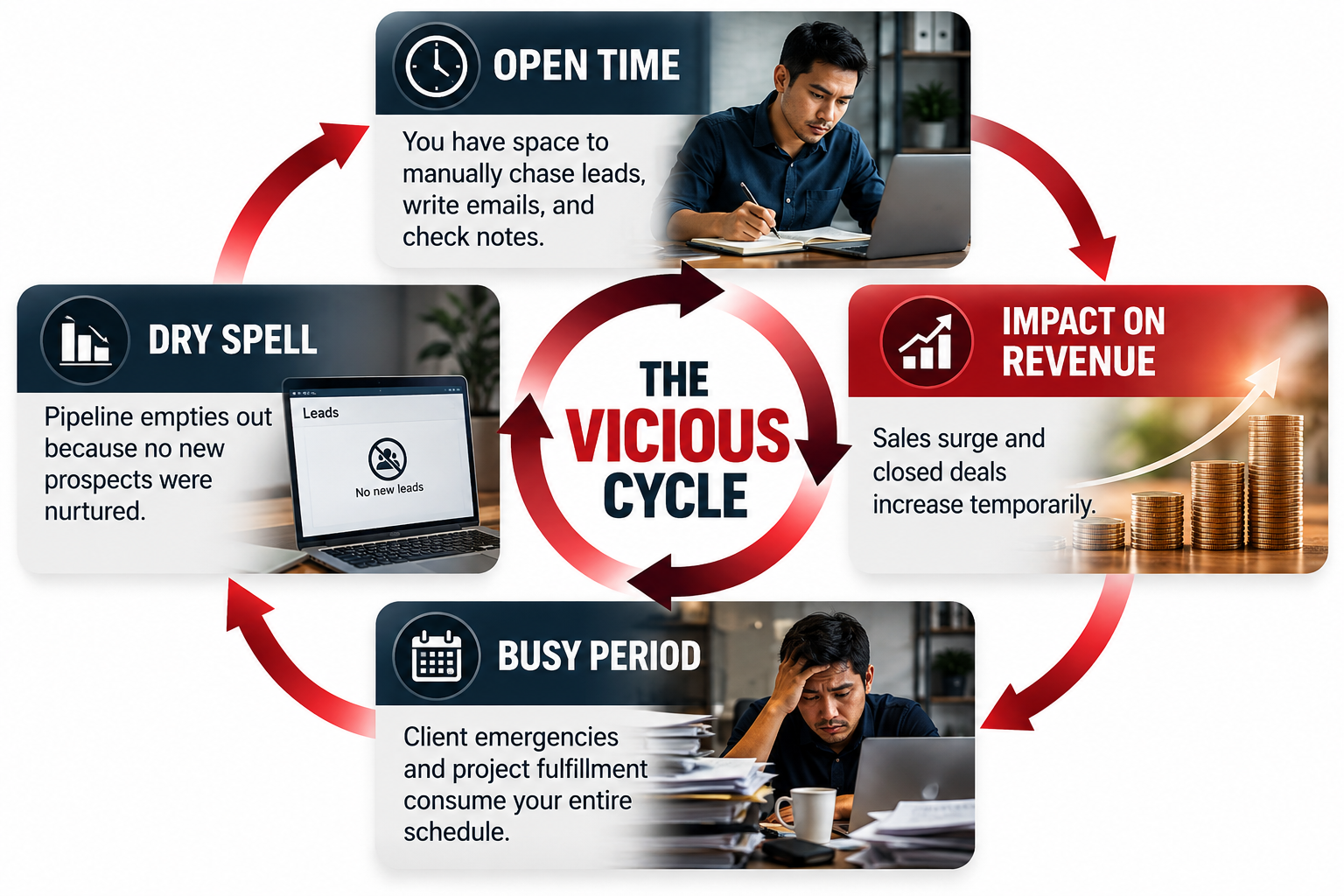
How Manual Follow-Up Creates Revenue Volatility
When business owners rely on manual follow-up, they inadvertently introduce severe operational friction into their sales pipeline. The issue is rarely a lack of interest from potential buyers; it is that human-dependent processes cannot maintain the speed and consistency required to turn interest into revenue. Every time a manual step fails, potential income slips away without leaving a trace in your metrics.
To understand why your revenue fluctuates, you must look at how manual communication breaks down across your daily operations. When follow-up depends on individuals remembering to check tabs, type messages, and log notes, three predictable system failures occur.
Follow-Up Breakdown | Operational Mechanism | Direct Impact on Revenue |
The Follow-Up Black Hole | Prospect details sit inside an inbox, DM, or spreadsheet without an automated trigger pushing the next step. | Qualified leads go cold, forcing you to spend more money acquiring new leads to replace them. |
Speed-to-Lead Delay | Inquiries sit for hours or days while your team handles existing client emergencies or internal meetings. | Prospects reach out to faster-responding competitors, destroying conversion rates before a call happens. |
The Owner Bottleneck | Communication and approvals route through the owner, who must manually check and assign every next action. | Progress stalls completely whenever the owner steps away, creating erratic revenue dips. |
The Follow-Up Black Hole
The follow-up black hole occurs when sales outreach relies on direct human involvement and unlinked notes rather than automated triggers, causing prospective deals to stall and go cold. It is prevented by anchoring communication and task assignments into an event-driven operating system.
When days pass without a response, the prospect assumes you are too busy or disorganized to handle their business. They are unlikely to send a follow-up email to remind you; they simply go find someone else.
The information existed in your system, but because the tool stored data without triggering action, the revenue was lost.
The Hidden Cost of Speed-to-Lead Breaks
A speed-to-lead break happens when manual lead intake delays initial outreach past the peak prospect intent window. Automating multi-channel responses ensures immediate contact within sixty seconds, drastically improving conversion rates.
Modern buyers expect immediate responses when they request information or fill out a contact form. When a prospect reaches out, their intent and attention are at their peak. Waiting even thirty minutes to send a manual reply drastically reduces your chances of entering a meaningful sales conversation.
If your process requires a team member to see an email notification, log into a CRM, find the contact, and manually draft a response, you are losing deals to competitors with automated instant replies. By the time your team sends a manual email three hours later, the prospect has already booked a discovery call with a company that engaged them in sixty seconds.
The Owner Bottleneck
In most growing businesses, the owner acts as the “human API,” manually connecting scattered communication channels. Lead notifications arrive in your personal inbox, texts go to your cell phone, and notes live in your notebook. Your team cannot progress on a prospect without asking you who needs follow-up and what message should go out next.
This creates an environment where every sales opportunity waits on your personal availability. When you are stuck in meetings, managing job sites, or attempting to take a weekend off, the entire sales pipeline grinds to a halt. You become the central bottleneck holding back the growth of the company you built.

Why Adding More Software Apps Makes Follow-Up Worse
When business owners notice leads slipping through the cracks, their initial reaction is almost always to buy another software tool. They sign up for a standalone email sequencer, an isolated text messaging app, or a fancy CRM module designed to fix that specific complaint. But adding more point-solution apps to a fractured operation only increases daily complexity while leaving the core structural problem unsolved.
Trying to solve systemic business friction with isolated software apps is like painting over damaged walls without fixing the leaking pipes underneath. The software might temporarily store contact records or send a scheduled email, but it cannot fix the fundamental disconnect between your sales, task management, and customer delivery.
The "Symptom Spray" Trap
Most business software on the market treats single symptoms rather than curing structural failures. A standalone email tool helps you send marketing broadcasts, but it does not notify your operations team when a prospect requests a custom quote. An isolated SMS app allows you to send text messages, but those conversations stay hidden from the rest of the team.
This creates a chaotic software stack where your customer data is scattered across five different logins. Instead of simplifying your workday, every new tool adds another open browser tab you must manually check, update, and manage.
Data Storage vs. Automated Action
A major misconception is that buying a CRM automatically solves your follow-up problems. Most CRMs are designed to hold data, acting as expensive digital filing cabinets where contact information goes to sit undisturbed. Storing a prospect's phone number and email address inside a database does not mean a follow-up action will actually happen.
If your system relies on a human being logging into a platform, looking up a record, and remembering to send a message, you do not have an automated system. You simply have a digital list. True operational leverage requires an infrastructure where information immediately triggers the next required action across your entire business.
The Kyrios Wide Root Solution
To build a business that scales predictably, you must replace duct-taped software tools with a connected operational foundation like Kyrios. In nature, wide lateral roots spread out horizontally to balance the tree and stabilize its growth. In business, your wide roots represent deep integration across every department and customer touchpoint.
When your communication channels, task management, sales pipelines, and customer records share the exact same context, work moves forward seamlessly. A prospect fills out a form, receives an instant text response, gets assigned to the correct team member, and moves down the sales pipeline without the owner having to check a single box.
Four Essential Elements of a Reliable Automated Follow-Up System
Building a reliable follow-up system does not mean replacing your team with cold, robotic spam sequences. It means creating an operational safety net that handles the initial speed, tracking, and organization so your team can focus on meaningful conversations. When built correctly, an automated follow-up system acts as the digital infrastructure that keeps your pipeline moving forward predictably.
To transform chaotic outreach into a connected operating system, your business needs four core structural elements. Without these four components working together, leads will continue to stall and land back on your plate.
1. Multi-Channel Immediate Response
The first few minutes after a prospect fills out a contact form or requests a quote are critical. A reliable follow-up system immediately captures that inquiry and initiates a multi-channel response across email, SMS, or web chat.
Instead of waiting for a staff member to manually draft a reply, the system instantly acknowledges the request, provides helpful context, and offers a clear next step like booking a discovery call. This immediate contact meets the prospect while their attention is focused on solving their problem, securing the opportunity before a competitor can step in.
2. Context-Aware Nurture Chains
Context-aware nurture chains are automated follow-up sequences that adjust their messaging dynamically based on prospect actions and real-time behavioral data (such as opening an email, clicking a proposal link, or booking a calendar slot). Instead of sending static, one-size-fits-all broadcasts, the system automatically checks prospect engagement and updates or pauses the sequence accordingly to ensure relevant communication.
Unlike generic email blasts, an automated system checks prospect behavior before sending the next message. If a lead opens a proposal or books a calendar slot, the nurture chain pauses automatically, ensuring your messaging always matches the client's current status.
3. Automated Task Handoffs
External follow-up with prospects is only half the battle; internal team coordination is where many sales processes break down. When a prospect replies or takes a specific action, the system must instantly create an internal task and assign it to the responsible team member.
Instead of relying on verbal instructions or forwarded emails, the system generates a clear task with complete context, attached client notes, and a firm deadline. If the assigned team member does not complete the task within the set timeframe, the system escalates the notification to ensure no customer inquiry gets left behind.
4. Operational Dashboard Visibility
You cannot manage or scale a sales process if you are relying on guesswork and verbal status updates. A complete follow-up system provides a central dashboard that gives you real-time visibility into your entire pipeline.
You can see exactly how many leads came in, how fast they received a response, which follow-up stage they are sitting in, and who owns the next action step. This operational visibility eliminates the need to constantly interrupt your team with quick questions, allowing you to lead with objective data rather than anxiety.
Practical Application: What Changes When Follow-Up Moves Automatically
Transitioning your business from manual chasing to an automated follow-up system fundamentally changes how your operations run day to day. Instead of spending your mornings reacting to dropped balls and unreturned messages, you gain clarity over a sales pipeline that moves prospects forward without constant supervision.
When your communication, tasks, and sales stages share a connected infrastructure, operational friction decreases across every department. The shift creates three major operational transformations that stabilize your revenue and give you room to lead.
Before Automated Systems | After Automated Systems |
Erratic lead conversion rates driven by team availability and memory. | Reliable lead movement through instant responses and multi-channel nurture chains. |
Prospects feel ignored or forgotten when manual follow-ups get delayed. | Clients experience prompt, professional communication from first contact through fulfillment. |
Day spent checking, chasing, fixing, and answering "got a minute?" questions. | Real-time operational visibility into metrics, freeing space for strategy and growth. |
Predictable Lead Conversion
When follow-up depends on manual checks, your monthly conversion rates fluctuate wildly based on how busy your team gets with daily tasks. An automated system eliminates this variability by ensuring that every single inbound lead experiences the exact same prompt, professional outreach.
Because instant replies and scheduled check-ins happen automatically, prospects never feel stranded or forced to look for faster options. Your sales pipeline transforms from a leaky bucket into a reliable engine that consistently converts interest into booked appointments and closed deals.
Protecting Customer Relationships
Many business owners worry that introducing automation will make their company feel cold or transactional to prospective clients. In reality, dropped promises and delayed responses destroy client trust far faster than a well-crafted automated message ever could.
Automating your communication safeguards your brand's reputation by making sure every prospect receives consistent updates at every step of their decision-making process. By removing the risk of forgotten touchpoints, you build long-term trust from the very first interaction.
Restoring Leadership Space
When you personally hold disconnected tools together, your entire workday is consumed by shallow execution tasks. You spend hours asking staff for status updates, checking spreadsheets, and making sure follow-ups were actually sent.
Moving to an automated operating system replaces constant firefighting with objective visibility into your business metrics. You can see pipeline health and team performance at a glance, allowing you to stop managing daily tasks and return to building the long-term vision of your company.
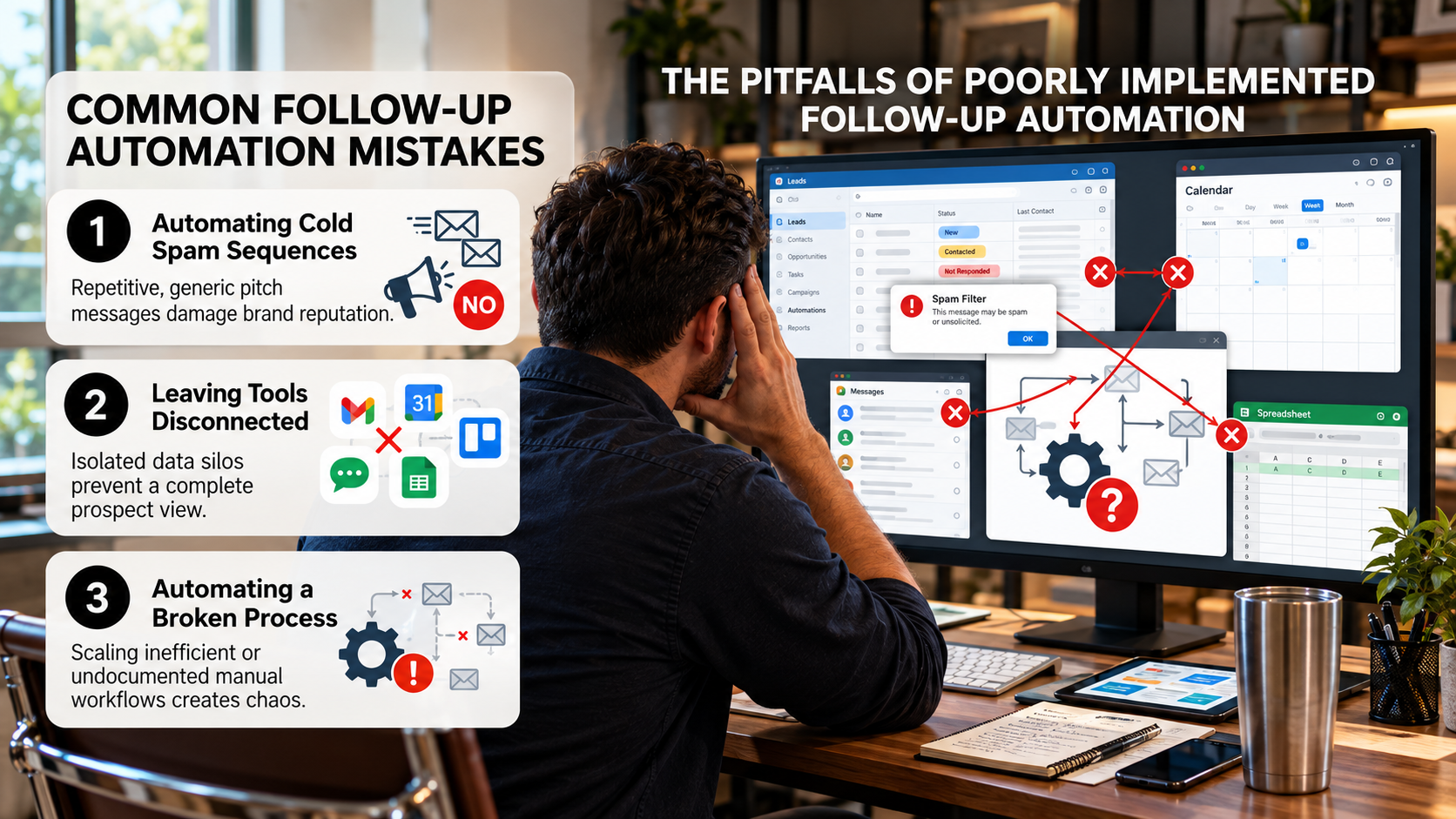
Three Mistakes to Avoid When Automating Business Follow-Up
Automating your communication is one of the fastest ways to stabilize your revenue, but implementing automations on a fractured foundation can create new operational headaches. When business owners rush to automate without a clear strategy, they risk alienating leads and overwhelming their team.
To ensure your follow-up system builds trust and drives predictable growth, you must avoid three common implementation traps. Recognizing these mistakes keeps your automation strategy grounded in real operational leverage.
Implementation Mistake | How It Shows Up in Operations | Operational Risk & Result |
1. Automating Cold Spam Sequences | Blasting aggressive, generic messages to prospects without internal task triggers. | Damages brand reputation and annoys leads without moving deals forward. |
2. Leaving Tools Disconnected | Running automations inside standalone apps that do not share customer data. | Creates duplicate records and forces staff to copy-paste information across tabs. |
3. Automating a Broken Process | Building complex workflow logic on top of unwritten or messy internal habits. | Magnifies existing operational chaos and causes setup paralysis for your team. |
1. Automating Cold Spam Sequences
The biggest mistake business owners make is treating automation purely as a high-volume sales tool. They set up aggressive, automated email sequences that bombard prospects with generic pitch messages every single day.
Automation should support personal relationships, not replace them with spam. Effective follow-up delivers relevant context, answers common questions, and prompts your team to jump in the moment a prospect shows genuine buying intent.
2. Leaving Tools Disconnected
Setting up an automated sequence inside a standalone app while your team operates out of a separate inbox or task board creates massive friction. When your software tools do not share context, data gets trapped inside isolated silos.
A prospect might reply to an automated text message, but if that response does not trigger an update in your central system, your team remains in the dark. Your staff ends up wasting hours copy-pasting customer details across browser tabs, defeating the entire purpose of automation.
3. Automating a Broken Process
Automation is a powerful force multiplier, but it multiplies whatever you feed into it. If your manual follow-up process is messy, disorganized, and full of unclear handoffs, automating it will only make your business fail faster.
Before setting up complex triggers and logic trees, you must establish a clear, simple path for how leads should move through your business. Starting with a unified operational foundation ensures your automations streamline daily work rather than creating more confusion.
How to Build an Integrated Follow-Up Foundation for Your Business
Unpredictable revenue is rarely caused by a lack of sales skill, effort, or lead volume. It is the direct outcome of running a business on shallow, disconnected tools that force you to act as the human glue holding everything together. When follow-up depends on memory, scattered notes, and manual checking, income will always fluctuate based on your daily schedule.
Stabilizing your revenue requires shifting from reactive chasing to an integrated root system that moves work forward automatically. By unifying your communication, sales pipelines, task management, and customer records into one operating system, you remove the owner bottleneck and ensure that every prospect experiences consistent, professional outreach.
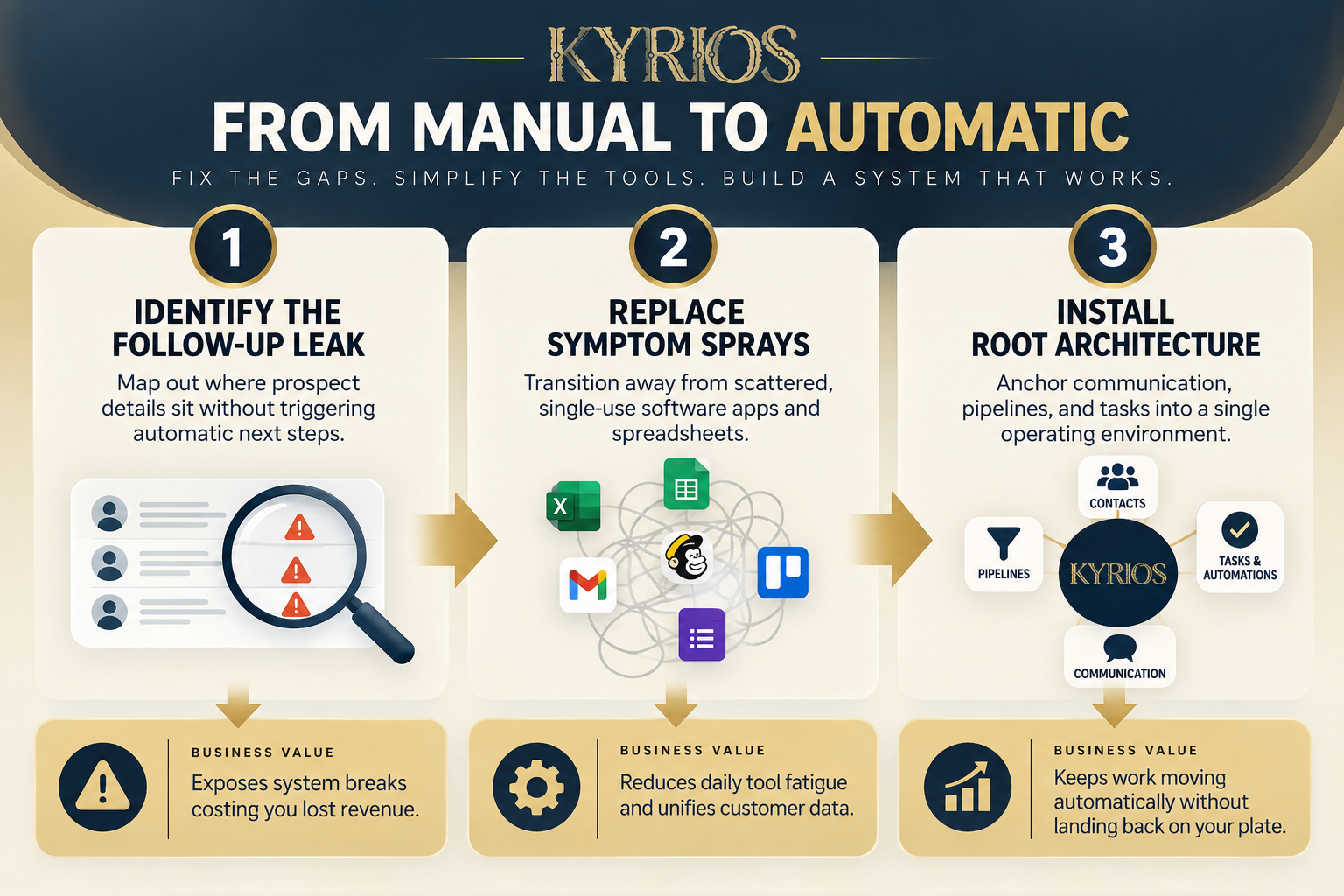
If you are tired of watching qualified leads fall through the cracks and want to put a connected operating system underneath your business, the next move is to evaluate your root architecture.
Explore Kyrios to see how an integrated system connects your follow-up, automates daily operations, and provides the structural stability required to scale predictably.