

Most Owners Aren’t Overwhelmed By Growth; They’re Overwhelmed By Gaps
Monday morning starts before you even open the inbox. A lead came in overnight. Someone messaged the Facebook page. A client replied to last week’s email thread.
Your phone buzzes.
“Did anyone follow up with that proposal?”
You open three tabs to check. The CRM shows one thing. The inbox shows another. The notes are buried somewhere in Slack. So you do what you’ve learned to do. You piece the answers together yourself.
Follow-ups live in your head. Messages are scattered across tools. Tasks don’t really belong to anyone unless you catch them. The business is growing, but more depends on you, not less.
Is growth supposed to feel like this?
It often seems like growth is the problem. More leads. More conversations. More moving parts. But growth usually isn’t what overwhelms business owners.
The gaps are.
Growth simply exposes them.
When a business runs on memory, scattered tools, and informal processes, those gaps stay manageable while things are small. As activity increases, they become harder to carry. Not because the business is failing.
Because the systems that should support the growth were never built.
Why Do Business Owners Feel Overwhelmed?
Business owners usually feel overwhelmed, not because the business is growing, but because growth exposes operational gaps where tasks, communication, and follow-ups rely on memory instead of structured systems.
When a company is small, many things happen informally. The owner remembers who needs a reply. Messages get answered when someone notices them. Tasks move forward because the owner pushes them along.
It works for a while.
But growth changes the environment in which the business operates:
More leads come in
More conversations happen
More work depends on coordination
Suddenly, the same informal processes that once felt manageable start breaking down.

Follow-ups fall through the cracks. Messages get missed. Tasks sit waiting because no one is sure who owns the next step.
Many owners start noticing the same patterns showing up across their day:
A lead submits a form, but no one responds for hours
Messages arrive through email, social media, and chat tools
Team members ask for updates because the next step isn’t clear
Tasks get delayed until someone reminds the team
Information lives in different tools that don’t connect
Together, these problems create constant pressure. So the owner does what they’ve always done. They step in to keep things moving, check messages, remind the team, and push the next step forward.
At first, it feels like responsibility. Over time, it becomes something heavier. The owner slowly becomes the system holding the business together.
What Are Operational Gaps in a Business?
Operational gaps are places where the business relies on memory, manual coordination, or disconnected tools instead of clear systems that move work forward automatically.
These gaps are not always obvious at first. Many businesses operate this way in the early stages. The owner fills the gaps by remembering follow-ups, checking messages, and pushing tasks forward.
As activity increases, those hidden gaps become harder to manage.
Most operational gaps fall into a few common categories.
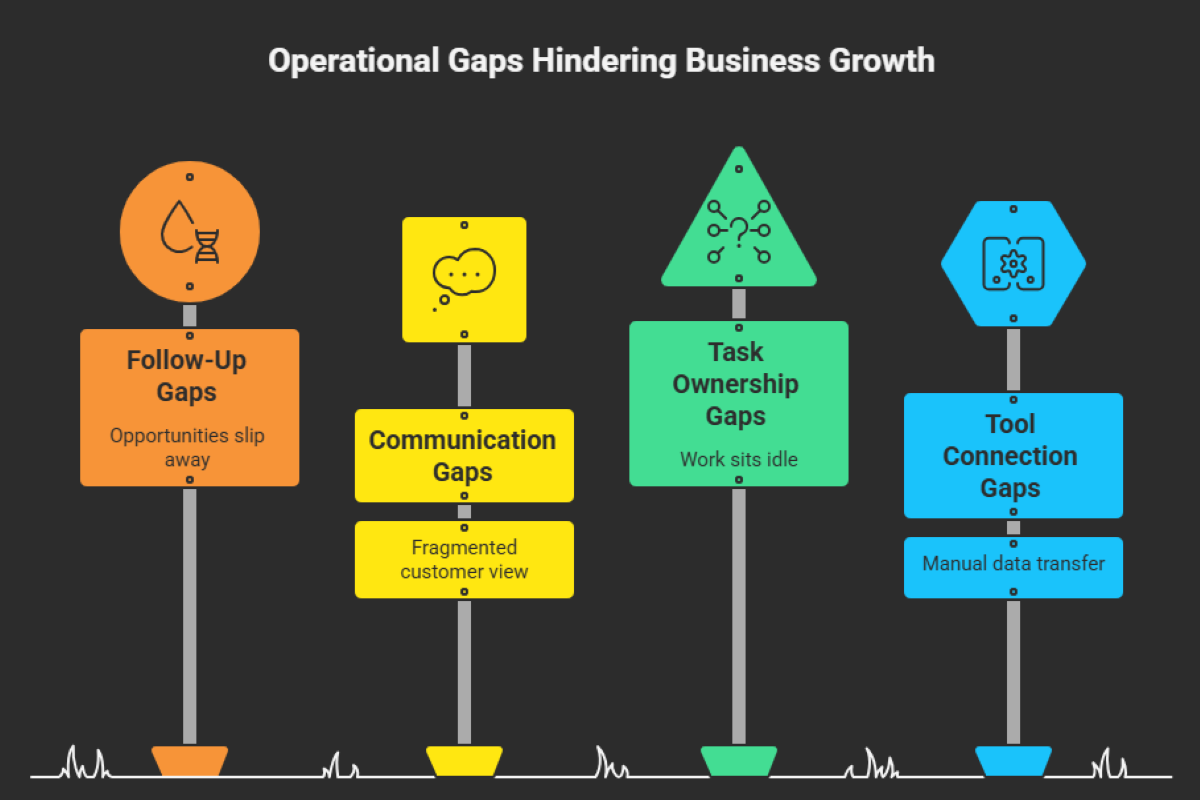
1. Follow-Up Gaps
Follow-up often depends on someone remembering to do it.
A lead submits a form, but no workflow triggers the next step. A proposal is sent, but no reminder follows if the client does not respond. Someone says, “I’ll check back later,” but the task never becomes visible to the team.
When follow-up relies on memory, opportunities quietly slip away.
2. Communication Gaps
Conversations begin to scatter across multiple platforms.
A message arrives through email. Another through social media. A third through website chat. Team members may answer some of them, but the conversation history becomes fragmented.
When communication lives in separate places, it becomes difficult to see the full picture of what is happening with a customer or lead.
3. Task Ownership Gaps
Tasks sometimes exist without clear ownership.
A team member assumes someone else is handling the next step. Another person believes the task is still waiting for input. Without a defined process, work can sit idle even when everyone believes it is being handled.
These moments create small delays that slowly compound over time.
4. Tool Connection Gaps
Many businesses use multiple tools added over time to solve specific problems. A CRM tracks contacts, an email platform manages campaigns, a calendar handles appointments, and a project tool manages tasks. Each tool works on its own.
But when those systems do not connect, information has to be manually moved from one place to another. This creates extra work and increases the chances that something important will be missed. These gaps do not mean the business is failing. They mean growth now requires more structure than the business has, and when that structure is missing, the owner becomes the one holding everything together.
Why Growth Exposes These Gaps
Growth does not create operational problems alone. It increases the volume of activity inside a business until the gaps that were once manageable become impossible to ignore.
When a company is small, the owner can personally keep track of many things. Follow-ups live in memory. Messages are checked across different platforms. Tasks move forward because the owner notices what needs attention and steps in.
For a while, that approach works.
But as the business grows, the number of interactions increases. More leads arrive. More conversations happen with customers. More work needs to be moved between team members. The same informal processes that once felt manageable begin to strain under the weight of the activity.
What used to be a few reminders in your head turns into dozens of things that require attention throughout the day. A missed message becomes more likely. A delayed follow-up becomes more costly. A task that no one clearly owns begins to slow down progress.
This is the moment many owners experience a shift in how their business feels. The company may be generating more opportunities, but the day-to-day operations start feeling heavier and harder to control.
The pressure does not come from growth itself.
It comes from the fact that the systems needed to support that growth have not yet been built.
Without those systems, the owner often becomes the person connecting everything together. They check conversations across tools, remind the team about next steps, and make sure important details do not slip through the cracks.
Over time, that invisible coordination work becomes one of the biggest sources of stress in the business.
The Little Things That Exhaust Business Owners
The pressure many business owners feel rarely comes from one big problem. It comes from the constant background work required to keep everything moving.
Most of this work is invisible. It does not appear on a task list. It is not assigned to a team member. It lives in the owner’s attention throughout the day.
The business keeps running because someone is quietly coordinating the details.
Over time, that person becomes the owner.
A typical day often includes three types of hidden work.
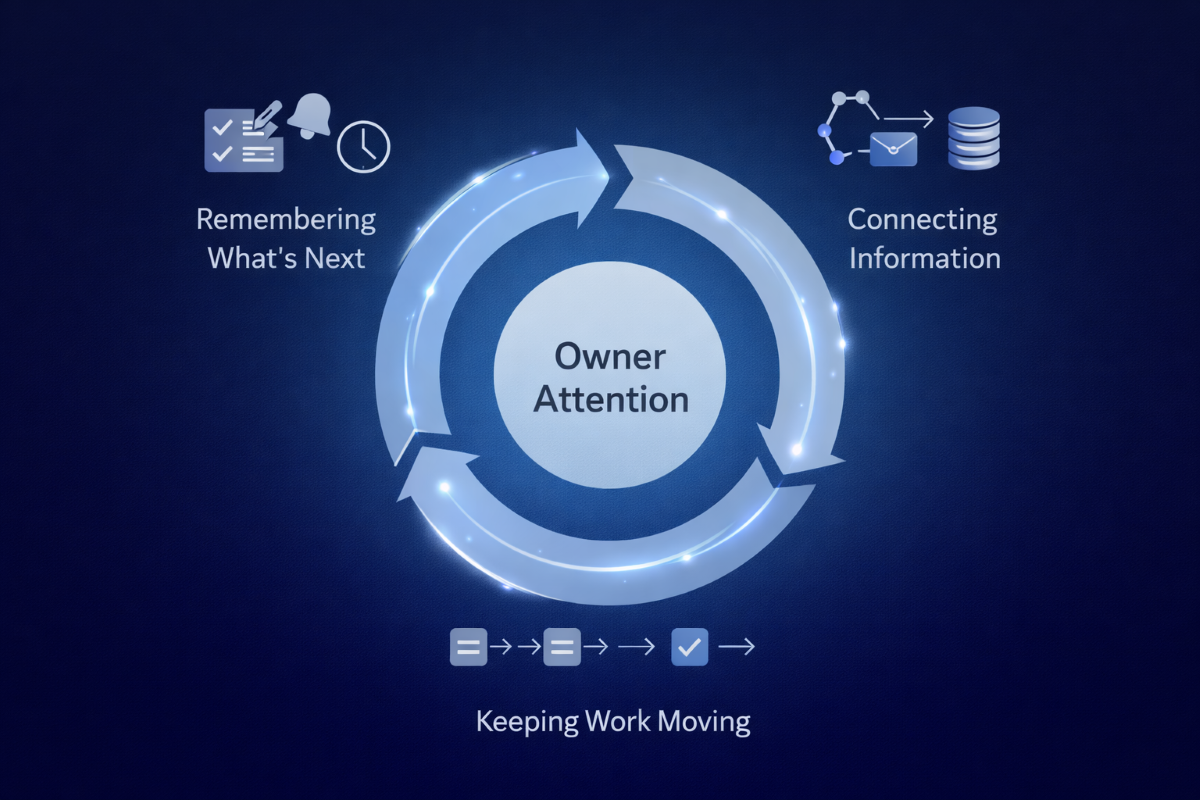
1. Remembering What the Business Needs Next
Many business owners carry a mental checklist of things that need to happen.
Remembering to follow up with a lead who requested information
Checking whether a proposal received a response
Making sure a task actually moved forward after a meeting
Noticing when a client's message still needs an answer
None of these things appear to be a huge problem by themselves, but when you start stacking them, they create a constant mental load.
2. Connecting Information Across Tools
As businesses grow, information begins living in different places. One tool holds contacts. Another holds conversations. A third holds project details.
That means someone must connect the pieces.
For example:
A message arrives through social media.
The conversation needs to be linked to the correct contact.
A follow-up task must be created.
The opportunity may need to move in the sales pipeline.
When systems are not connected, the owner often becomes the one performing this coordination.
3. Making Sure Work Actually Moves Forward
Even when tasks are assigned, work can stall without clear processes.
Team members may not know what the next step should be. Tasks may wait for clarification. Updates may not be visible across the team.
So the owner checks in.
They ask for updates. They remind someone of a deadline. They make sure the next step happens.
These small interventions keep the business moving, but they also make the owner the center of the operation.
Over time, this invisible coordination work becomes exhausting. The owner is not just leading the business. They are quietly holding together dozens of moving parts that depend on their attention.
That is why growth can start to feel heavier instead of easier.
The work itself is not the problem.
The problem is that the systems designed to carry that work do not exist yet.
Why Tools Alone Don’t Fix the Problem
When operations begin to feel chaotic, many business owners try to solve the problem by adding another tool.
A new CRM promises better lead tracking.
A project management app promises clearer tasks.
An email platform promises automated follow-ups.
Each tool solves a specific problem. But the underlying issue often remains.
The reason is simple. Tools perform individual functions. Systems coordinate how those functions work together.
Without systems, tools operate in isolation. Over time, the business begins relying on people to bridge the gaps between them. That coordination work often falls back on the owner.
This usually happens in a few ways:
Information gets captured, but the next step never starts automatically.
A CRM may record a new lead, but someone still needs to decide who follows up, when the follow-up happens, and what message should be sent. The tool stores information, but it does not move the process forward.Important context lives in multiple places.
Customer conversations might happen through email, social media, website chat, or text messages. Without a connected system, team members have to check several tools just to understand the full situation.Tasks still depend on someone remembering.
A proposal is sent, and someone needs to remember to check back. A meeting ends, and someone needs to assign the next step. Even with good tools, work can stall if the process itself is not defined.Owners become the connection point between tools.
They check the CRM, confirm the task, verify the message, and make sure the next step happens. The tools may exist, but the owner is still the one coordinating the work.
That is why adding more software rarely removes operational pressure. The number of tools increases, but the coordination work stays the same.
What actually reduces the pressure is not another tool.
It is a system that connects the work, so actions trigger the next step automatically, and the business can move forward without constant oversight.
What Systems Actually Reduce Business Overwhelm?
Business overwhelm begins to decrease when work moves through clear operational systems instead of relying on memory or constant supervision. Systems define what triggers the next step, who owns it, and how progress becomes visible across the team. Instead of reacting to everything manually, the business begins moving through predictable processes.
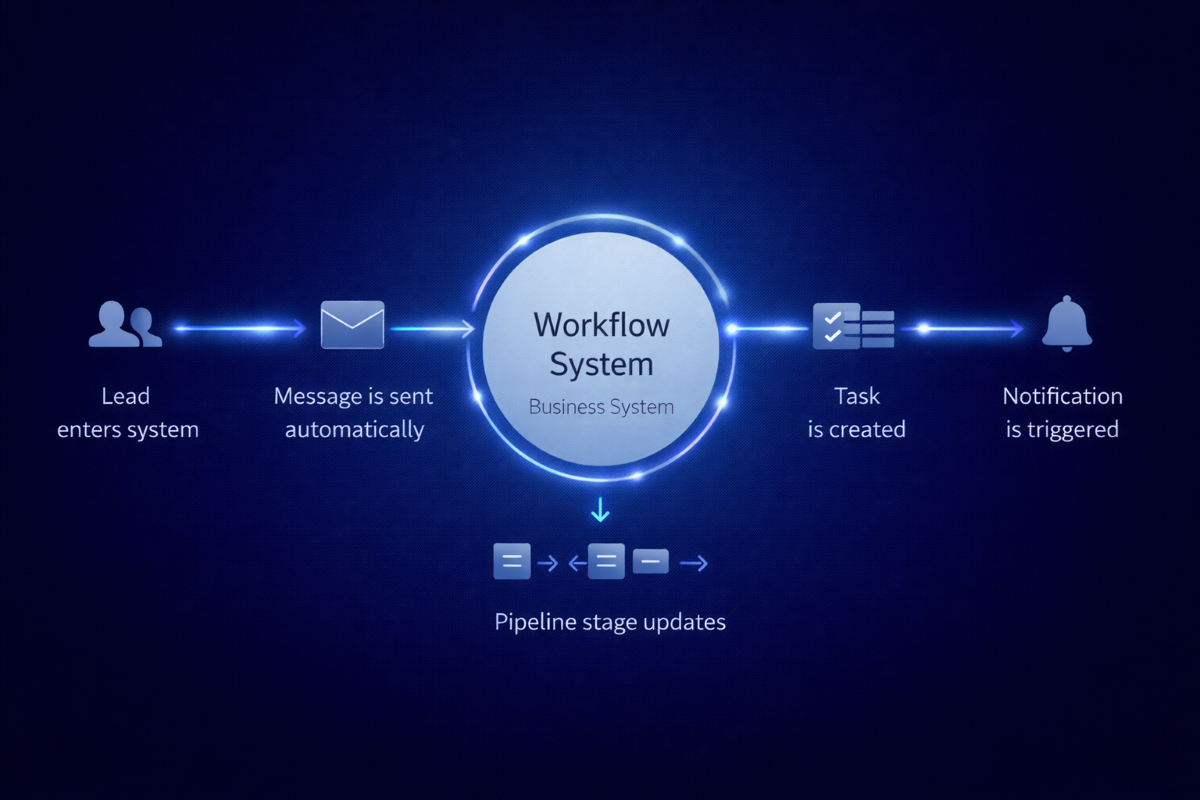
One of the most important systems is a lead response system. When a new lead enters the business, the response process should begin immediately rather than waiting for someone to notice the inquiry. The system creates the contact record, sends the initial response, and places the opportunity into the pipeline so the team knows exactly where that lead stands.
A communication system is another key piece. Customer conversations often happen across email, social media, website chat, and text messages. When those conversations connect to a single contact record, the team can see the entire history in one place instead of searching across multiple tools to understand the situation.
At the operational level, these systems usually ensure that a few important things always happen:
New inquiries trigger immediate responses
Conversations connect to the correct contact record
Tasks appear automatically after important actions
A process system for tasks and workflows ensures work continues moving forward without depending on reminders. When a meeting ends, the next step should already exist. When a task is completed, the following stage of work begins automatically. This keeps projects, deals, and customer requests from stalling.
Businesses also benefit from clear visibility systems that make activity easy to understand across the company. Dashboards and pipelines allow owners and teams to quickly see where leads are, which deals are progressing, and what tasks need attention. Instead of checking multiple tools or asking for updates throughout the day, the business becomes easier to monitor and manage.
As these systems take over the coordination work, progress no longer depends on someone remembering what should happen next. The system carries the responsibility, allowing the owner to focus on leading the business instead of constantly holding it together.
The Real Problem Was Never Growth
Many business owners believe they feel overwhelmed because the business is growing.
More leads. More conversations. More opportunities.
But growth itself is not the problem.
The real problem appears when activity increases, but the structure needed to handle that activity doesn’t exist yet.
That is when follow-ups start getting lost. Messages scatter across platforms. Tasks wait for reminders.
And slowly, without realizing it, the owner becomes the person responsible for holding everything together. Not because they want to. Because the business has no system doing that work yet.
Once that structure exists, growth begins to feel different.
Leads move forward without waiting
Conversations stay organized
Tasks trigger the next step automatically
The business starts moving through clear processes instead of constant supervision.
What It Looks Like When the Gaps Finally Close
If parts of this article felt familiar, it likely means your business has reached the point where growth requires a stronger operational structure.
The pressure most owners feel usually comes from a few common gaps:
Conversations are scattered across multiple tools
Leads waiting for follow-up
Tasks depending on reminders
No clear visibility into what is happening
When those gaps close, something important changes.

The business becomes easier to run.
You can open one place and immediately see:
Where leads stand
Which deals are moving
What work is waiting
What has already been handled
Your team knows the next step. Follow-ups happen consistently. Work moves forward without constant coordination. And the biggest shift is simple.
You stop being the system holding everything together.
If you want to see how businesses replace these operational gaps with a connected system that carries the work with you, explore how Kyrios brings communication, pipelines, workflows, and customer activity into one place so the business can finally move with clarity and control.