


Why Small Business Social Media Fails (and How to Turn It Around)
Why Small Business Social Media Fails
Most small business social media strategies fail because they rely on inconsistent manual effort instead of structured systems. When content creation, engagement, follow-up, and performance tracking depend entirely on memory and daily motivation, consistency breaks down, and momentum disappears.
A successful small business social media strategy requires more than posting regularly. It requires a repeatable workflow for content planning, audience engagement, communication management, and performance visibility that can continue operating even when business owners become busy.
In most cases, social media failure is not caused by poor content or bad algorithms. It is caused by a lack of operational structure behind the marketing process.
Key Takeaways
Small business social media often fails because it depends on manual execution
Consistency problems are usually workflow problems, not motivation problems
Content systems create long-term momentum more effectively than random posting
Structured engagement and follow-up improve visibility and lead generation
Sustainable social media growth requires process, planning, and performance tracking
It’s Monday morning.
You open Instagram to post something for your business. You pause for a second, trying to remember the last time you posted. Was it last week? Maybe earlier.
You scroll through your page. The posts aren’t bad. Some even did well. But there’s no rhythm. No direction. Just random moments where you were active… and long gaps where nothing happened.
You think, “I need to get consistent again.”
So you post something. Maybe even two posts this week. You reply to a few comments, check your messages, and for a moment, it feels like you’re back on track.
Then the week gets busy.
A client needs attention. A task runs longer than expected. Something urgent comes up. Social media drops to the bottom of the list, where it usually goes.
A few days pass. Then a week.
When you come back to it, the same thought hits again:
“I need to start posting again.” And the cycle repeats.
Not because you don’t care. Not because social media doesn’t work.
But because every part of it depends on you remembering, deciding, and pushing it forward.
If you’re trying to build a stronger long-term social media approach for your business, start with a clear strategy first.
This guide breaks down how to create a social media strategy that actually supports growth instead of adding more pressure to your day-to-day operations.
[Develop a Successful Small Business Social Media Strategy]
The Real Reason Small Business Social Media Fails
At first glance, it looks like a content issue.
You think you need better ideas, better visuals, or more consistency. And when results slow down, that’s where most advice points you. Post more. Engage more. Be more active.
But if you look at what’s actually happening day to day, a different pattern shows up.
Your social media doesn’t run on a system. It runs on you.
Every action depends on a decision you have to make in the moment. What to post, when to post, whether to reply, whether to follow up, whether to check performance. None of it moves unless you push it forward.
That creates a fragile setup.
When you have time and energy, things move. You post, you engage, you show up. But the moment your attention shifts back to the core of the business, everything slows down or stops completely.
This is why consistency breaks so easily. Not because you lack discipline, but because there’s no structure carrying the work when you’re focused elsewhere.
This is the same reason many small businesses become operationally fragile over time: too much of the business depends on memory instead of systems.
Over time, this turns social media into something reactive. You don’t follow a clear flow. You restart it whenever you can, then lose momentum again. Each restart feels like starting from zero.
That’s the real failure point.
It’s not the quality of your content. It’s not the algorithm. It’s not even your strategy.
Most small businesses do not fail at social media because they lack ideas. They fail because their marketing depends on constant manual attention in a business environment that constantly pulls attention elsewhere.
It’s the fact that your social media depends entirely on manual effort instead of running through a system.
What This Looks Like in Real Life
Social media failure doesn’t happen all at once. It builds slowly through small breakdowns that repeat until momentum disappears.
You start with good intent. You want to stay consistent, post valuable content, and engage with your audience. But without a system behind it, every action still depends on you deciding what to do in the moment. What to post, when to post, what to reply to, and what to follow up on.
When your attention is available, things move. When it’s not, everything slows down.
That’s where the pattern begins.
Posting becomes inconsistent. Not because you lack discipline, but because there’s no structure supporting it. Content gets delayed, skipped, then restarted in cycles that never stabilize.
Content starts to feel disconnected. One post doesn’t lead to the next. There’s no clear direction guiding what you create, so everything feels reactive instead of intentional.
Engagement becomes unpredictable. Messages and comments are answered when you see them, not when they should be handled. Some conversations move forward. Others disappear without follow-up.
Performance becomes unclear.
You look at your results, but nothing tells a consistent story.
This breakdown shows up in a few clear ways:
You post in short bursts, then disappear for days or weeks
You create content on the spot instead of following a plan
You miss messages or respond too late to matter
You don’t know what’s working, so you keep guessing
These aren’t separate issues.
They all come from the same place.
Social media is being managed manually instead of being supported by a system.
And when everything depends on your attention, it will always compete with more urgent parts of your business.
Why “Trying Harder” Makes It Worse

When social media starts slipping, the instinct is to push harder.
You tell yourself you need to be more consistent. More active. More disciplined. So you try to post more often, respond faster, and stay on top of everything.
For a short time, it works. You show up more. You engage more. You feel back in control.
Then the pressure builds.
Because nothing around the work has changed. It still depends on you remembering, deciding, and executing everything manually. The only difference is that now you’re trying to do more of it.
That’s where the breakdown happens again.
Effort increases, but stability doesn’t.
This creates a cycle that feels productive but leads nowhere:
You push harder and become more active
Your workload increases across the business
Social media starts slipping again
You feel like you’re falling behind
You try to restart with more effort
Each time, it feels like a discipline problem. It’s not.
It’s a structural problem.
Consistency is rarely a motivation problem. In most cases, it is a structural problem disguised as a discipline problem.
Trying harder doesn’t fix inconsistency when the system itself is unstable. In fact, it often makes things worse by increasing the amount of manual work you’re responsible for.
And over time, that turns social media into something you avoid instead of something that drives growth.
Because it always feels like something you have to “catch up on.”
What Actually Fixes Social Media Performance
If effort isn’t the problem, then better content alone won’t fix it.
You can improve your posts, test new ideas, and even follow a strategy, but if execution still depends entirely on you, the same patterns will keep repeating. Activity will come in bursts, engagement will stay inconsistent, and results will never stabilize.
What actually changes performance is structure.
Not more work.
A system.
A system doesn’t replace your strategy. It supports it. It takes the decisions you make once and turns them into a repeatable flow so things keep moving even when your attention is elsewhere.
Instead of asking what to do every day, the work is already defined.
That shift changes how social media operates.
Content is planned instead of improvised
Actions are triggered instead of remembered
Engagement is managed instead of checked randomly
Performance is tracked in a way that shows clear patterns
The difference is simple.
You stop restarting your social media every week.
And start running it as an ongoing process.
Momentum grows when execution no longer depends entirely on memory, energy, or availability.
This doesn’t mean removing flexibility or creativity. It means creating a structure strong enough to carry the work without constant effort.
Because when the system holds the process, your role changes.
You’re no longer trying to keep things alive.
You’re improving something that’s already running.
The Social Media Stability Framework
Turning social media around doesn’t start with posting more often. It starts with building a structure that removes inconsistency and creates sustainable momentum.
The Social Media Stability Framework focuses on three core shifts that help small businesses move from reactive social media management to a system that supports long-term growth.
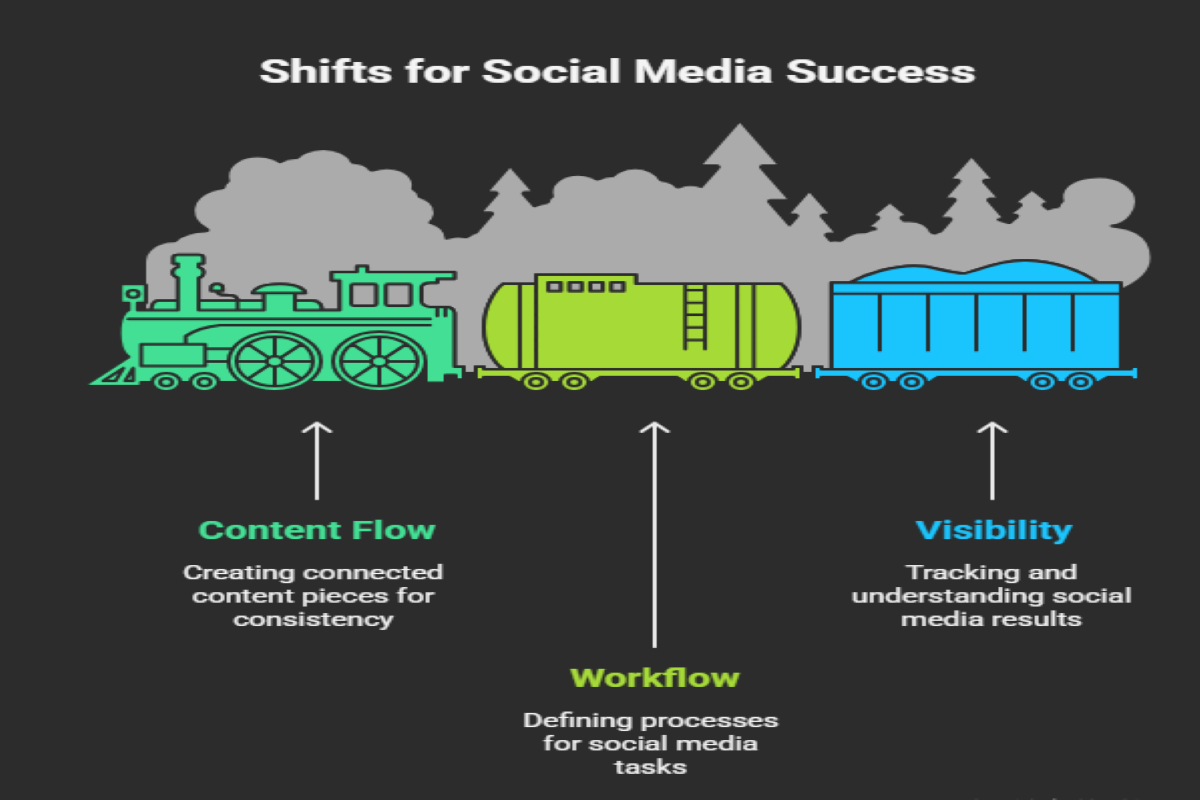
1. From Posting → To Content Flow
When social media is manual, every post is a separate decision. You sit down and ask, “What should I post today?” and the answer changes depending on time, energy, or pressure.
That’s why consistency breaks.
A content flow removes that friction. Instead of creating in isolation, your content follows a defined structure with clear categories and direction. Each piece connects to the next, building momentum over time instead of resetting every week.
This shift does three things:
It removes daily decision-making
It creates consistency without forcing it
It turns content into a progression, not a random activity
You stop thinking post by post.
You start operating as a system.
2. From Manual Work → To Workflow
Most social media tasks are invisible until they’re missed.
Replying to messages, following up on conversations, checking engagement, responding to opportunities. These actions don’t feel like a system because they live in your head.
That’s the problem.
A workflow takes these actions out of memory and puts them into a defined process. Instead of reacting when you remember, you follow a structure that ensures nothing important gets dropped.
This shift changes execution completely:
Messages are handled consistently
Follow-ups don’t get missed
Engagement becomes intentional instead of reactive
You stop relying on memory.
You start relying on the process.
3. From Guessing → To Visibility
When activity is inconsistent, results are unclear.
You might see spikes in engagement or occasional leads, but you can’t trace them back to specific actions. Without structure, there’s no pattern to learn from.
Visibility fixes that.
When your content and actions follow a system, your results become easier to track and understand. You start seeing what actually drives engagement, what leads to conversations, and what brings results.
This creates a feedback loop:
You identify what works
You repeat it with intention
You improve over time
You stop guessing.
You start making decisions based on clear signals.
These three shifts don’t require more effort. They require a different foundation.
Because once social media runs through a system, consistency is no longer something you chase.
It’s something that naturally happens.
Where Most “Social Media Strategies” Fall Short
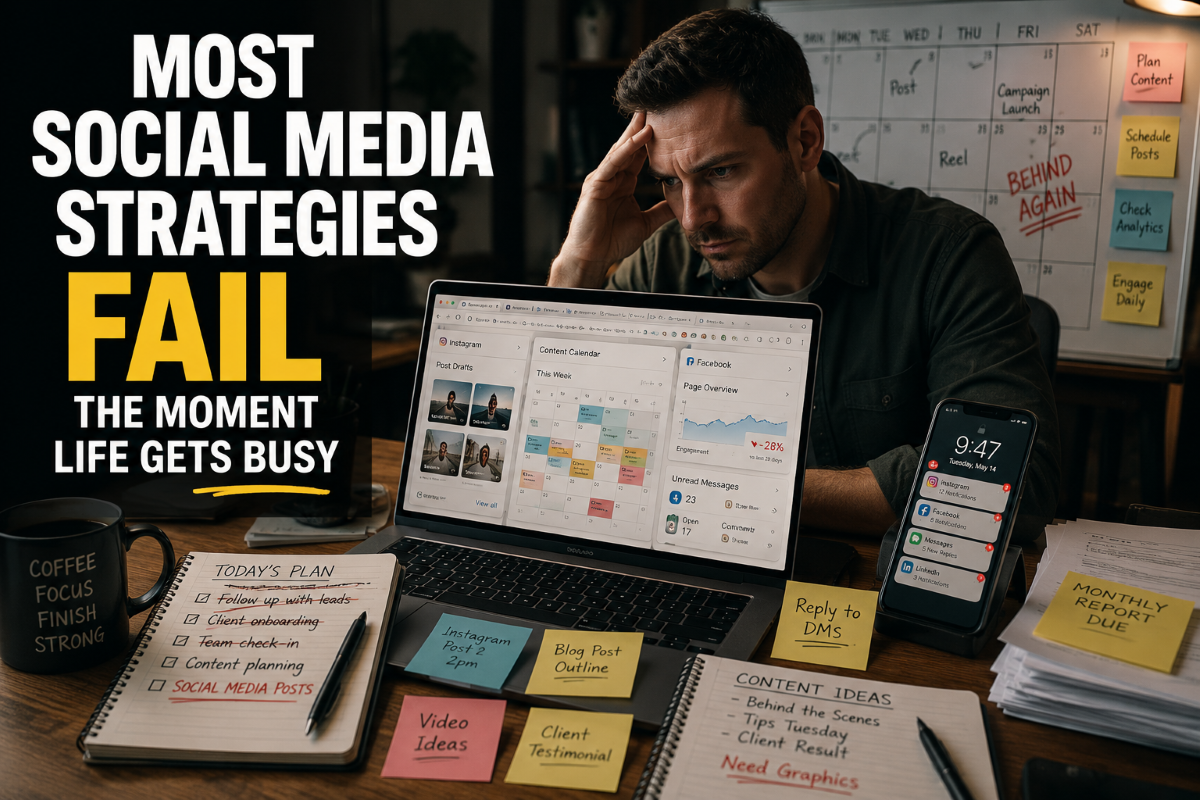
At some point, you’ve probably looked for a strategy.
You’ve read articles, watched videos, and maybe even tried to follow a content plan. And on the surface, it all makes sense. Define your audience, choose your platforms, create valuable content, and stay consistent.
The advice isn’t wrong.
Most social media advice assumes you already have the time, structure, and operational capacity to execute consistently. Many small businesses do not.
It’s incomplete.
Most strategies focus on what to do, but they don’t address how the work actually gets done on a daily basis. They assume you already have the structure in place to execute consistently.
That’s where things break.
You end up with a plan, but no system to support it. So execution still depends on your time, your memory, and your availability. And when those shift, the strategy collapses with them.
This gap shows up in a few clear ways:
You know what kind of content you should create, but not when or how it fits together
You have ideas, but no structure to turn them into consistent output
You understand engagement matters, but you don’t have a process to manage it
You follow a plan for a short time, then fall out of it
The strategy exists.
The execution doesn’t hold.
That’s why many small businesses feel like they’ve “tried social media” and it didn’t work. In reality, they never had a system strong enough to carry the strategy long enough to see results.
Because a strategy without structure is fragile.
It works when conditions are perfect.
And breaks the moment your attention moves elsewhere.
How to Build a Social Media Strategy That Actually Works
A strategy only works when it can actually be maintained. That’s where most small businesses get stuck.

They know they should post consistently. They know they need engagement, follow-up, and visibility. But the execution falls apart because everything still depends on memory, scattered tools, and finding time in the middle of an already overloaded day.
So instead of building momentum, they keep restarting.
A working strategy connects direction with execution.
It gives you a clear plan for what to post, how to stay consistent, and how to keep communication moving without everything relying on you remembering the next step.
That starts with a few foundational pieces.
First, your content needs structure. Not random ideas or last-minute posts, but clear content categories tied to what your audience actually cares about. This removes the daily pressure of figuring out what to post.
Second, your execution needs consistency. Content should be planned ahead of time. Messages and follow-ups should have a process behind them. Engagement should not depend on whether you happen to remember to check notifications between everything else on your plate.
Third, you need visibility into what is actually working. You should be able to see which content creates engagement, which conversations turn into leads, and where momentum is building so improvement stops feeling like guesswork.
When those pieces are in place, social media stops feeling reactive.
It becomes part of a system that keeps moving even when your attention is pulled somewhere else.
What Changes When You Fix the Root Problem
When social media runs on manual effort, it always feels heavier than it should.
You carry the responsibility of posting, replying, planning, and keeping everything moving. Some weeks, you manage it well. Other weeks it slips. And every time it slips, you feel like you’re starting over.
That’s the cycle.
Fixing the root problem doesn’t mean doing more. It means changing how the work operates.
When structure replaces manual effort, the experience shifts.
Content doesn’t depend on your mood or availability. It follows a clear direction and continues moving even when your focus is elsewhere.
Engagement doesn’t get missed. Messages and interactions are handled through a defined process, not random check-ins.
Results become easier to understand. You can see what’s working, what’s not, and what to improve because your actions are consistent enough to produce patterns.
This is what most business owners are actually trying to get to.
Not more content. Not more activity.
Control and Clarity.
A business that no longer depends on them remembering every moving piece.
If you want your social media to stay consistent, your messages to never get missed, and your entire workflow to run without constant effort, Kyrios was built to help you stop relying on memory to keep everything moving.
Frequently Asked Questions
Why does social media fail for small businesses?
Social media often fails for small businesses because it depends on inconsistent manual effort instead of structured systems. Without workflows for content planning, engagement, and follow-up, businesses struggle to maintain momentum and visibility.
What is the biggest social media mistake small businesses make?
One of the biggest mistakes is treating social media as a task instead of a process. Many businesses post inconsistently, create content reactively, and manage engagement manually, which makes long-term growth difficult to sustain.
How can small businesses stay consistent on social media?
Small businesses improve consistency by creating repeatable systems for content planning, scheduling, engagement, and performance tracking. Structured workflows reduce the need for constant manual decision-making.
Does social media automation help small businesses?
Automation can help small businesses maintain consistency by supporting content scheduling, engagement workflows, follow-up processes, and performance tracking. Automation works best when combined with a clear content strategy.
How often should a small business post on social media?
Posting frequency depends on the platform and business goals, but consistency matters more than volume. A sustainable posting schedule supported by a structured workflow is typically more effective than inconsistent bursts of activity.