Did You Blow Up The Internet?
The content you were looking for couldn't be found. Try something else below!

What’s Actually Causing the Constant Chaos in Your Business?
You check your phone before you even make coffee. A lead came in last night. A client replied to a message no one saw. Someone on the team is asking, “What’s next on this?” And somewhere in the back of your mind, there’s that familiar question:
“What am I forgetting?” That’s how business chaos usually feels. Not dramatic. Not explosive. Just constant.
A missed follow-up here. A delayed update there. A task that was mentioned but never assigned. A project that stalled because everyone thought someone else had it. By noon, you’re not leading the business anymore. You’re chasing it.
Most owners blame themselves when this happens. They think they need to be more organized. More disciplined. More on top of things. But in many growing businesses, the problem is not the owner’s effort.
The problem is that the business has outgrown the systems holding it together. When follow-ups live in your head, messages are scattered across tools, tasks move through verbal handoffs, and your team relies on you to clarify every next step, chaos becomes predictable. The business may keep moving, but only because you’re pushing it forward.
That is the real issue. Your business is not chaotic because you’re bad at running it. It feels chaotic because too much of the business depends on memory, manual checking, and you being available to catch what slips.
This article will break down what is actually causing the daily fires, why more effort rarely fixes them, and what your business needs instead if you want smoother, more predictable operations.

What Is Operational Chaos in Business?
Operational chaos happens when the everyday work of the business moves through memory, scattered tools, verbal instructions, and manual follow-up instead of clear, connected systems.
It is not one big problem. That’s what makes it frustrating. It shows up as small things that keep repeating. A lead does not get a response. A client waits too long for an update. A task is discussed in a meeting but never assigned. A team member asks where something stands, and no one has a clear answer.
At first, these issues look random. After a while, you start to see the pattern. The business is moving, but the process behind the work is not clear enough to keep up.
Operational chaos often looks like:
missed follow-ups
scattered customer messages
Unclear task ownership
Too many disconnected tools
projects getting stuck without anyone noticing
Customers waiting for updates
Team members are asking the same questions
The owner becomes the default problem-solver
The hardest part is that the business may still look fine from the outside. Customers are being served. Work is getting done. Revenue is coming in.
But behind the scenes, everything takes more effort than it should. That is the real cost of operational chaos. It makes normal work feel heavier. It turns simple handoffs into interruptions. It turns minor delays into fires. It forces the owner to become the safety net for every process that should already be running on its own.

Why Growing Businesses Become Chaotic
When your business was smaller, keeping everything in your head probably worked. You knew every customer. You remembered who needed a call back. You could glance around the office and instantly know what was happening. There were fewer moving parts, fewer people, and fewer opportunities for something to fall through the cracks.
Then the business started growing. More customers meant more conversations. More employees meant more handoffs. More services meant more tasks, more deadlines, and more decisions. To keep up, you added software, hired people, and created new processes. Each change solved one problem, but it also introduced new complexity.
Growth itself isn't the problem. The problem is that every stage of growth increases the number of connections your business has to manage. Information has to move between people. Tasks have to move from one stage to the next. Customers expect timely updates. Team members need clarity. Payments, appointments, projects, and communications all need to stay synchronized.
If your systems don't evolve as quickly as your business does, those connections begin to break.
That's when owners start feeling like they're working harder than ever but accomplishing less. Instead of creating space to focus on strategy, growth creates more interruptions. Every new customer, employee, or service adds another opportunity for work to stall unless someone manually keeps it moving.
Many business owners assume this means they've reached their limit. In reality, they've reached the limit of their operational systems.
This is a common turning point for businesses generating between $500,000 and $3 million in annual revenue. They have enough customers and enough staff to create complexity, but not enough operational infrastructure to manage that complexity consistently. The owner naturally fills those gaps, becoming the person who remembers, checks, reminds, clarifies, and follows up on everything.
That's why growth often feels heavier instead of easier. The business didn't become chaotic overnight. It simply grew beyond the systems that were holding it together.
The Real Root Cause: You Became the System
Most business owners think they have a time problem. Or a staffing problem. Or a communication problem.
In reality, those are often symptoms of something much deeper. The real problem is that somewhere along the way, you became the operating system for your business.
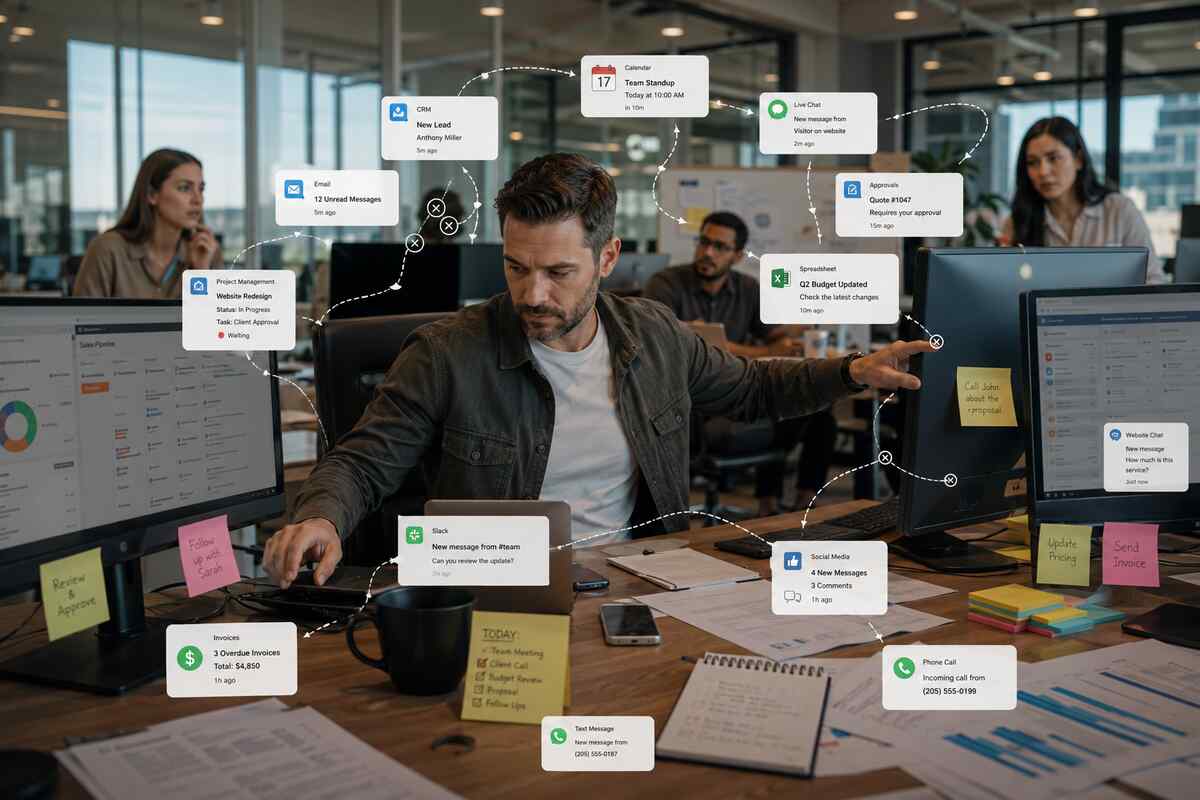
You remember which prospects need a follow-up. You know which projects are waiting on approval. You remind employees about deadlines. You answer the "quick questions." You notice when something falls through the cracks. You connect information between tools that don't communicate with each other. You aren't just running the business anymore. You're holding it together.
At first, this feels normal. It's part of being an owner. You care deeply about your customers, your team, and the reputation you've worked hard to build. So when something needs attention, you naturally step in.
Over time, however, that habit becomes the way the business operates. Instead of processes moving work forward, they wait for you. Instead of systems creating accountability, people look to you for direction. Instead of information flowing automatically, it flows through your memory.
Without realizing it, you become the central hub through which every important decision, conversation, approval, and follow-up must pass.
That's why stepping away for even a day can feel impossible. When you take a vacation, work slows down. When you're in meetings, decisions pile up. When you're sick, projects stall.
When you simply want an afternoon to think strategically, your phone keeps buzzing with questions that someone else should have been able to answer.
This isn't a reflection of your leadership. It's a reflection of your operational infrastructure.
A healthy business doesn't depend on one person remembering everything. It relies on systems that consistently move work forward, regardless of who is in the office that day.
One of the biggest mindset shifts a business owner can make is realizing this:
You are not supposed to be the system. Your role is to provide vision, make important decisions, coach your team, and guide the future of the business. The system's role is to handle the repeatable work: assigning tasks, triggering follow-ups, keeping communication organized, tracking progress, and making sure nothing falls through the cracks.
When those responsibilities stay on your shoulders, growth becomes exhausting. When they move into well-designed systems, your role changes. You stop spending your day reacting to problems. You start spending it leading the business.
That's the difference between a business that constantly feels fragile and one that continues moving forward, even when you're not personally pushing every task across the finish line. This shift is central to Kyrios' philosophy: business owners shouldn't have to be the bottleneck. Systems should carry the operational load so owners can return to leading instead of constantly firefighting.

The Operational Gaps That Create Daily Fires
Daily chaos rarely comes from one catastrophic failure. More often, it grows out of small operational gaps that quietly repeat throughout the day. Each one seems manageable on its own. Together, they create a business that constantly feels reactive.
The challenge is that these gaps often remain invisible. Business owners become so accustomed to working around them that they begin to see them as a normal part of running a company. In reality, they're symptoms of operational systems that haven't kept pace with the business.
Follow-Up Depends on Memory Instead of a System
Every business depends on follow-up. Prospective customers need timely responses. Existing customers expect updates. Invoices need to be sent. Appointments need to be confirmed. Reviews need to be requested. Vendors need replies. Team members need reminders.
When those activities depend on someone remembering to take the next step, inconsistency becomes inevitable.
No matter how organized you are, memory isn't a reliable workflow. It works until you're interrupted by an urgent phone call, an unexpected customer issue, or a dozen "quick questions" from your team. Before long, something important slips through the cracks.
Many owners assume they have a discipline problem when they miss a follow-up. More often, they have a system problem. If your business relies on memory to move work forward, it will eventually disappoint both you and your customers.
Communication Lives in Too Many Places
Most growing businesses communicate everywhere.
Customer conversations happen through email, text messages, Facebook Messenger, Instagram, phone calls, website chat, and review platforms. Internal conversations happen through Slack, Microsoft Teams, text messages, hallway conversations, and sticky notes.
Each communication channel works independently. None of them provide a complete picture of what's happening.
The result is predictable. Someone replies in one place without realizing another team member already handled the conversation somewhere else. A customer receives inconsistent information. A message sits unanswered because everyone assumes someone else responded.
The problem isn't the number of communication channels. The problem is that they're disconnected.
Ownership Isn't Always Clear
One of the fastest ways for work to stall is when everyone believes someone else is responsible.
A task gets mentioned during a meeting but never formally assigned. A project reaches the next stage, but nobody knows who should move it forward. A customer request is acknowledged, but no one owns the follow-up.
When responsibility isn't clearly defined, accountability disappears. Business owners often find themselves asking the same questions every day.
"Has this been completed?"
"Who's handling this?"
"Where are we with that project?"
Those questions aren't signs of poor leadership. They're signs that the workflow isn't providing enough visibility for everyone involved.
Your Tools Don't Work Together
Many businesses don't suffer from a lack of software. They suffer from having software that works in isolation.
The CRM stores customer information. The project management platform tracks tasks. The scheduling software books appointments. Accounting manages invoices. Marketing sends emails.
Individually, each tool performs its job well. Collectively, they create more work because information has to be manually transferred from one system to another. Team members update multiple platforms with the same information. Owners jump between browser tabs trying to piece together the full picture. Instead of reducing complexity, disconnected tools often multiply it.
The Owner Becomes the Default Problem Solver
As operational gaps grow, something interesting begins to happen. Every unanswered question eventually finds its way back to the owner.
Employees ask for clarification because the process isn't documented. Customers ask for updates because no automated communication exists. Projects wait because someone needs approval. Deadlines get checked because nobody trusts the workflow enough to let it run on its own.
Without intending to, the owner becomes the backup plan for every weakness in the operation. That creates an exhausting cycle. The more problems flow through the owner, the less time they have to improve the business. And because they have less time to improve the business, the same problems continue appearing tomorrow.
There Is No Single Source of Truth
Perhaps the biggest operational gap of all is the absence of one reliable place where everyone can see what is happening.
When customer information lives in one system, tasks live in another, conversations happen somewhere else, and project updates exist only in someone's memory, the business loses visibility.
Nobody feels fully confident. The owner double-checks everything. Employees interrupt each other for updates. Customers wait longer than necessary because information takes too long to find.
This is where operational chaos becomes self-perpetuating. Every missing piece of information creates another interruption. Every interruption creates another opportunity for work to slow down.
Over time, these operational gaps don't simply create more work. They fundamentally change the owner's role. Instead of leading the business, they spend their days connecting disconnected pieces that should have been connected from the start.

Why More Effort Does Not Fix Operational Chaos
When a business starts feeling chaotic, most owners respond the same way. They work longer hours. They wake up earlier. They stay later. They check their inbox one more time before bed. They become more involved in projects, follow up more often, and try to keep a closer eye on everything happening across the business.
It feels like the responsible thing to do. The problem is that more effort only treats the symptoms. It doesn't address the underlying cause.
Imagine a bucket with several small holes in the bottom. Pouring water into it faster won't keep it full. You'll simply work harder while the water continues leaking out. The same thing happens in a business with operational gaps. The harder you work, the more you compensate for broken processes instead of fixing them.
This is why so many business owners feel trapped. They're incredibly productive, yet they rarely feel like they're making meaningful progress.
Their days are filled with activity:
answering questions from the team
checking whether tasks were completed
reminding people about deadlines
searching for customer information
following up on work that should already be moving
resolving issues that could have been prevented
At the end of the day, they're exhausted. Yet the important work they wanted to accomplish, whether it was improving the business, developing new services, strengthening customer relationships, or planning for growth, remains untouched.
This creates a frustrating cycle. The more the business depends on the owner to keep everything moving, the less time the owner has to improve the systems that would reduce that dependence. As a result, the business becomes even more reliant on the owner's time and attention.
Over months and years, this cycle begins to shape how the business operates. Employees learn to wait for the owner's approval before taking the next step. Customers expect delays because responses aren't always consistent. The owner becomes the unofficial project manager, customer service representative, operations director, and quality control department all at once.
It's easy to mistake this for strong leadership. In reality, it's a sign that the business lacks the operational infrastructure needed to function independently.
One of the most important mindset shifts a business owner can make is recognizing that working harder is not the same as building a stronger business.
Strong businesses are not built on extraordinary effort alone. They are built on repeatable systems that produce consistent results, regardless of who is having a busy day, taking a vacation, or handling an unexpected emergency.
That's why solving operational chaos isn't about becoming more organized or more disciplined. It's about designing processes that reduce the amount of effort required in the first place.
When routine work is supported by clear workflows, automated follow-ups, connected communication, and defined ownership, the owner no longer has to carry the business through sheer determination.
Instead of asking, "How can I keep up with everything?" the better question becomes, "How can the business keep moving without depending on me for every next step?"
That single shift in thinking changes everything. It moves the conversation away from personal productivity and toward operational design. And that's where lasting improvements begin.

Why Hiring More People May Not Solve the Problem
When the pressure keeps building, hiring another employee often feels like the obvious solution. After all, if there's more work than your current team can handle, adding another person should reduce the workload. Sometimes that's true. But many business owners discover that hiring doesn't eliminate the chaos. It simply changes its shape.
The reason is simple. People don't fix broken systems. They work within them. If follow-up depends on memory today, adding another employee means there's now one more person who might forget. If communication is scattered across six different platforms, you've just introduced another person who has to monitor those same six platforms. If tasks aren't clearly assigned, you've increased the number of people who might assume someone else is handling them.
The underlying problem remains exactly the same. In fact, complexity often grows faster than the team itself. Every new hire introduces additional communication, coordination, training, and accountability. They need context. They need processes. They need clear expectations. They need reliable systems that help them do their jobs consistently.
Without those systems, the owner becomes the bridge between everyone. One employee needs clarification on a project. Another needs approval before moving forward. Someone else can't find the latest customer information. Another team member isn't sure whether an invoice has been sent.
None of these interruptions seem significant on their own. Together, they consume hours every week. This is why many business owners find themselves asking a frustrating question:
"Why does it feel like I'm busier now that I've hired help?"
The answer is that you've increased your management responsibilities without reducing your operational burden. A growing team should create leverage. Instead, it often creates more coordination work because the systems haven't evolved alongside the business.
Think about it this way. Imagine adding more cars to a city where every major intersection lacks traffic lights. Congestion doesn't disappear because there are more drivers. It gets worse because the infrastructure wasn't designed to support additional traffic.
Businesses work the same way. As your team grows, your operational infrastructure becomes even more important. Clear workflows, automated handoffs, centralized communication, and defined ownership allow more people to work together without creating more confusion.
This is one reason many growing businesses feel like they've hit a ceiling. They believe the next stage of growth requires hiring more people. In reality, the next stage often requires building better systems first. That doesn't mean hiring is the wrong decision.
Talented people are one of the greatest investments a business can make. But those people deliver their best work when they're supported by processes that eliminate unnecessary friction.
Instead of spending their day chasing information, asking for updates, or waiting for approvals, they can focus on serving customers, solving problems, and creating value.
For business owners, this changes the role of hiring entirely. Instead of adding people to compensate for inefficient operations, you're adding people to expand what a well-organized business is capable of achieving.
That's a very different kind of growth. It also explains why so many successful businesses don't necessarily have the largest teams. They have the clearest systems.
When the operational foundation is strong, every new employee increases capacity instead of increasing complexity. The business becomes easier to scale because growth is supported by structure, not by asking more people to work harder.

Why More Tools Can Make the Chaos Worse
When the chaos doesn't go away, the next instinct is usually to buy another tool. A CRM promises better customer management. A project management app promises better accountability. A scheduling tool promises fewer missed appointments. An automation platform promises to save time.
Each one solves a specific problem. But together, they often create a new one. Instead of making work simpler, they scatter it.
Customer information lives in one platform. Tasks live in another. Communication happens somewhere else. Payments are tracked separately. Before long, your team spends more time switching between tools than serving customers.
The problem isn't that you have too much software. The problem is that your software doesn't work together.
Think about what happens when a new lead comes in. Someone has to check the CRM, send a follow-up email, assign a task, update a spreadsheet, notify the team, and schedule the next step. If those actions aren't connected, people become responsible for connecting them manually.
That's where things start falling through the cracks. A missed update here. A forgotten task there. An email that never gets sent. A customer waiting longer than they should.
None of these problems happen because your team doesn't care. They happen because disconnected systems create disconnected work. More software doesn't automatically create better operations. Connected systems do.
When your tools share information and trigger the next step automatically, work keeps moving without someone constantly checking, reminding, or chasing updates. Your team spends less time managing technology and more time helping customers. Technology should reduce your workload, not become another thing you have to manage.
How Kyrios Systems Helps Bring Order to the Chaos
If you've recognized your business in the examples throughout this article, the good news is that operational chaos isn't permanent.
The goal isn't to work harder, hire faster, or buy another disconnected tool. It's to build a business where work moves forward through clear systems instead of constant supervision.
That's the philosophy behind Kyrios Systems. Kyrios is designed to help small businesses replace scattered processes with connected workflows, so your team spends less time chasing information and more time serving customers.
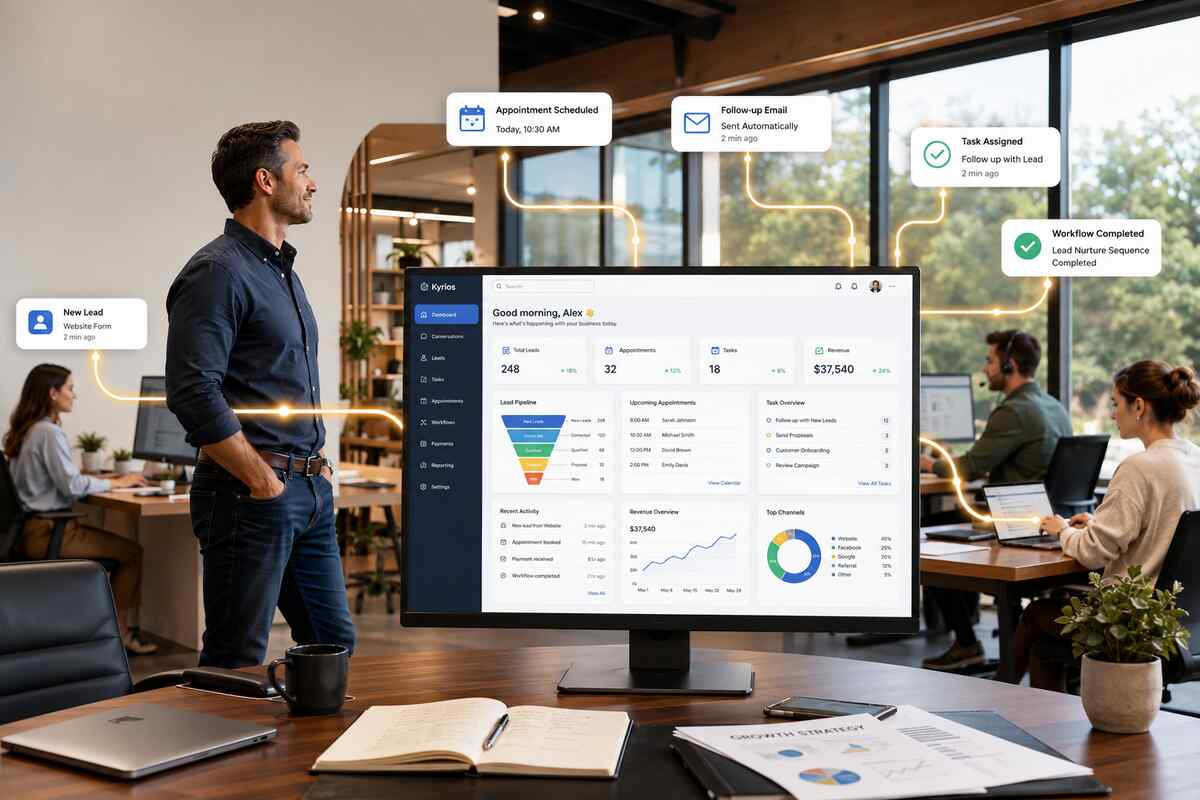
Instead of relying on multiple disconnected platforms, Kyrios brings the essential parts of your operations into one connected system. Customer communication, lead management, tasks, appointments, workflows, payments, reporting, and automation work together to support the way your business operates.
More importantly, Kyrios helps eliminate many of the operational gaps that create daily fires.
For example, you can:
Capture and organize every lead in one place.
Automate follow-up so prospects don't slip through the cracks.
Assign tasks automatically when the next step is triggered.
Keep customer conversations connected instead of scattered across multiple platforms.
Give your team clear visibility into what needs to happen next.
Track progress without constantly asking for status updates.
Build repeatable workflows that create consistency across your business.
The result isn't simply better organization. It's a business that requires less manual coordination.
Instead of reminding people what to do, your systems help guide the work. Instead of checking multiple apps for updates, you have one place to see what's happening. Instead of carrying every operational detail in your head, your business has processes that keep moving, even when you're focused elsewhere.
That doesn't mean technology replaces people. It means technology removes the repetitive work that keeps talented people from doing their best work.
Your team spends less time searching, checking, reminding, and following up. They spend more time helping customers, solving problems, and growing the business. And perhaps the biggest benefit isn't operational at all.
It's personal. When your business no longer depends on you to remember every detail or push every task forward, you gain something many business owners haven't experienced in a long time.
Space to think. Space to lead. Space to focus on the future of your business instead of constantly reacting to the present. That's what operational systems are really designed to create.

Chaos Is a Signal, Not a Character Flaw
If your days feel like one fire after another, don't blame yourself. The constant interruptions, forgotten follow-ups, and endless questions aren't signs that you're failing. They're signs that your business has outgrown the systems supporting it.
The encouraging part is this: systems can change. Every workflow you improve, every repetitive task you automate, and every disconnected process you bring together makes your business a little easier to run. Over time, those small improvements create a big shift.
Your team works with more confidence. Your customers enjoy a more consistent experience. And you spend less time reacting to problems and more time leading the business.
That's what every business owner wants. Not a business that depends on them every minute of every day, but one that continues moving forward because the right systems are doing the heavy lifting.
The goal isn't to eliminate hard work. It's to eliminate unnecessary work. When your operations are connected, your business becomes more predictable, your team becomes more effective, and growth becomes far less stressful.
So if you're constantly putting out fires, don't ask yourself, "How can I work harder?"
Ask a better question.
"Which system is missing?"
The answer to that question is often the first step toward building a business that grows with you instead of depending on you.

(205) 736-8422
1236 Blue Ridge Blvd,
Hoover, AL 35226




Copyright Kyrios Systems 2026 - All Rights Reserved | Privacy Policy | Terms and Conditions
1236 Blue Ridge Blvd, Hoover, AL 35226
Download the Kyrios app now
(205) 736-8422
1236 Blue Ridge Blvd,
Hoover, AL 35226

Company


