


Why Your Business Feels Chaotic (And How Automation Fixes It)
You start the day already behind. Before you even open your laptop, your mind is running through a list:
“Did we follow up with that lead?”
“Did someone send that update?”
“Did anything slip yesterday?”
Then the day begins. Messages come in from everywhere. Email. Text. DMs. A missed call. A team member asks, “Got a minute?” You answer one thing, then another. You check a task, reply to a client, fix a small issue, and jump to the next.
By the end of the day, you’ve been moving nonstop. But something feels off. You were busy the entire time, yet nothing feels finished. You’re not fully confident that everything got handled. And there’s always that quiet question in the background:
“What did I miss?” This is where most business owners get stuck. From the outside, things look fine. The business is running. Clients are coming in. Work is getting done. But underneath it, everything depends on you remembering, checking, and pushing things forward.
That’s the hidden weight. The follow-ups live in your head. The tasks move because you move them. The business works… because you’re holding it together. And that creates a constant, low-level pressure that never really turns off. It’s not a time problem. It’s not a motivation problem.
It’s what happens when a business grows faster than the systems supporting it. When there’s no real structure behind the scenes, the owner becomes the structure. Every detail, every next step, every “don’t forget” moment runs through you first.
That works for a while. Until it doesn’t.

Why Your Business Feels Chaotic (Even If It’s Growing)
At first, growth feels like progress. More clients. More revenue. More opportunities. On paper, everything is moving in the right direction.
But behind the scenes, something starts to shift. The day gets more crowded. More conversations to track. More tasks to manage. More moving parts that need to stay aligned. What used to feel manageable now feels… messy.
You start noticing small cracks:
A lead doesn’t get a reply right away
A task sits longer than it should
A client asks for an update, you thought someone had handled
Nothing breaks completely. But everything requires more attention than it used to. That’s the turning point most business owners don’t see clearly. Growth doesn’t just add revenue. It adds complexity.
Every new client introduces:
more communication
more follow-up
more coordination
Every new team member introduces:
more handoffs
more chances for misalignment
more dependency on clear processes
And every new tool you add to “fix” things often creates a new layer:
another inbox
another place to check
another system that doesn’t fully connect
So instead of things becoming smoother, they become fragmented.
You end up with:
messages in multiple platforms
tasks in different tools
information spread across systems
And no single place where everything comes together. At that point, the business doesn’t run on structure. It runs on awareness.
You’re the one connecting the dots:
remembering what needs follow-up
checking if something was completed
filling in the gaps between tools
That’s why it feels chaotic. Not because you’re disorganized. But because the business has outgrown the way it’s being managed.
When systems don’t evolve with growth, the workload doesn’t disappear. It shifts onto the owner. Quietly. Gradually. Until every part of the business depends on your attention to keep moving. And that’s when the days start to feel reactive instead of controlled.

The Real Problem: You Became the System
Most business owners think the problem is scattered tools, missed follow-ups, or a team that needs more structure. Those are real issues. But they’re not the root problem.
The real problem is this:
You became the system. It didn’t happen overnight. It happened gradually.
At first, you were just staying on top of things:
replying quickly
double-checking tasks
making sure clients were taken care of
That worked when the business was smaller. But as things grew, that habit turned into responsibility.
Now you’re the one who:
remembers what needs follow-up
notices when something slips
connects conversations across tools
moves work forward when it stalls
You’re not just running the business. You’re holding it together. That creates a hidden dependency. If you remember, things move.
If you forget, things stall. If you’re available, progress continues. If you’re busy, things slow down. If you step away, even briefly, the cracks start to show. This is why everything feels heavier than it should. Because the business doesn’t have a true operating system. It has you.
Your brain is tracking:
open loops
pending tasks
client expectations
team responsibilities
next steps that no system is enforcing
That’s not leadership. That’s mental load. And it’s exactly what creates the constant pressure you feel throughout the day. The sense that you can’t fully switch off. The quiet worry that something important might slip if you’re not paying attention.
This is a common pattern in growing businesses. When there’s no central system connecting everything, the owner becomes the connection point. Every task, message, and process flows through them by default.
It works for a while because you’re capable. But it doesn’t scale. Eventually, the business reaches a point where effort isn’t enough. You can’t remember more, check more, or work harder to fix it.
That’s when the chaos becomes visible. Not because the business is failing. But because it’s outgrown a system that never existed.

Common Business Pitfalls That Create Daily Chaos
By this point, the chaos isn’t random. It follows patterns. The same issues show up again and again, just in slightly different forms. A missed message here. A delayed task there. A client waiting longer than they should. It feels unpredictable, but it’s not.
It’s structural. Once you start looking closely, you’ll see a handful of repeatable problems driving most of the pressure in your day.
The Follow-Up Gap
This is where money quietly disappears. A lead comes in. You intend to reply. Something interrupts you. You come back later… or forget entirely.
Or someone on your team was supposed to follow up, but:
they assumed someone else handled it
the message got buried
there was no clear next step
No one notices right away.
But over time, this creates:
lost deals
slower conversions
inconsistent client experience
Follow-up fails because it depends on memory, not the system.
Scattered Communication
Your conversations live everywhere.
Email
Text messages
Social media DMs
Calls and voicemails
Internal chats
Each one holds part of the story.
But none of them connect.
So when you need context, you’re forced to:
search multiple platforms
piece together conversations
ask your team for updates
This leads to:
missed messages
delayed responses
duplicated replies
Everything is technically “handled,” but nothing feels fully under control.
The “Who’s Doing What?” Problem
Tasks exist, but ownership doesn’t. Something gets mentioned in a meeting or message. It sounds clear in the moment. Then the day moves on.
Later, you’re asking:
“Is that done?”
“Who’s handling this?”
“Where are we with this project?”
And your team is wondering the same thing.
Without clear assignment and visibility:
tasks get forgotten
work gets duplicated
projects stall without warning
So you step in. Not because you want to micromanage, but because you don’t trust that things are moving without you checking.
Constant Firefighting
Most days don’t go as planned.
Something always comes up:
a client didn’t get a response
a task wasn’t completed
a detail was missed
a miscommunication created confusion
None of these issues are major on their own. But together, they create a pattern.
Your day shifts from:
planned → reactive
Instead of building, you’re fixing. Instead of moving forward, you’re catching up. And by the end of the day, you feel busy… but not productive. Tool Overload Without Connection
At some point, you tried to fix these problems.
So you added tools.
A CRM for leads
A project tool for tasks
A scheduler for appointments
Messaging apps for communication
Each one solves a piece of the problem. But none of them fully connect.
So now you’re dealing with:
multiple logins
multiple dashboards
multiple versions of the same information
You end up switching between tabs just to understand what’s happening.
And worse, you become the bridge between those tools:
copying information
updating multiple systems
manually triggering next steps
The tools don’t reduce the workload. They shift it.
The Pattern Behind All of This
These aren’t isolated issues. They’re all symptoms of the same underlying problem. There’s no system ensuring that work moves forward.
So everything depends on:
someone remembering
someone checking
someone following up
And most of the time, that someone is you. These patterns show up in almost every growing business that lacks connected systems. Communication fragments, tasks lose visibility, and progress depends on manual effort instead of structured workflows.
That’s why the chaos feels constant. Because it is. Until something changes underneath it.

What This Chaos Actually Costs You
At a glance, the business is still running. Clients are coming in. Work is getting done. Revenue is moving. That’s why this stage is so dangerous.
Because the real cost of chaos doesn’t show up all at once. It builds quietly, underneath the surface, until it starts affecting everything.
The Operational Cost
This is where most people first notice something is wrong.
Leads don’t get followed up consistently
Projects take longer than they should
Tasks need to be redone or clarified
Communication gaps create small mistakes
None of these feel catastrophic. But they compound. A missed follow-up here turns into lost revenue. A delayed task slows down delivery. A small mistake affects the client experience. Over time, the business becomes less efficient without anyone clearly seeing why.
The Emotional Cost
This is the part no one talks about enough. You carry the business in your head.
Even when you’re not working, you’re thinking:
“Did we handle that?”
“Did someone follow up?”
“What am I forgetting?”
That constant background noise drains you.
It affects:
your focus
your energy
your ability to make clear decisions
You’re always slightly on edge. Not because something is wrong, but because something might be. That’s the weight of running a business without systems.
The Strategic Cost
This is where growth starts to stall.
You know what you should be doing:
planning
improving processes
building new opportunities
leading your team
But most of your time goes to:
answering questions
fixing issues
checking on progress
handling “quick things” that aren’t quick
So the business stays in motion… …but it doesn’t move forward. You’re working hard, but you’re not gaining ground. This is the trap many business owners fall into: busy every day, but no real progress over time.
The Hidden Cost: You Become the Bottleneck
At some point, everything starts routing through you.
Not by design, but by necessity.
Your team waits for:
clarification
decisions
approvals
Work pauses until you step in. That creates a ceiling. Because no matter how capable your team is, the business can only move as fast as you can respond. And that’s not scalable.
The Bigger Picture
When you step back, the pattern becomes clear.
Operational issues slow things down
Emotional pressure builds in the background
Strategic work gets pushed aside
Growth becomes harder than it should be
All of this comes from the same root:
The business depends on constant human attention to function. That’s why it feels heavy. And that’s why working harder doesn’t fix it.
What Workflow Automation Actually Means (Beyond Tools)
At this point, most people start thinking:
“Okay, I need automation.” And that’s where things usually go wrong. Because automation gets misunderstood.
It’s often reduced to:
email sequences
marketing campaigns
a few integrations between tools
Helpful? Yes. Enough to fix the chaos? Not even close.
What Automation Actually Is
Automation isn’t about adding tools. It’s about removing manual dependency.
At its core, workflow automation means this: Work moves forward without someone needing to remember, check, or push it. That’s the shift.
Instead of relying on:
“Did someone follow up?”
“Did we assign that task?”
“What happens next?”
The system handles it. Automatically.
A Simple Way to Think About It
Right now, your business likely works like this:
A lead comes in → you notice it → you respond
A task is mentioned → someone remembers → it gets done
A project step finishes → someone manually moves it forward
Everything depends on awareness.
With automation, it changes:
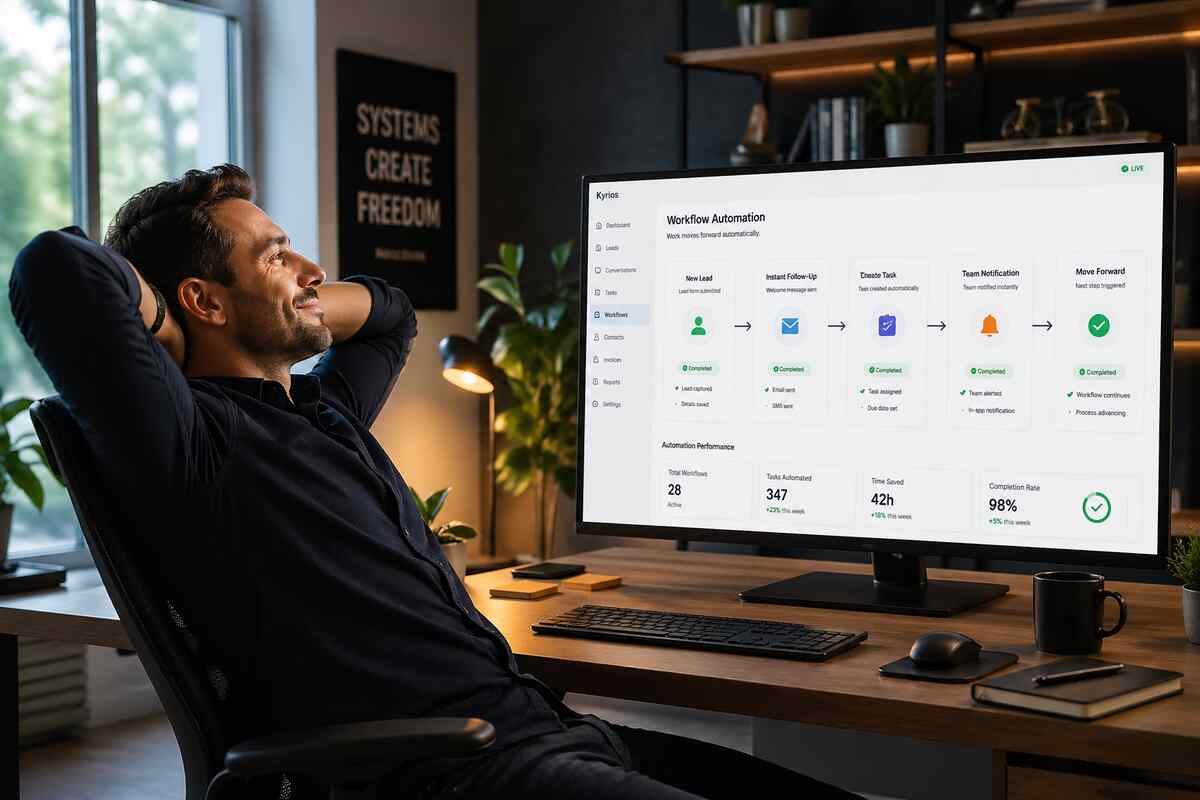
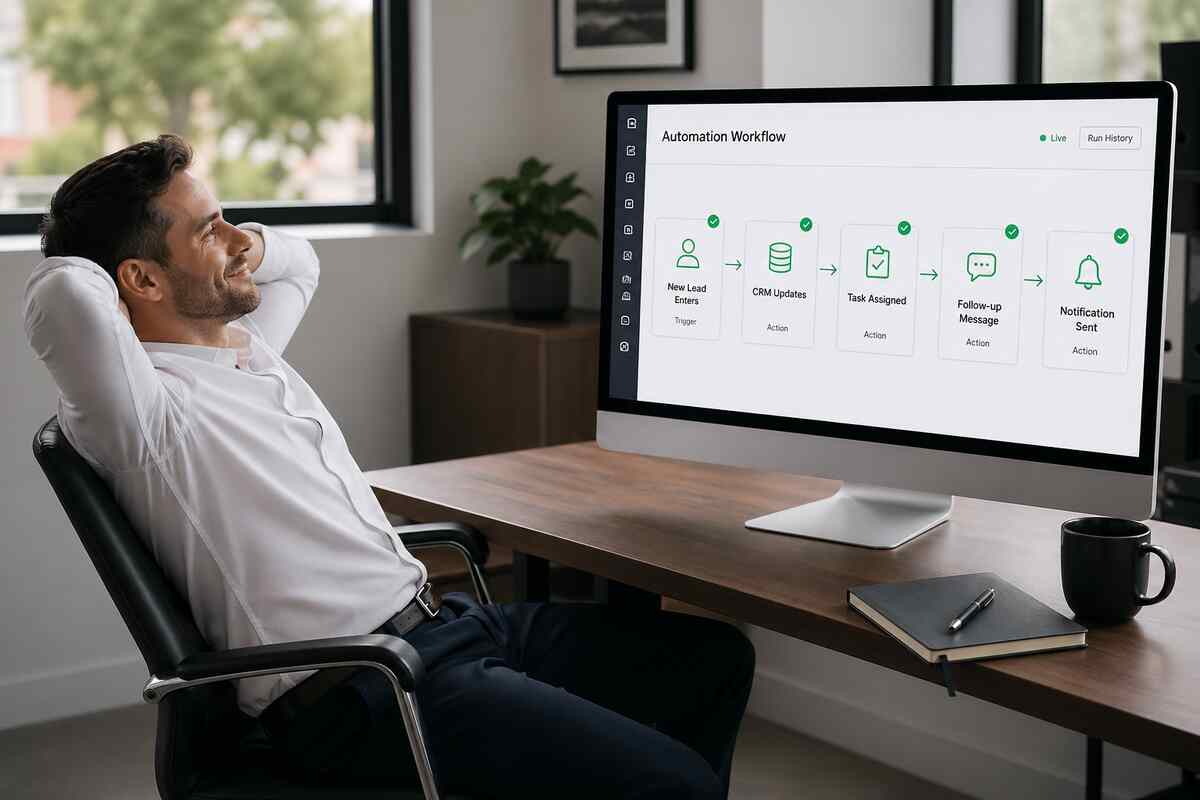
A lead comes in → follow-up is sent automatically → task is created
A task is completed → next step is assigned instantly
A client message arrives → it’s logged, tracked, and visible to the team
No chasing. No guessing. No relying on memory. The system carries the flow of work.
Why This Matters More Than It Seems
This isn’t just about saving time. It’s about removing uncertainty.
Right now, you’re constantly asking:
“Did that happen?”
“Did someone take care of it?”
Automation replaces that question with confidence. Because the process doesn’t depend on someone remembering. It’s built into how the business operates.
The Key Shift: From Manual to Structured
Most businesses operate in a manual loop:
notice → act → check → follow up → repeat
That loop lives in your head.
Automation turns that into a structured system:
trigger → action → next step → completion
Once that structure exists:
tasks don’t disappear
follow-ups don’t get missed
communication doesn’t scatter
The system enforces consistency.
What Automation Is Not
It’s important to be clear here.
Automation is not:
adding more software
building complex workflows you don’t understand
replacing people
And it’s definitely not about making things feel more technical or complicated. Done right, automation makes the business feel simpler. Less to track. Less to remember. Less to worry about.
That aligns directly with the goal of simplifying operations and reducing chaos across the business.
The Real Outcome
When automation is set up properly:
Work continues even when you’re not thinking about it
Your team knows what to do without constant direction
Follow-ups happen without reminders
Nothing depends on your memory to move forward
That’s when the business starts to feel different. Not faster. Not busier. Just… controlled.
How Automation Fixes the Chaos
Up to this point, the problem is clear. The business feels chaotic because everything depends on manual effort. You’re tracking, checking, and pushing work forward just to keep things moving.
Automation changes that. Not by making you work faster, but by changing how work moves in the first place.
It Removes the Mental Load
Right now, your brain is doing too much.
It’s holding:
open loops
pending tasks
follow-ups you “need to remember”
things you plan to check later
That’s where most of the stress comes from. Automation offloads that.
Instead of thinking, “I need to follow up tomorrow”
The system handles it:
follow-up is scheduled
reminder is triggered
task is created automatically
You don’t have to carry it anymore. That mental space comes back to you.
It Connects Your Business
One of the biggest sources of chaos is disconnection. Your CRM knows one thing. Your task manager knows another. Your messages live somewhere else. Automation connects these pieces.
So instead of jumping between tools:
a new lead updates your CRM
triggers a follow-up
assigns a task
notifies the right person
All in one flow. You stop acting as the bridge between systems. The system becomes the bridge.
It Creates Predictable Operations
Right now, work is inconsistent. Sometimes things get done immediately. Sometimes they sit. Sometimes they’re forgotten. That inconsistency creates stress.
Automation introduces structure. Every time a specific event happens, the same sequence follows.
For example:
New client signs → onboarding steps trigger
Task completed → next step assigned
Message received → logged and visible
No variation. No guessing. Work becomes predictable. And predictability is what removes chaos.
It Frees You From Being the Bottleneck
This is the biggest shift.
Without automation:
Everything flows through you.
With automation:
Work flows through the system.
That means:
your team doesn’t wait for instructions
tasks don’t stall without your input
progress doesn’t depend on your availability
You’re no longer the central point of movement. You become the overseer, not the engine.
What This Feels Like in Practice
The difference is noticeable almost immediately.
Before:
You check things constantly
You follow up manually
You worry about what’s slipping
After:
The system tracks everything
Follow-ups happen automatically
You trust that work is moving
You’re still involved. But you’re no longer carrying the business in your head. That’s the real fix. Not more effort. Not more tools. A system that runs with you, instead of because of you.
What to Automate First (A Practical Starting Point)
At this stage, the idea of automation makes sense. But this is where many business owners hesitate. Because it feels like a big shift. Like you need to overhaul everything at once.
You don’t. The goal isn’t to automate your entire business overnight. The goal is to remove the pressure points first. Start where the chaos is most visible. Where things break, get missed, or depend heavily on memory.
Lead Capture and Follow-Up
This is the highest-impact place to start. Right now, leads come in and depend on someone noticing and responding. That delay costs you.
Automate this flow:
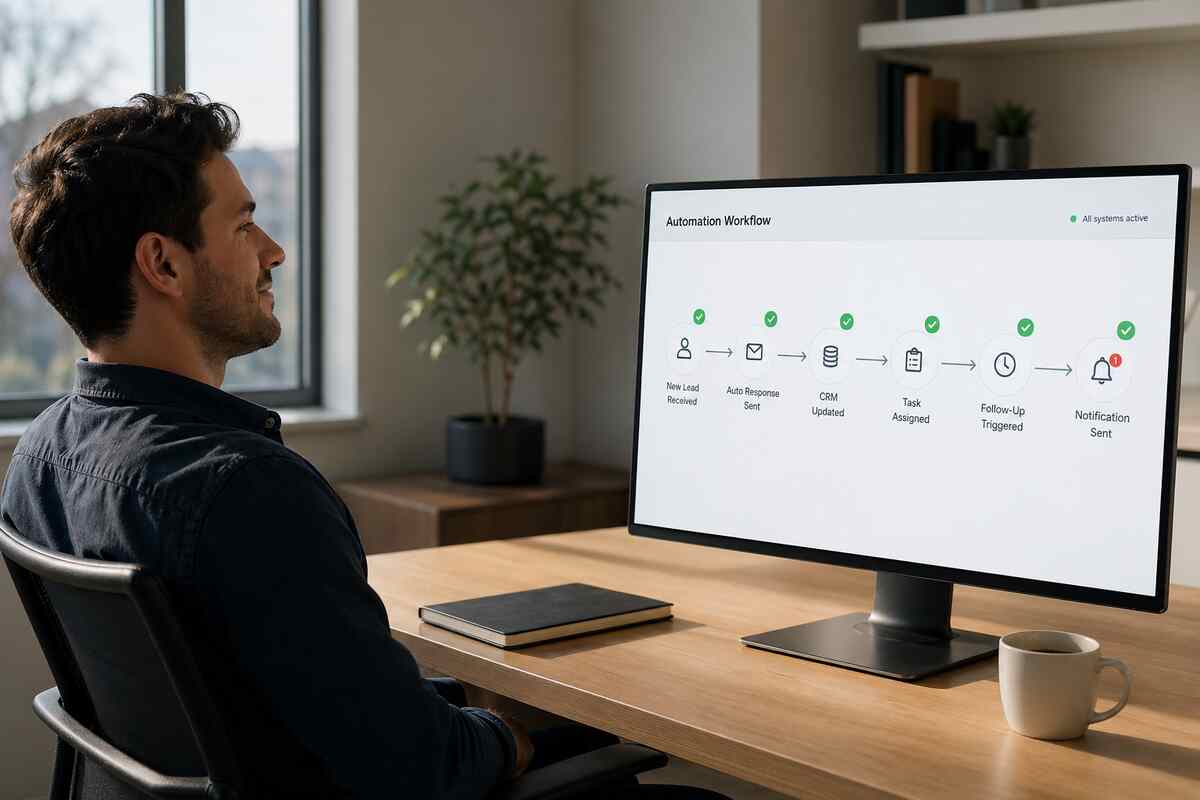
New lead comes in → instant acknowledgment sent
Lead details captured in one place
Follow-up sequence triggered
Task created if human action is needed
This ensures:
every lead gets a response
no opportunity slips through
first impressions stay consistent
Task Assignment and Handoffs
Most internal confusion comes from unclear ownership. Someone mentions a task. It gets lost in conversation. Or everyone assumes someone else is handling it. Automation fixes this by making ownership explicit.
For example:
A deal closes → onboarding task assigned
A form is submitted → task routed to the right team member
A step is completed → next person is automatically notified
Now, work doesn’t depend on someone remembering to pass it along. It moves on its own.
Client Communication Updates
Clients don’t like silence. And most of the time, delays aren’t intentional. They happen because updates aren’t triggered consistently.
Automation keeps communication steady:
Project starts → welcome message sent
Milestone reached → update sent
Delay detected → notification triggered
This builds trust without adding more work to your plate.
Scheduling and Confirmations
Back-and-forth scheduling is a quiet time drain. So are missed appointments.
Automate it:
Clients book through a system
Confirmation is sent instantly
Reminders go out automatically
Rescheduling is handled without manual coordination
This removes friction for both you and your clients.
Review and Feedback Requests
Most businesses rely on memory for this. You think, “I should ask for a review,” but it happens inconsistently.
Automation solves that:
Project completes → review request sent
Positive feedback → prompt for testimonial
No response → follow-up reminder
This turns something sporadic into a consistent growth driver. A Simple Rule to Guide You. If something in your business requires you to remember it…
…it’s a candidate for automation.
That includes:
follow-ups
reminders
task assignments
status updates
next steps
Start there.
Keep It Simple
This is where people overcomplicate things.
They try to:
automate everything at once
build complex workflows
optimize before stabilizing
That usually backfires.
Instead:
pick one area
make it reliable
then expand
Small wins here create immediate relief. And more importantly, they start shifting the business away from memory-based operations toward structured systems.

The Shift That Changes Everything
The chaos isn’t random. It’s what happens when your business runs on disconnected tools and manual effort. The fix isn’t doing more. It’s having one system that connects everything.
When your workflows, communication, leads, and tasks live in one place, the business starts to run differently. Follow-ups happen automatically. Tasks move without chasing. Your team sees what’s happening without asking.
That’s the shift. From scattered to connected. From reactive to structured.
If you’re ready for that, the Kyrios Systems Grow plan gives you an all-in-one system built to run your operations together. Instead of managing multiple tools and trying to hold everything in your head, you get one place where your business actually works as a system. That’s how you stop managing chaos. And start running with control.