


Why Your Team Keeps Asking “What’s Next?” (And How to Fix Your Business Processes)
Why Does Everyone Keep Asking “What’s Next?”
You’re in the middle of your day, juggling five different things at once, when someone on your team leans in and asks, “Hey… what’s next?”
You pause, switch context, and give them direction. It takes less than a minute, so you don’t think much of it. But ten minutes later, someone else asks a variation of the same question. Later in the afternoon, it happens again. By the end of the day, you’ve answered “what’s next?” so many times that it starts to blend into the background noise of running your business.
At first, it just feels like part of the job. You tell yourself your team just needs a bit more clarity, maybe a bit more training, maybe a bit more time to catch up. You assume this is what leadership looks like: being available, giving direction, keeping things moving.
But there’s a moment, usually after a long day, where it starts to feel heavier than that. You realize that nothing really moves unless you’re involved. Tasks stall, decisions wait, and progress slows the second your attention shifts somewhere else. Even when everyone is working hard, the business itself doesn’t feel like it’s moving forward in a clean, predictable way. It feels like it’s being pushed forward, one conversation at a time.
That’s when the question starts to change meaning.
“What’s next?” stops being a simple request for direction and starts becoming a signal. Not a loud, dramatic one, but a quiet, persistent indicator that something deeper isn’t working the way it should. It points to a kind of invisible friction inside the business—something that makes even simple work feel heavier, slower, and more dependent on you than it needs to be.
Most business owners don’t immediately recognize this for what it is. It’s easy to blame communication gaps, assume the team isn’t fully aligned yet, or think the solution is to just stay more involved. And for a while, that approach works well enough to keep things going. But over time, it comes at a cost: more interruptions, more mental load, and a growing sense that you’re holding too much of the business together in your own head.
What’s actually happening has less to do with your team and more to do with how the work itself is structured. When there’s no clear, reliable way for work to move from one step to the next, people naturally look for direction. And when that direction isn’t built into the business, it defaults to you.
This article will walk through why that happens, why it’s more common than most people realize, and how to fix it in a way that doesn’t add more complexity to your plate. Because the goal isn’t just to answer “what’s next?” faster, it’s to build a business where that question doesn’t need to be asked in the first place.
Why “What’s Next?” Is a Warning Sign (Not a Normal Question)
At first glance, “what’s next?” sounds like a healthy question. It can even feel like a sign that your team is engaged, proactive, and ready to move forward. But when that question shows up repeatedly across different people, different tasks, and different days, it stops being a positive signal and starts revealing a deeper issue in how your business operates.

In a well-structured business, the next step doesn’t rely on someone asking for it. It’s already defined, visible, and expected. Work moves forward because there’s a clear path, not because someone steps in to point the way each time.
When that structure is missing, a pattern begins to form.
Instead of work flowing naturally:
People pause at the end of tasks
Decisions wait for approval
Handoffs become unclear
Progress slows between steps
That pause is where the question shows up.
It’s important to understand that your team isn’t asking “what’s next?” because they lack initiative. In most cases, they’re asking because they’re trying to avoid making the wrong move. Without a defined process, every next step feels like a guess, and guessing in a business environment carries risk. So instead of acting, they check.
Over time, this creates a subtle but powerful shift in how the business operates. Instead of processes driving progress, conversations do. Instead of systems creating clarity, your availability does. And instead of momentum building on its own, it depends on how often you can step in and redirect things.
That’s why this question matters more than it seems.
“What’s next?” is not just a request for instruction; it’s a signal that:
The workflow isn’t clearly defined
Ownership isn’t fully established
The process isn’t guiding the work
And the system isn’t carrying the load
When those pieces are missing, the business naturally falls back on the one thing that feels reliable: you.
This is where many business owners get stuck. They try to fix the problem by improving communication, being more available, or giving clearer instructions. While those things can help in the short term, they don’t address the root cause. The question keeps coming back because the structure behind the work hasn’t changed.
A business that relies on constant direction will always generate constant questions.
And the longer that pattern continues, the more it reinforces a system where progress depends on intervention instead of design.
What a Real Business Process Actually Is (Simple, Clear Definition)
Before fixing the problem, it’s important to define what’s actually missing because “process” is one of those words that gets used often but is rarely understood clearly.
Most business owners assume they already have processes in place. After all, work is getting done, tasks are being completed, and customers are being served. But activity alone doesn’t mean there’s a real process behind it. In many cases, what looks like a process is actually a collection of disconnected actions held together by memory, communication, and constant oversight.
A true business process is much simpler and much more powerful than that.
At its core, a business process is a repeatable sequence of steps that moves work forward in a consistent and predictable way. It defines what happens, in what order, and what the expected outcome is every time that type of work occurs.
To make this clearer, it helps to separate three concepts that are often confused:
Task
A task is a single action. It’s something that gets done in isolation, like sending an email, calling a lead, or updating a record. Tasks are necessary, but on their own, they don’t create flow.Process
A process is a sequence of tasks connected together in a logical order. It defines how work moves from start to finish. For example, a new lead coming in, being contacted, scheduled, and converted into a customer, that’s a process, not just a set of random tasks.System
A system is what ensures that the process actually happens the way it’s supposed to. It removes the need to remember, chase, or manually push every step forward. Without a system, even the best-designed process breaks down under real-world conditions.
This distinction is where most businesses struggle.
They have plenty of tasks and sometimes even loosely defined processes, but they don’t have systems that make those processes run consistently. So instead of work flowing naturally, it relies on someone to keep it moving, usually the owner.
That’s why things feel heavier than they should. It’s not because the work is unusually complex, but because the structure behind the work isn’t doing its job.
Once you start seeing the difference between tasks, processes, and systems, a lot of things begin to click. You realize that the goal isn’t just to organize work better, it’s to create a structure where work moves forward without needing constant intervention.
And that shift is what sets the foundation for everything that comes next.
Why Most Small Businesses Don’t Have Real Processes
If processes are so important, the natural question becomes: why don’t most businesses actually have them?
It’s not because owners don’t care about structure or efficiency. In fact, most reach a point where they want better systems, clearer workflows, and a more organized operation. The problem is that businesses rarely start with structure; they grow into complexity before structure ever catches up.

In the early stages, speed matters more than process. You’re focused on getting clients, delivering work, and keeping things moving. Decisions happen quickly, communication is informal, and tasks are handled in whatever way gets the job done fastest. For a while, that works.
But as the business grows, those early habits don’t evolve; they compound.
Instead of building processes, most businesses rely on:
Memory
Important steps live in your head. You remember who needs follow-up, what stage a client is in, and what should happen next. It works until there’s too much to remember.Messages and conversations
Instructions are given through chats, calls, or quick conversations. Things get done, but there’s no consistent structure behind them. Each situation is handled slightly differently.Reactive decision-making
Instead of a defined flow, work moves based on what feels urgent in the moment. The day is shaped by incoming requests rather than a predictable system.“Just handle it” culture
As the team grows, people are expected to figure things out as they go. This creates flexibility, but also inconsistency and hesitation.
Over time, these patterns create a business that functions but doesn’t truly operate on a system. Work gets done, but it depends on constant coordination, reminders, and intervention.
This is where the real shift happens, often without being fully noticed.
Instead of processes running the business, the owner becomes the process, and over time, everything starts to depend on you more than it should.
Everything starts to route through one person:
Decisions need approval
Tasks need assignment
Next steps need clarification
Issues need escalation
Progress becomes tied to availability. If you’re present and engaged, things move. If you’re busy, distracted, or unavailable, things slow down or stall entirely.
This isn’t a failure of leadership or effort. It’s the natural result of a business that grew without building the structure needed to support that growth.
And that’s why so many business owners feel stuck in the middle of everything. Not because they want to control every detail, but because the business hasn’t been designed to move forward without them.
Until that structure is in place, the pattern continues: more growth leads to more complexity, and more complexity leads to more dependence on you.
The Real Cost of Operating Without Processes
When a business runs without clear processes, the impact doesn’t show up all at once. It builds gradually, often hidden behind busy days and constant activity. On the surface, things seem to be moving. Tasks are getting done, customers are being served, and the business continues to operate. But underneath that activity, there’s a growing layer of friction that makes everything harder than it needs to be.
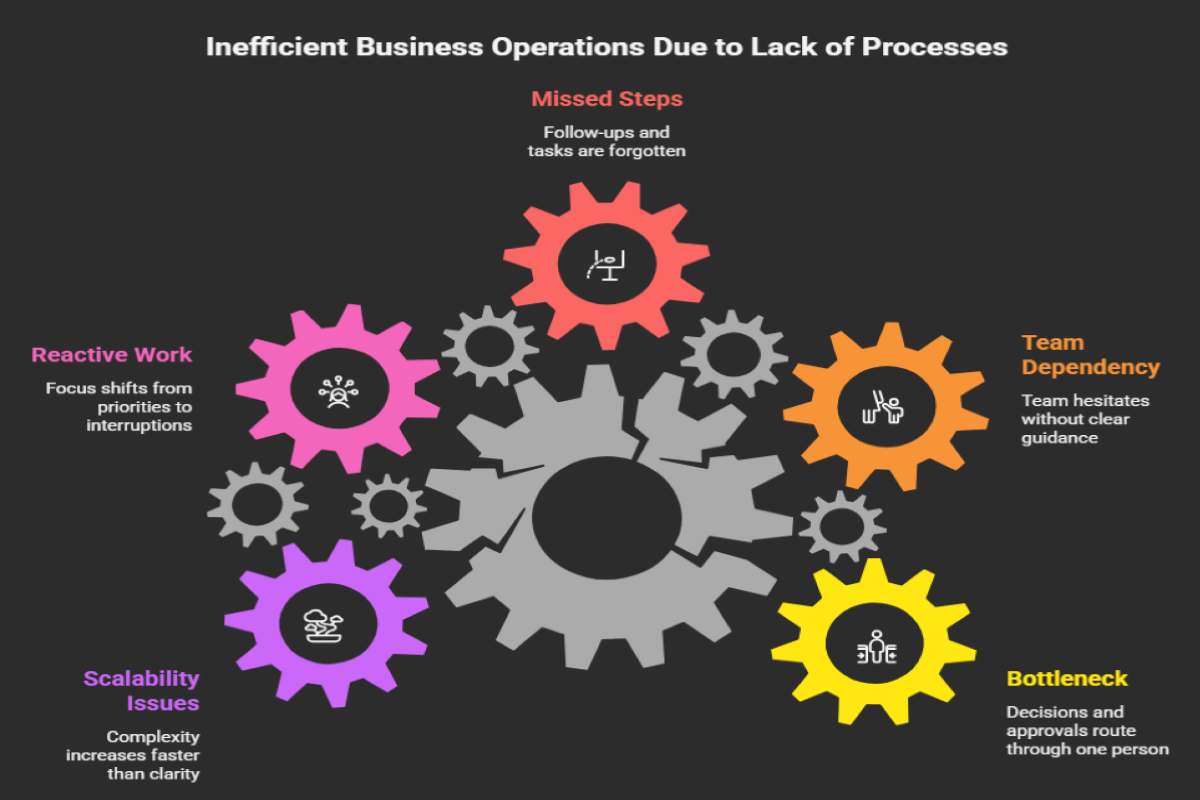
One of the first things that happens is that you become the bottleneck without realizing it. Decisions, approvals, and next steps start routing through you by default. Even when your team is capable, they hesitate because there’s no clear structure guiding them forward. Work slows down not because people aren’t working, but because progress depends on your involvement at too many points.
At the same time, your team becomes more dependent than they should be. Without defined processes, there’s no shared understanding of how work should move from one step to the next. This creates hesitation. Instead of acting with confidence, people pause, double-check, and ask for direction. Over time, this erodes momentum and reinforces the idea that you are the one who needs to keep everything aligned.
As this pattern continues, things inevitably start slipping through the cracks. Follow-ups get missed, small tasks are forgotten, and inconsistencies begin to show in how work is delivered. These aren’t usually major failures, but they accumulate.
Each missed step adds a bit more pressure, a bit more mental load, and a bit more time spent fixing things that could have been prevented, and over time, that pressure starts to feel like overwhelm, even when the business is growing.
Your days also begin to shift in a way that’s easy to overlook. Instead of working through structured priorities, you find yourself reacting to whatever comes up. Questions, interruptions, and small decisions fill the gaps between larger tasks. It becomes harder to focus, harder to plan, and harder to step back and think strategically about the business as a whole.
As the business grows, these issues don’t resolve themselves; they expand. More clients mean more moving parts. More team members mean more coordination. Without processes to support that growth, complexity increases faster than clarity. What once felt manageable starts to feel chaotic, and progress becomes harder to sustain.
The challenging part is that the business still functions through all of this. From the outside, it may even look successful. But internally, it relies heavily on your constant input to keep things from drifting off track. Over time, that creates a kind of pressure that’s difficult to maintain, where the business continues to move forward, but only because you’re holding so much of it together yourself.
The Real Reason Your Team Keeps Asking “What’s Next?”
By this point, it becomes easier to see that the question isn’t random; it’s a direct result of how work is structured inside the business.

When someone asks “what’s next?”, they’re not just looking for guidance. They’re responding to a gap. Something in the workflow didn’t clearly tell them what to do after completing their current step, so the responsibility for deciding the next move shifts back to you.
In a business with defined processes, that gap doesn’t exist. Each step naturally leads to the next. Ownership is clear, expectations are understood, and progress continues without needing to stop and ask for direction. But when those elements are missing, even simple workflows break into disconnected pieces.
That’s when people pause.
They pause because there’s no defined next step. They pause because they don’t want to make the wrong decision. They pause because the process doesn’t give them enough clarity to move forward with confidence. And in that pause, the easiest and safest option is to ask.
Over time, this creates a pattern where work doesn’t move unless it’s actively pushed. Tasks get completed, but the transition between tasks becomes the weak point. Handoffs aren’t automatic, responsibilities aren’t clearly triggered, and nothing consistently signals what should happen next.
This is where most business owners misinterpret the situation. It can look like a training issue, a communication gap, or even a motivation problem. But in reality, it’s structural. The system isn’t defining the flow of work, so people are forced to rely on external direction.
What’s important to recognize is that your team is adapting to the environment you’ve given them. When the process is unclear, asking becomes the safest behavior. It reduces mistakes, avoids misalignment, and keeps things moving even if it creates more dependency in the process.
That’s why this question keeps repeating. It’s not being solved at the root level.
When there’s no defined process, people wait. And when there’s no system in place to carry that process forward, they ask.
Until those two pieces are in place, the pattern doesn’t change. The same question shows up again and again, not because people aren’t capable, but because the structure of the business requires them to keep asking.
What a Business Looks Like When Processes Actually Work
Up until now, everything we’ve covered has focused on the problem of how work breaks down, why your team keeps asking questions, and how that pressure builds on you over time.

But once processes are clear and supported by a system, the entire experience of running a business starts to change, not in a dramatic, overnight way but in a steady, noticeable shift from friction to flow.
Work stops feeling like something you have to constantly push forward.
It starts moving on its own.
At a practical level, the difference shows up in how everyday operations unfold.
Instead of relying on reminders and check-ins:
Tasks are triggered automatically when something is completed
The right person is assigned without needing to be told
The next step is already defined and visible
There’s no pause between steps. No confusion about ownership. No need to stop and ask what should happen next.
That clarity changes how your team behaves.
They no longer:
wait for direction
second-guess decisions
rely on constant approval
Instead, they move with confidence because the structure supports them.
They know:
what they’re responsible for
when they’re responsible for it
and what comes after
That shift alone removes a huge amount of friction from the business.
It also changes how communication works.
Instead of scattered conversations across different tools and channels, everything becomes connected to the work itself. Updates, tasks, and decisions are tied to a process, not floating around in messages.
This means:
Fewer interruptions
Fewer repeated explanations
Fewer “quick questions” that break your focus
Communication becomes part of the system, not a replacement for it.
And then there’s the part most people don’t expect.
The feeling.
When processes are working properly, the business starts to feel different:
calmer
more predictable
easier to manage
You’re no longer waking up wondering what you forgot. You’re not constantly scanning for problems or trying to keep everything in your head. There’s a sense that things are being handled even when you’re not directly involved in every step.
This is where the real shift happens.
The business stops relying on memory.
It stops relying on constant oversight.
It stops relying on you being in the middle of everything.
And instead, it starts running on a structure where work flows because it’s designed to, not because someone is manually holding it together.
The Mistake Most Businesses Make When Fixing This
Once business owners recognize that processes are the problem, they usually take action. They start looking for ways to bring more structure into the business and reduce the constant dependency on themselves. On the surface, this is where things should improve.
But this is also where a second problem quietly appears.
Most of the solutions people reach for don’t actually solve the issue; they just reshape it. At first, it feels like progress. There’s more organization, more intention, and more effort being applied. But over time, the same patterns return, just in slightly different forms.
One of the most common approaches is documentation. Processes get written down as SOPs, checklists, or internal guides, and everything starts to look more structured on paper. The problem is that the documentation doesn’t execute. It doesn’t assign tasks, it doesn’t trigger the next step, and it doesn’t ensure consistency. It simply sits there, relying on someone to remember to follow it in the middle of a busy day.
Another common move is adding more tools. A platform for tasks, another for communication, something for CRM, something else for automation. Each tool promises to solve a specific problem, and individually, they can be useful. But when they aren’t connected, they create a new layer of complexity. Information becomes scattered, work gets duplicated, and instead of simplifying operations, the system becomes harder to manage.
There’s also the tendency to shift expectations onto people. Business owners often try to solve the issue by encouraging the team to be more organized, more proactive, or more disciplined. While this can create short-term improvements, it doesn’t hold over time. It asks people to compensate for a lack of structure, which eventually leads to inconsistency, hesitation, and increased pressure rather than real clarity.
At the same time, many owners respond by becoming more involved. They check more frequently, follow up more often, and stay closer to the details to make sure nothing slips. It feels responsible, and in many ways it is. But it also reinforces the same dependency that created the problem in the first place, because progress continues to rely on their attention rather than a system.
All of these approaches share the same underlying issue. They focus on improving execution without fixing the structure behind it. As a result, the business may look more organized, but it doesn’t actually become more predictable or self-sustaining.
A process that depends on memory, effort, or constant oversight isn’t really a process at all. It’s a fragile structure that holds together as long as enough attention is applied to it. And no matter how capable the team is, or how hard people work, that kind of setup will always produce the same outcome: recurring questions, repeated interruptions, and a level of dependency that makes growth harder than it should be.
How to Fix This Without Overcomplicating Your Business
Once you understand that the issue isn’t effort or communication but structure, the next step is fixing it in a way that doesn’t create even more complexity.
Because that’s the trap most businesses fall into.
They try to “fix” operations by adding layers, more tools, more rules, more documentation, until the system itself becomes overwhelming. What actually works is much simpler. The goal is not to build a perfect system. It’s to create a clear, repeatable flow that removes guesswork and carries work forward consistently.
It starts by focusing on what already exists in your business.
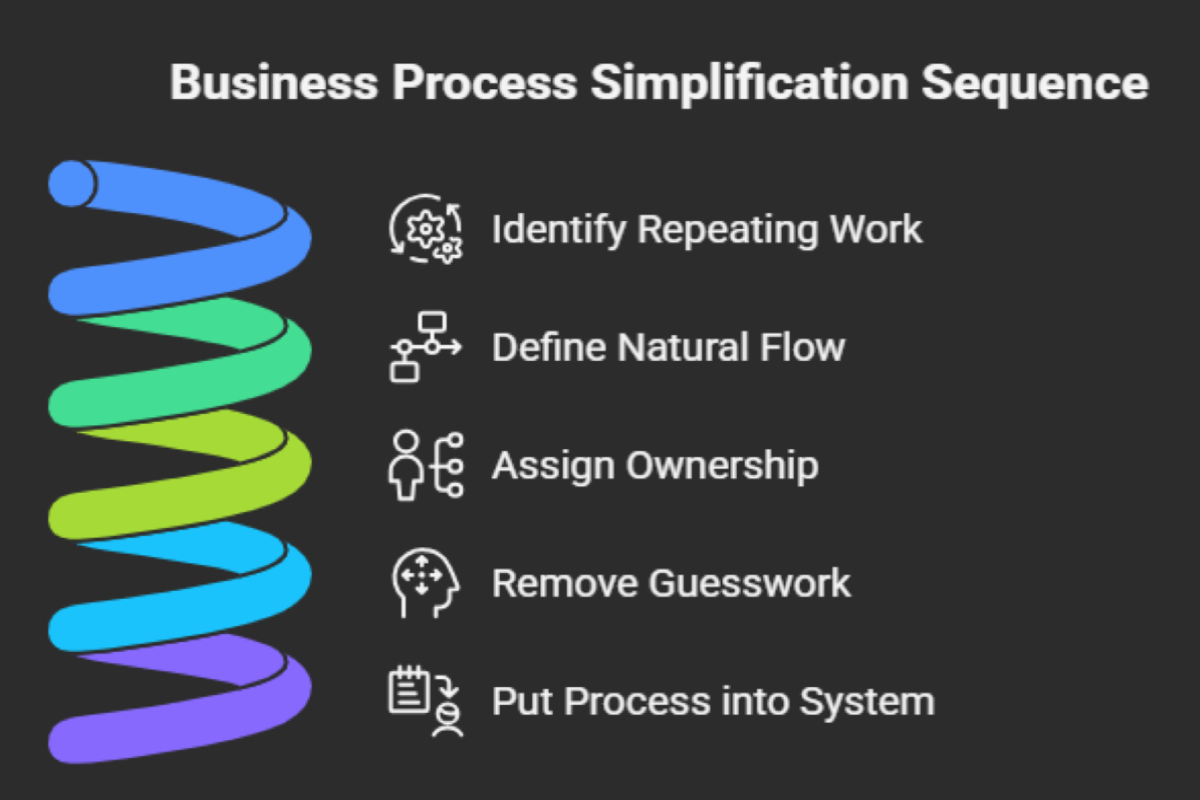
1. Identify the Work That Repeats
Every business has a core set of activities that happen over and over again. These are the areas where processes matter most because they directly impact consistency, speed, and customer experience.
For most businesses, this includes:
lead handling
onboarding
service delivery
follow-up
If something happens frequently, it should not be reinvented every time.
It should follow a defined path.
2. Define the Natural Flow of Work
Once you identify repeatable activities, the next step is to map what should happen clearly and simply.
Not in a complicated diagram. Not in a 20-page document.
Just a straightforward sequence:
What triggers the process?
What is the first step?
What happens next?
What signals completion?
The goal here is clarity, not perfection.
If someone new joined your team, they should be able to look at this and understand how work moves from start to finish without needing constant explanation.
3. Assign Ownership at Every Step
A process without ownership creates hesitation.
At each stage, someone should know:
This is my responsibility
This is when I step in
This is what I need to complete
When ownership is unclear, work stalls. People wait, double-check, or pass responsibility back up the chain.
Clarity removes that friction.
4. Remove Guesswork From Execution
This is where most processes break down.
Even if the steps are defined, if people still have to interpret what to do next, the process becomes inconsistent again. The more interpretation required, the more variation you get in execution.
Strong processes reduce thinking at the point of action.
They replace:
“What should I do here?”
with“This is the next step.”
That shift is small but powerful.
5. Put the Process Into a System
This is the step that changes everything.
Because defining a process is only half the solution.
If the process still relies on:
Someone remembering
Someone assigning
Someone checking
Then nothing fundamentally improves.
A system removes that dependency.
It ensures that:
Tasks are created when they should be
Work is assigned to the right person
The next step is triggered automatically
Progress is visible without manual tracking
Without this layer, even well-designed processes eventually break under pressure.
This is where most businesses get stuck.
They do the thinking.
They define the steps.
They try to organize things better.
But the execution still depends on them.
And that’s the real shift to aim for.
Not just having processes…
But having processes that run.
The Shift That Changes Everything: From Processes to Systems
Up to this point, the focus has been on creating clarity, defining how work should move and who is responsible at each step. That alone already puts you ahead of most businesses. But there’s a second shift that determines whether that clarity actually holds under pressure.
That shift is moving from processes to systems.
At a surface level, the difference can seem small. In reality, it changes how the business operates day to day.
A process explains what should happen. It gives structure to the work and creates a path from start to finish. But a system is what ensures that path is followed consistently, without relying on constant attention or intervention.
Without a system, even well-defined processes remain fragile.
They depend on:
Someone remembers to start them
Someone is assigning the next step
Someone is checking that everything is moving
And when things get busy, as they always do, those dependencies start to break. Steps get skipped, follow-ups get delayed, and the process slowly turns back into a series of disconnected actions.
With a system in place, that dynamic changes completely.
Instead of relying on memory or manual coordination:
Tasks are created at the right moment
Ownership is assigned automatically
The next step is triggered as soon as the previous one is completed
Progress is tracked without needing to ask for updates
Work no longer needs to be pushed forward. It moves because the structure behind it is designed to carry it.
This is where many business owners have a realization.
They’ve spent time trying to improve how people work, communicating more clearly, organizing better, and following up more consistently. But the real leverage doesn’t come from improving effort. It comes from improving the environment in which that effort happens.
A strong system changes behavior without needing to constantly enforce it.
It reduces hesitation because the next step is already clear.
It removes dependency because ownership is already assigned.
It creates consistency because the process runs the same way every time.
The goal isn’t to build something complex.
It’s to remove the need for constant involvement.
When systems are in place, you no longer have to:
Track every moving part
Remember every next step
Step in to keep things aligned
Instead, you move into a different role.
You oversee rather than manage.
You guide rather than direct.
You focus on growth instead of coordination.
That’s the real transformation.
Not just having processes…
But having processes that run, whether you’re involved in every step or not.
What Happens When Your Business Finally Runs on Systems
At this point, you can probably recognize parts of your own business in what we’ve covered.
The constant questions.
The interruptions.
The feeling that everything depends on you.
Those aren’t random frustrations. They’re symptoms of how the business is currently structured. And if nothing changes at that level, those same problems will keep showing up, no matter how much effort you or your team put in.
Right now, the pattern likely looks familiar.
Work slows down the moment you’re not involved. Your team hesitates because they’re unsure what comes next. Tasks get completed, but the transition between them is inconsistent. Follow-ups depend on someone remembering. And even when things are going well, there’s always a quiet sense that something might be slipping in the background.
That’s the reality of operating without clear, system-driven processes.
But the goal isn’t just to “improve” that situation slightly. It’s to replace it entirely with a different way of operating.
Instead of work depending on you to move forward, it should move because the next step is already defined. Instead of your team asking for direction, they should be able to see exactly what they’re responsible for and when. Instead of tasks existing in isolation, they should be connected as part of a larger flow that carries work from start to finish.
That shift solves very specific problems.
Where you currently feel like the bottleneck, the goal is to have work continue moving even when you’re not involved in every step. Where your team currently asks “what’s next?”, the goal is for the next step to already be clear and triggered. Where follow-ups and tasks slip through the cracks, the goal is for them to be handled consistently without relying on memory.
It also changes the day-to-day experience in ways that are hard to ignore.

Instead of reacting to interruptions, you start seeing fewer of them. Instead of constantly checking on progress, you can trust that things are moving. Instead of carrying everything mentally, you have visibility into what’s happening without needing to track it all yourself.
The pressure doesn’t disappear because the business becomes smaller or simpler. It disappears because the structure becomes stronger.
And that’s the real target.
Not just a business that runs…but a business that runs without needing you to hold every piece together.
If you’re ready to stop being the bottleneck, eliminate the constant “what’s next?” questions, and finally have your business run with clarity and structure, the next step is to put a system in place that does the heavy lifting for you.